
Exam Variety: Admissions rely on various national, state, and university-level tests—such as CAT (widely accepted), NMAT, SNAP, and CMAT—each targeting different groups of institutes.
Strategic Selection: Choosing the right exam is crucial, as each differs in pattern, difficulty, application process, and participating colleges.
Purpose of the Guide: The full guide details the top MBA entrance exams for 2026–27—covering eligibility, exam patterns, dates, accepted colleges, and preparation tips—to help students pick the best exams for their academic profile and career goals.
Examination schedules are important because application deadlines differ across entrance tests. The following table provides the available schedule as of November 2026.
| Entrance Exam | Examination Date / Window | Status as of November 24, 2026 |
|---|
| CAT 2026 | November 29, 2026 | Registration closed |
| XAT 2027 | January 3, 2027 | Registration open |
| NMAT 2026 | November 2–December 20, 2026 | Registration closed; testing ongoing |
| SNAP 2026 | December 13, 19 and 26, 2026 | Registration closes November 25 |
| MAT December 2026 PBT | December 20, 2026 | Registration open |
| MAT December 2026 CBT | December 27, 2026 | Registration open |
| CMAT 2027 | February 7, 2027 (tentative) | Check official notification |
| MAH MBA CET 2027 | To be announced | Awaiting schedule |
| ATMA 2027 | To be announced | Awaiting schedule |
Important: Examination dates and registration deadlines are subject to official updates. The CAT 2026 and XAT 2027 schedules, SNAP dates and MAT December dates should be checked on their respective official portals before publication or application. The CMAT 2027 date is listed as tentative in the NTA schedule.
MBA entrance examinations can be divided into four major categories.
1. National-Level MBA Entrance Exams
These examinations are conducted at the national level and accepted by multiple management institutes across India. Examples include CAT, XAT, CMAT, MAT and NMAT.
2. State-Level MBA Entrance Exams
State-level examinations are primarily conducted for admission to participating management colleges within a particular state. MAH MBA CET, Karnataka PGCET, TANCET, AP ICET and TG ICET are important examples.
3. University-Level MBA Entrance Exams
Certain universities and management institutes conduct their own entrance examinations. Examples include IBSAT, MICAT and KIITEE MBA.
4. International Management Entrance Exams
GMAT and GRE scores are accepted by selected Indian business schools and international universities. They are particularly relevant for candidates considering international management programmes.
The choice of entrance examination should be based on the business schools where a student wants to study.
| Entrance Exam | Examples of Colleges |
|---|
| CAT | IIM Ahmedabad, IIM Bangalore, IIM Calcutta, FMS Delhi, MDI Gurgaon |
| XAT | XLRI Jamshedpur, XAT-accepting institutes |
| NMAT | NMIMS Mumbai and other participating institutes |
| SNAP | SIBM Pune, SCMHRD Pune |
| CMAT | Participating AICTE-approved management institutes |
| MAT | Participating MBA/PGDM colleges |
| MAH MBA CET | JBIMS Mumbai and participating Maharashtra institutes |
| IBSAT | ICFAI Business Schools |
Admission criteria, cut-offs and programme-specific acceptance rules may vary. A college accepting an examination score does not automatically guarantee admission.
The following table provides an overview of the major MBA entrance examinations available to management aspirants.
| Entrance Exam | Conducting Body | Major Colleges/Institutes |
|---|
| CAT | IIMs (rotating conducting institute) | IIMs, FMS Delhi, MDI Gurgaon |
| XAT | XLRI Jamshedpur | XLRI, XAT-accepting B-schools |
| NMAT | GMAC | NMIMS and participating institutes |
| SNAP | Symbiosis International University | SIBM Pune, SCMHRD |
| CMAT | National Testing Agency | CMAT-accepting management colleges |
| MAT | AIMA | Participating MBA/PGDM institutes |
| ATMA | AIMS | Participating management institutes |
| MAH MBA CET | Maharashtra CET Cell | JBIMS and participating Maharashtra colleges |
| Karnataka PGCET | Karnataka Examinations Authority | Participating Karnataka colleges |
| TANCET | Anna University | Participating Tamil Nadu colleges |
| IBSAT | ICFAI Foundation | ICFAI Business Schools |
| MICAT | MICA Ahmedabad | MICA |
| GMAT | GMAC | Selected Indian and international B-schools |
College acceptance policies can change between admission cycles. Students should always verify the latest admission criteria before applying.
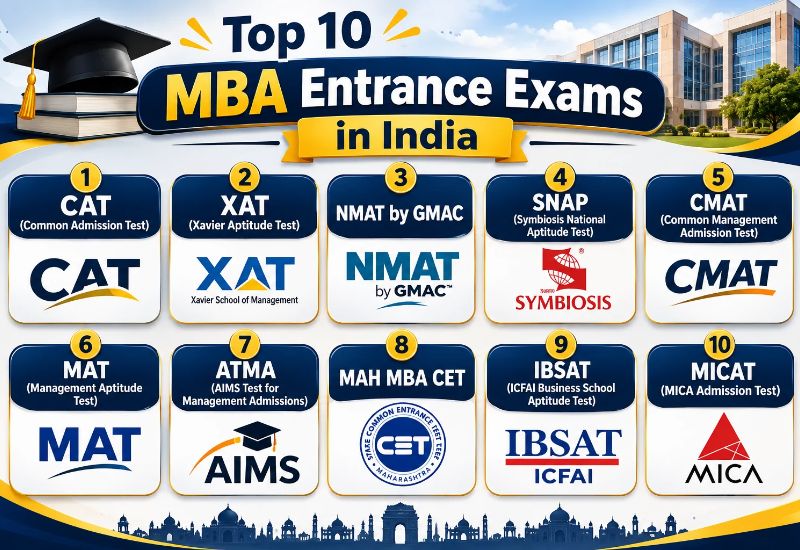
1. CAT (Common Admission Test)
CAT is among the most competitive and widely recognised MBA entrance examinations in India. It is conducted annually by one of the Indian Institutes of Management on a rotational basis.
A strong CAT percentile can help candidates apply to IIMs and several other reputed management institutes.
Important Highlights:
• Conducting authority: One of the IIMs.
• Exam mode: Computer-based test.
• Main sections: VARC, DILR and Quantitative Aptitude.
• Duration: Generally 120 minutes.
• Eligibility: Bachelor's degree with the prescribed minimum marks.
• Suitable for: Students targeting IIMs and other CAT-accepting institutes.
Some prominent institutes accepting CAT scores include IIM Ahmedabad, IIM Bangalore, IIM Calcutta, FMS Delhi and MDI Gurgaon.
2. XAT (Xavier Aptitude Test)
XAT is conducted by XLRI Jamshedpur and is another important national-level MBA entrance examination.
The examination is particularly known for its Decision Making section, which evaluates a candidate's ability to analyse business situations and make appropriate decisions.
Important Highlights:
• Conducting authority: XLRI Jamshedpur.
• Exam mode: Computer-based.
• Main sections: Verbal Ability and Logical Reasoning, Decision Making, Quantitative Aptitude and Data Interpretation, and General Knowledge.
• Duration: As specified in the annual examination bulletin.
• Eligibility: Bachelor's degree from a recognised university.
• Suitable for: Candidates interested in XLRI and other XAT-accepting colleges.
XLRI offers management programmes in areas such as Business Management and Human Resource Management.
3. NMAT by GMAC
NMAT is conducted by the Graduate Management Admission Council (GMAC). It is popular because candidates can select their examination date within the available testing window and may have opportunities to retake the examination according to the applicable rules.
Important Highlights:
• Conducting authority: GMAC.
• Sections: Language Skills, Quantitative Skills and Logical Reasoning.
• Exam mode: Computer-based.
• Exam duration: 120 minutes.
• Eligibility: Depends on the admission requirements of the participating institute.
• Suitable for: Candidates targeting NMIMS and other NMAT-accepting institutions.
NMIMS Mumbai is one of the prominent institutes associated with NMAT admissions.
4. SNAP (Symbiosis National Aptitude Test)
SNAP is conducted by Symbiosis International (Deemed University) for admission to its participating management institutes.
It is an important option for students who want to pursue an MBA from Symbiosis institutions.
Important Highlights:
• Conducting authority: Symbiosis International University.
• Sections: General English, Analytical and Logical Reasoning, and Quantitative, Data Interpretation and Data Sufficiency.
• Exam mode: Computer-based.
• Duration: 60 minutes.
• Eligibility: Bachelor's degree with the applicable minimum marks.
• Suitable for: Candidates targeting Symbiosis management institutes.
Important institutes accepting SNAP include SIBM Pune and SCMHRD Pune.
5. CMAT (Common Management Admission Test)
CMAT is a national-level entrance examination conducted by the National Testing Agency (NTA).
It provides an opportunity to apply to management institutes that accept CMAT scores. The examination evaluates candidates across different management aptitude areas.
Important Highlights:
• Conducting authority: NTA.
• Sections: Quantitative Techniques and Data Interpretation, Logical Reasoning, Language Comprehension, General Awareness and Innovation and Entrepreneurship.
• Exam mode: Computer-based.
• Duration: 180 minutes.
• Eligibility: Bachelor's degree from a recognised university.
• Suitable for: Students seeking admission to participating MBA and PGDM institutes.
CMAT is worth considering for candidates who want to explore management colleges beyond the IIM admission route.
6. MAT (Management Aptitude Test)
MAT is conducted by the All India Management Association (AIMA). It is a popular examination because it provides multiple testing opportunities during the year.
Candidates can generally choose between Paper-Based Test (PBT) and Computer-Based Test (CBT), subject to the available examination schedule.
Important Highlights:
• Conducting authority: AIMA.
• Sections: Language Comprehension, Intelligence and Critical Reasoning, Mathematical Skills, Data Analysis and Sufficiency, and Economic and Business Environment.
• Exam mode: PBT and CBT.
• Duration: 120 minutes.
• Eligibility: Graduation from a recognised university.
• Suitable for: Students applying to participating MBA and PGDM colleges.
MAT can be a useful alternative for candidates seeking additional management admission opportunities.
7. ATMA (AIMS Test for Management Admissions)
ATMA is conducted by the Association of Indian Management Schools (AIMS). It assesses analytical and management-related aptitude.
Important Highlights:
• Conducting authority: AIMS.
• Sections: Analytical Reasoning, Quantitative Skills and Verbal Skills.
• Exam mode: As specified in the examination notification.
• Duration: Generally 3 hours.
• Eligibility: Bachelor's degree or equivalent qualification.
• Suitable for: Candidates applying to ATMA-accepting institutes.
8. MAH MBA CET
MAH MBA CET is a state-level entrance examination conducted by the State Common Entrance Test Cell, Maharashtra.
It is an important examination for candidates targeting MBA and MMS colleges in Maharashtra.
Important Highlights:
• Conducting authority: Maharashtra CET Cell.
• Sections: Logical Reasoning, Abstract Reasoning, Quantitative Aptitude and Verbal Ability/Reading Comprehension.
• Exam mode: Computer-based.
• Duration: 150 minutes.
• Eligibility: Graduation with applicable category-wise requirements.
• Suitable for: Candidates targeting participating Maharashtra management colleges.
JBIMS Mumbai is one of the prominent institutes associated with MAH MBA CET admissions, subject to the applicable admission rules and eligibility conditions.
9. IBSAT (ICFAI Business School Aptitude Test)
IBSAT is an institute-level entrance examination conducted for admission to participating ICFAI Business School programmes.
Important Highlights:
• Conducting authority: ICFAI Foundation.
• Sections: Verbal Ability, Reading Comprehension, Quantitative Aptitude and Data Adequacy and Data Interpretation.
• Exam mode: Computer-based.
• Duration: Generally 120 minutes.
• Eligibility: Bachelor's degree with the prescribed requirements.
• Suitable for: Students interested in ICFAI Business School programmes.
10. MICAT (MICA Admission Test)
MICAT is conducted by MICA Ahmedabad for admission to its management programmes, particularly those related to strategic marketing and communications.
It evaluates candidates through aptitude-based sections and a specialised assessment of creative and divergent thinking.
Students interested in advertising, brand management, media, digital marketing and strategic communication can consider this examination.
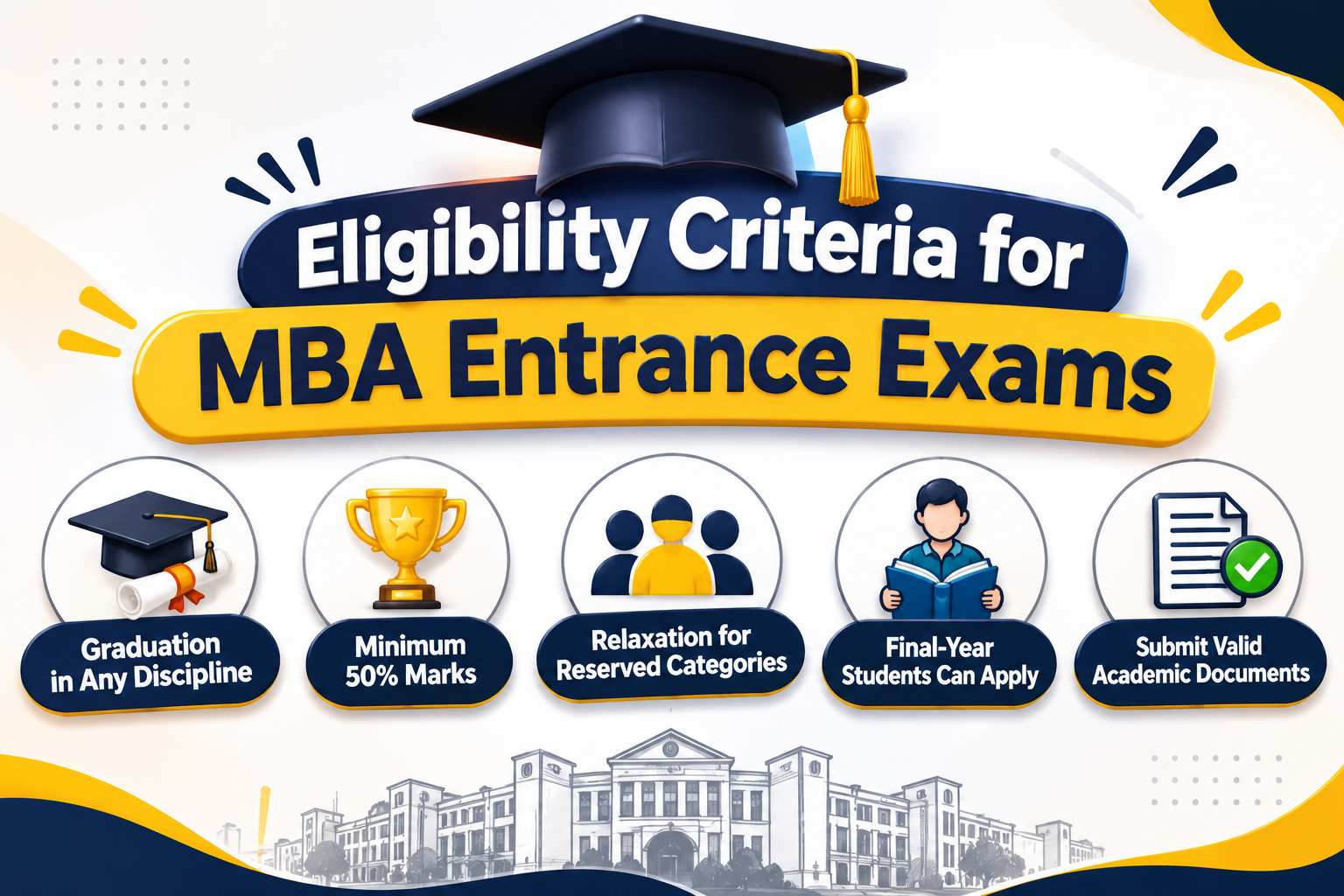
Most MBA entrance examinations require candidates to hold a bachelor's degree from a recognised university.
The general eligibility requirements are:
1. Candidates should have completed graduation in any recognised discipline.
2. Many examinations and institutions prescribe a minimum of 50% marks for General category candidates.
3. Relaxation may be available for reserved categories according to applicable rules.
4. Final-year graduation students may also apply if they satisfy the examination and admission requirements.
5. Candidates must submit valid academic documents during the admission process.
Eligibility requirements are not identical across all examinations and institutes. Candidates should read the relevant information bulletin carefully.
Although different examinations have different structures, many of them assess similar aptitude areas.
| Subject | Important Topics |
|---|
| Quantitative Aptitude | Arithmetic, Algebra, Geometry, Number Systems |
| Logical Reasoning | Arrangements, Puzzles, Series, Coding-Decoding |
| Data Interpretation | Tables, Graphs, Charts and Caselets |
| Verbal Ability | Grammar, Vocabulary, Para Jumbles |
| Reading Comprehension | Passages, Inference and Main Idea |
| General Awareness | Business, Economy, Current Affairs |
| Decision Making | Business Situations and Case-Based Questions |
Candidates should understand the individual examination syllabus because not every section is included in every entrance test.
Selecting the right examination depends on the candidate's strengths and target colleges.
| Parameter | CAT | XAT | NMAT | SNAP | CMAT |
|---|
| Difficulty | High | High | Moderate to High | Moderate | Moderate |
| Decision Making | No separate section | Yes | No | No | No |
| General Awareness | No | Yes | No | No | Yes |
| Exam Duration | 120 min | Around 180 min | 120 min | 60 min | 180 min |
| Main Target | IIMs | XLRI | NMIMS | Symbiosis | CMAT colleges |
CAT and XAT are generally considered challenging because of their competitive nature and analytical requirements. NMAT offers scheduling flexibility, while SNAP has a shorter examination duration. CMAT provides another route to participating management institutions.
Students should not select an examination only because it is popular. Instead, they should evaluate their admission priorities.
For IIM Admission: CAT should be the primary examination because it is the main entrance route for IIM postgraduate management programmes.
For XLRI Admission: XAT is an important examination for students interested in XLRI's management programmes.
For Symbiosis Admission: SNAP is relevant for candidates targeting SIBM Pune, SCMHRD and other participating institutes.
For NMIMS Admission: NMAT is an important option for students considering NMIMS management programmes.
For Maharashtra Colleges: MAH MBA CET is worth considering for students interested in participating Maharashtra colleges.
For More Admission Opportunities: CMAT, MAT and ATMA can help students explore additional business schools.
A practical strategy is to identify 8–12 preferred colleges first and then register for the entrance examinations accepted by those institutions.
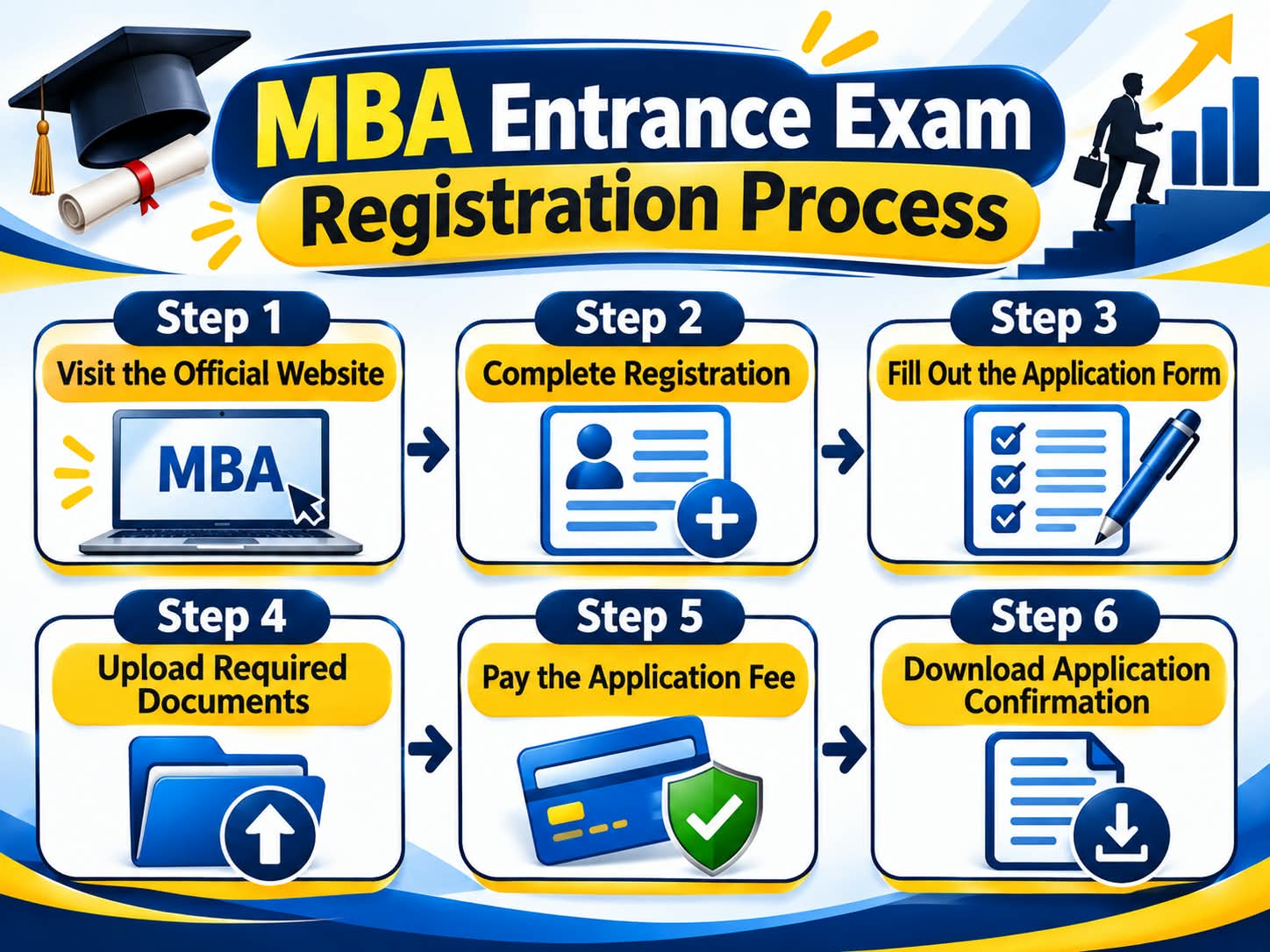
Most MBA entrance examinations follow an online application process.
Step 1: Visit the Official Website
Open the official examination portal and check the latest admission notification.
Step 2: Complete Registration
Enter personal details, email address, mobile number and other required information.
Step 3: Fill Out the Application Form
Provide academic qualifications, category details and examination preferences.
Step 4: Upload Documents
Upload the required photograph, signature and supporting documents in the prescribed format.
Step 5: Pay the Application Fee
Complete payment through the available online payment methods.
Step 6: Download Confirmation
Save the application confirmation and regularly check the examination portal for admit cards and announcements.
A well-planned preparation strategy can improve performance across multiple entrance examinations.
1. Understand the Examination Pattern
Start by studying the syllabus, marking scheme, section-wise structure and previous question papers.
2. Strengthen Basic Concepts
Focus on arithmetic, algebra, reading comprehension, grammar, reasoning and data interpretation.
3. Practise Mock Tests
Regular mock examinations help candidates understand time management, accuracy and question selection.
4. Analyse Previous Papers
Previous examination papers help identify recurring topics, question formats and difficulty levels.
5. Develop Reading Habits
Reading newspapers, business articles, and editorials can improve comprehension and vocabulary.
6. Prepare for Multiple Exams Smartly
CAT, XAT, NMAT, SNAP and CMAT share several aptitude areas. However, students should also prepare for exam-specific sections such as XAT Decision Making and CMAT General Awareness.
7. Revise Regularly
Maintain short notes for formulas, vocabulary, reasoning methods and important concepts.
• Preparing without understanding the examination syllabus.
• Applying to colleges without checking their admission requirements.
• Ignoring sectional cut-offs where applicable.
• Taking mock tests without analysing performance.
• Spending too much time on difficult questions.
• Missing application deadlines.
• Depending entirely on coaching material without practising independently.
• Choosing colleges only based on advertised placement figures.
A balanced approach to examination preparation and college research is essential for making informed admission decisions.
Clearing an MBA entrance examination is generally only the first stage of admission.
The next steps may include:
1. Shortlisting: Colleges shortlist candidates based on entrance scores, cut-offs and other eligibility criteria.
2. Written Assessment: Some institutes conduct written ability tests or other assessments.
3. Group Discussion: Candidates may participate in group discussions to demonstrate communication and teamwork skills.
4. Personal Interview: The interview panel evaluates academic background, career goals, confidence and overall suitability.
5. Final Selection: Colleges may consider entrance scores, academic performance, work experience, interviews and other components.
6. Admission Confirmation: Selected candidates complete document verification and fee payment.
The exact selection process varies between institutions.
1. Which are the top MBA entrance exams in India in 2026–27?
CAT, XAT, NMAT, SNAP, CMAT, MAT, ATMA and MAH MBA CET are among the important MBA entrance examinations in India.
2. Which MBA entrance exam is best for admission to IIMs?
CAT is the primary entrance examination for admission to IIM postgraduate management programmes. Individual IIMs also consider other selection criteria.
3. Can I pursue an MBA without appearing for CAT?
Yes. Students can explore colleges accepting XAT, NMAT, SNAP, CMAT, MAT, ATMA and other entrance examinations. Some institutions also have their own admission processes.
4. Is CAT more difficult than CMAT?
CAT is generally considered more challenging because of its competitive environment and question complexity. CMAT is comparatively moderate, although difficulty can vary each year.
5. Can final-year graduation students apply for MBA entrance exams?
Yes. Many entrance examinations allow final-year graduation students to apply, subject to the prescribed conditions and submission of required documents.
6. Which MBA entrance exam is accepted by NMIMS?
NMAT is an important entrance examination for NMIMS management admissions. Candidates should check the institute's programme-specific admission criteria.
7. Which entrance exam is required for Symbiosis MBA admission?
SNAP is used for admission to participating Symbiosis management institutes, including SIBM Pune and SCMHRD.
8. Are MBA entrance exams conducted online?
Most major MBA entrance examinations are computer-based tests conducted at designated examination centres. The mode may vary depending on the examination.
9. Can I prepare for CAT, XAT and CMAT together?
Yes. Their syllabuses overlap in areas such as quantitative aptitude, verbal ability and logical reasoning. However, students should separately prepare for examination-specific sections.
10. Which MBA entrance exam is suitable for students with average academic scores?
Students should consider their target colleges, entrance examination performance and eligibility requirements. MAT, CMAT, ATMA and other accepted examinations can provide additional admission options, but college-specific eligibility and selection standards must be checked.
11. How many MBA entrance exams should I take?
There is no fixed number. Candidates should select examinations according to their preferred colleges, preparation level, application budget and examination schedule.
12. What happens after clearing an MBA entrance examination?
After qualifying, candidates may be shortlisted for further selection rounds such as group discussions, written assessments and personal interviews. Final admission depends on the institute's selection criteria.
Selecting the right MBA entrance examination and management institute requires proper research, planning and an understanding of admission requirements. Get Your College helps students explore MBA colleges, compare programmes, understand eligibility conditions and make informed decisions about their higher education.
Students can seek guidance regarding:
• Choosing suitable MBA entrance examinations.
• Exploring government and private MBA colleges.
• Understanding admission eligibility and selection procedures.
• Comparing MBA specialisations and course structures.
• Evaluating college fees, placement information and other admission factors.
• Understanding application procedures and important deadlines.
Our objective is to help students make informed academic decisions by providing relevant college information and admission guidance.
Choosing the right entrance examination is an important step towards pursuing an MBA in India. CAT, XAT, NMAT, SNAP, CMAT, MAT and state-level examinations provide different admission opportunities depending on the student's preferred colleges and career objectives.
Before registering, candidates should carefully compare examination patterns, eligibility conditions, college acceptance policies and application deadlines. Preparing strategically for relevant examinations and researching business schools can improve the chances of securing admission to a suitable management institute.
With the right planning and reliable information, students can take a more confident approach towards their MBA admission journey in the 2026–27 academic cycle.
Explore MBA colleges, compare admission options and take the next step towards your management career with Get Your College.