Choosing the right B.Tech college can define the next four years of your life — and often, the four decades after that. With lakhs of students appearing for JEE Main, JEE Advanced, BITSAT, and state-level exams every year, the competition for seats at India's top engineering institutes has never been more intense. This guide breaks down the top 10 B.Tech colleges in India for the 2026-27 admission cycle, covering everything from fees and eligibility to placements, ROI, and entrance exam schedules so that you can make an informed decision.
Rank (NIRF) | College | Type | Avg Package (LPA) | Approx. Total Fees |
1 | IIT Madras | Government | 19-21 | ₹8-10 lakh |
2 | IIT Delhi | Government | 21-25 | ₹8-10 lakh |
3 | IIT Bombay | Government | 21-24 | ₹9-10 lakh |
4 | IIT Kanpur | Government | 19-22 | ₹9-10 lakh |
5 | IIT Kharagpur | Government | 18-20 | ₹8-10 lakh |
6 | IIT Roorkee | Government | 18-21 | ₹8-9 lakh |
7 | IIT Guwahati | Government | 17-19 | ₹8-9 lakh |
8 | IIT (BHU) Varanasi | Government | 16-18 | ₹8-9 lakh |
9 | NIT Trichy | Government | 14-16 | ₹5-6 lakh |
10 | BITS Pilani | Private | 19-22 | ₹22-26 lakh |
IIT Madras has topped NIRF's engineering category for ten consecutive years, anchored by India's first university-based research park and deep industry collaboration. IIT Delhi and IIT Bombay compete closely for the second and third spots, known respectively for cutting-edge labs and outstanding placement records. IIT Kanpur is renowned for its aerospace and computer science programs, while IIT Kharagpur, India's oldest IIT, excels in mining and ocean engineering. IIT Roorkee leads in civil engineering, IIT Guwahati has rapidly risen due to strong research output in the Northeast, and IIT (BHU) Varanasi is particularly strong in metallurgical engineering. NIT Trichy is consistently the highest-ranked NIT, competing closely with NIT Surathkal and NIT Warangal. BITS Pilani, India's top-ranked private institute, offers a flexible, no-mandatory-attendance academic culture across its Pilani, Goa, and Hyderabad campuses.
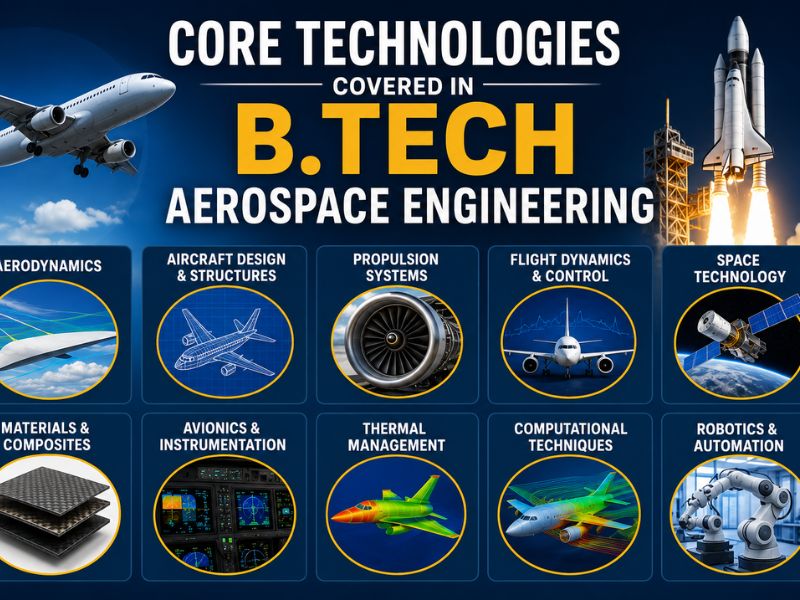
Most top colleges offer specialisations in Computer Science and Engineering (CSE), Electronics & Communication (ECE), Electrical Engineering (EE), Mechanical Engineering (ME), Civil Engineering (CE), Chemical Engineering, and increasingly, niche programs like Artificial Intelligence, Data Science, and Mathematics & Computing. Core technologies covered across these branches typically include:
Programming & Data Structures — C/C++, Python, Java, algorithms
AI/ML and Data Science — increasingly embedded even in non-CSE branches
VLSI and Embedded Systems — strong focus in ECE/EEE programs
Robotics and Automation — mechanical and mechatronics tracks
Cloud Computing and Cybersecurity — electives across most IITs
Core Engineering Fundamentals — thermodynamics, structural analysis, circuit theory, depending on branch
IITs follow a credit-based system with a mix of core courses, electives, and mandatory labs, alongside a strong emphasis on research projects (B.Tech Projects/BTP) from the third year onward. Most top institutes now integrate industry-sponsored projects, internships, and interdisciplinary minors (like AI, entrepreneurship, or public policy) into the curriculum. BITS Pilani is distinct for its flexible, near-total absence of mandatory attendance, an open elective system, and the unique Practice School (PS) program that places students in industry for real-world exposure before graduation.
Admission Eligibility and Fee Structure
IITs/NITs/IIITs: Eligibility requires passing Class 12 with Physics, Chemistry, and Mathematics, along with a qualifying rank in JEE Main (for NITs/IIITs) and JEE Advanced (for IITs). Total B.Tech fees at IITs range from approximately ₹8-10 lakh for the 4-year program, with substantial fee waivers available for students from families earning below ₹5 lakh annually, and full waivers for those below ₹1 lakh.
Selection Criteria for BTech colleges in India
Selection at IITs and NITs is purely merit-based through JEE Advanced and JEE Main ranks, respectively, followed by counselling via JoSAA (Joint Seat Allocation Authority) and CSAB for leftover seats. At BITS Pilani, the BITSAT score combined with Class 12 marks determines eligibility, while a separate direct-admission route exists for state board toppers. Private universities like VIT and SRM use their own entrance tests (VITEEE, SRMJEEE) alongside Class 12 percentage cutoffs.
BITS Pilani: Admission is via BITSAT, the university's own entrance exam. BITS Pilani's B.Tech fees for 2026 run around ₹5.4 lakh per year, totalling approximately ₹21.6 lakh over four years, though this can rise to ₹22-26 lakh depending on branch and campus. Students who rank among the top 500 in BITSAT with an annual family income up to ₹20 lakh are eligible for a 100% tuition fee waiver across all four years, subject to maintaining a minimum CGPA.
Register for JEE Main (NTA), JEE Advanced (host IIT), BITSAT, or the relevant state/private exam.
Appear for the exam(s) — JEE Main is held in two sessions (January and April); BITSAT typically runs in two sessions as well.
Check results and percentile/rank.
Register for counselling — JoSAA for IITs/NITs/IIITs/GFTIs, or the institute's own counselling for private universities.
Fill choices, get seat allotment, and complete document verification.
Pay the seat acceptance fee and report to the allotted campus.
Entrance Exam Schedule for 2026-27
Exam | Session 1 | Session 2 |
JEE Main 2027 | Last week of January 2027 | First week of April 2027 |
JEE Advanced 2027 | Around late May 2027 (after JEE Main Session 2) | — |
BITSAT 2026 | April 15–17, 2026 | May 24–27, 2026 |
JoSAA Counselling | Begins shortly after JEE Advanced results, typically in June | Multiple rounds through July |
JEE Main 2027 registration is expected to open in the last week of October 2026, with the syllabus and information bulletin released shortly before. Because NTA has not issued the official notification yet at the time of writing, candidates should treat these as projected dates and confirm via jeemain.nta.nic.in closer to the cycle.
Your JEE Main percentile broadly determines which tier of colleges you can target:
99.9+ percentile: Top IITs (Madras, Delhi, Bombay) — CSE/EE branches
99-99.9 percentile: Other IITs, top NITs (Trichy, Surathkal, Warangal) — CSE/ECE
97-99 percentile: NITs (mid-tier), IIITs, top GFTIs
90-97 percentile: State NITs, IIITs (newer campuses), reputed state universities
75-90 percentile: Private universities like VIT, SRM, Manipal, Thapar
Below 75 percentile: State-level private colleges and second-tier private universities
IIT Madras (Chennai, Tamil Nadu)
IIT Madras has topped the NIRF engineering category for ten consecutive years and remains the most research-intensive IIT in the country, home to 16 departments, 14 research centres, and a startup ecosystem that has spun off over 250 companies through its incubation cell.
Total B.Tech fees (4 years): Approximately ₹8.7-9.4 lakh for the general category, significantly lower with income-based waivers
Popular branches: Computer Science, Electrical Engineering, Engineering Physics, Civil Engineering, Aerospace
Placements: CSE recorded a median package of around ₹46 LPA and average of ₹53 LPA in the most recent cycle; the highest package on record stands at ₹4.3 crore (Jane Street). Overall institute average is roughly ₹17.9-21 LPA across branches.
Cutoff (JEE Advanced AIR, General): CSE closes around AIR 130-171; other branches open up to AIR 7,000+
Distinct strength: Unmatched research output, India's first university-based research park, and a top-50 global ranking for Civil and Structural Engineering
IIT Delhi (New Delhi)
Located in the heart of the capital, IIT Delhi is known for advanced labs, a strong AI/Data Science ecosystem, and one of the most diverse recruiter bases among Indian engineering schools.
Total B.Tech fees (4 years): Around ₹8-9.5 lakh
Popular branches: Computer Science, Electrical Engineering, Mechanical, Chemical, Artificial Intelligence
Placements: Median package for UG 4-year students stood at ₹20 LPA in the latest NIRF report, with average package estimated around ₹21.9-30 LPA; over 1,150 students placed with 40+ international offers in the most recent season
Top recruiters: Microsoft, Cisco, McKinsey & Company, Graviton Research Capital, HCL Technologies
Distinct strength: Core technical roles made up the largest share of offers (34%), followed by IT and consulting
IIT Bombay (Mumbai, Maharashtra)
IIT Bombay is widely regarded as India's strongest IIT for placements, industry perception, and global recruiter relationships, spread across a 550-acre campus with 36specialisedd research and computing centres.
Total B.Tech fees (4 years): Roughly ₹9-10 lakh
Popular branches: Computer Science, Electrical Engineering, Mathematics & Computing, Aerospace, Mechanical
Placements: Overall average package reached ₹26.45 LPA in 2025, up over 10% from the previous year, with a median of ₹20 LPA; CSE alone placed 258 of 277 participating students
Top recruiters: Google, Microsoft, Amazon, Goldman Sachs, Morgan Stanley, Boeing, Bosch
Distinct strength: Strongest alumni network and recruiter diversity among all IITs; consistently highest international offer volume
IIT Kanpur (Kanpur, Uttar Pradesh)
Known for its rigorous core engineering programs and a disproportionately strong relationship with global quant and finance recruiters relative to its size.
Total B.Tech fees (4 years): Approximately ₹9 lakh
Popular branches: Computer Science, Aerospace Engineering, Electrical Engineering, Engineering Science
Placements: Median package around ₹21.7 LPA and average around ₹26.27 LPA — among the highest of all IITs on a combined basis; Jane Street offered ₹5.5 crore to an IIT Kanpur student in the most recent cycle
Scholarships: Special awards for top 100 JEE rankers offering a full ₹9.19 lakh fee waiver plus a monthly stipend
Distinct strength: Exceptional quant-finance and core-tech recruiter relationships relative to batch size
IIT Kharagpur (West Bengal)
India's oldest IIT (established 1951), IIT Kharagpur has the largest campus and seat capacity among all IITs, translating into the highest absolute placement volume nationally.
Total B.Tech fees (4 years): Around ₹8-9.2 lakh (₹2.3 lakh/year approx.)
Popular branches: Mining Engineering, Ocean Engineering, Mechanical, Computer Science, Metallurgy
Placements: Average package around ₹24.3 LPA; despite a comparatively lower median (~₹13.5 LPA) than newer IITs, it attracts 250+ recruiting companies and places over 1,200 students annually — the strongest absolute volume of any IIT
Campus facilities: Includes its own hospital, two guest houses, multiple shopping complexes, and an extensive hostel network
Distinct strength: Largest and most diverse course offering among IITs, spanning over 100 programs including diplomas and joint degrees
IIT Roorkee (Uttarakhand)
A leader in Civil Engineering and earthquake-resistant structural design, IIT Roorkee combines a heritage campus (founded in 1847 as Thomason College) with consistently strong placement outcomes.
Total B.Tech fees (4 years): Around ₹8.8-9 lakh (₹2.2 lakh/year approx.)
Popular branches: Civil Engineering, Computer Science, Electronics, Mechanical
Placements: Average package around ₹18.3 LPA, with the highest recorded domestic/international offer around ₹1.5 crore
Distinct strength: India's leading institute for structural and earthquake engineering, with strong ties to infrastructure and PSU recruiters
IIT Guwahati (Assam)
Set on the banks of the Brahmaputra, IIT Guwahati is widely considered the most scenic IIT campus and has built one of the fastest-rising research and placement profiles among the older IITs.
Total B.Tech fees (4 years): Around ₹8.8-9 lakh (₹2.2 lakh/year approx.)
Popular branches: Computer Science, Mechatronics, Biotechnology, Electronics
Placements: Average package around ₹25.2-25.75 LPA, with a median around ₹21.6 LPA — among the strongest of all IITs relative to batch size; highest package on record around ₹1.3 crore
Distinct strength: Rapid rise in NIRF rank and research output over the past decade; strong dedicated AI and Data Science specialisations
IIT (BHU) Varanasi (Uttar Pradesh)
Operating inside the historic Banaras Hindu University campus, IIT (BHU) blends a legacy dating back to 1919 with full IIT status since 2012.
Total B.Tech fees (4 years): Around ₹8-8.5 lakh
Popular branches: Metallurgical Engineering, Ceramic Engineering, Mining, Pharmaceutical Engineering, Computer Science
Placements: Strong core-engineering placement record, with CSE and Electronics increasingly competitive with newer IITs
Cutoff: Comparatively more accessible than the older IITs, with CSE closing in the AIR 1,400-1,800 range
Distinct strength: Unique heritage campus culture combined with specialised strength in metallurgy and ceramics, rare among Indian engineering schools
NIT Tiruchirappalli (Trichy, Tamil Nadu)
Consistently the highest-ranked NIT in India and a close competitor to several IITs on placement quality.
Total B.Tech fees (4 years): Around ₹5-6.4 lakh (₹1.6 lakh/year approx.)
Popular branches: Computer Science, Electronics & Communication, Electrical, Production Engineering
Placements: Average package around ₹16.4 LPA, with the highest package on record around ₹64 lakh
Admission: Via JEE Main and JoSAA counselling (no JEE Advanced required)
Distinct strength: Best overall NIT for balancing affordability, academic rigour, and consistent placement outcomes
NIT Surathkal / NIT Warangal (Karnataka / Telangana)
These two NITs are perennial close competitors to NIT Trichy, often alternating in the second and third NIT positions nationally.
Total B.Tech fees (4 years): Around ₹5-6 lakh
Popular branches: Computer Science, Electronics, Mechanical, Chemical (Warangal); Computer Science, Information Technology (Surathkal)
Placements: Average packages in the ₹12-18 LPA range, with top CSE offers crossing ₹40-50 LPA
Distinct strength: Strong regional industry connect — Surathkal benefits from Bengaluru's tech ecosystem; Warangal has deep PSU and core-engineering recruiter ties
BITS Pilani (Pilani / Goa / Hyderabad)
India's top-ranked private engineering institute (NIRF Engineering #11), known for its no-mandatory-attendance culture and the unique Practice School industry-immersion program.
Total B.Tech fees (4 years): Approximately ₹21.6-26 lakh (₹5.4 lakh/year approx.)
Admission: BITSAT, conducted in two sessions; board toppers (rank 1 of any state/central board) get direct admission
Placements: Combined average package across Pilani, Goa, and Hyderabad campuses was around ₹22.28 LPA with a median of ₹19-20 LPA in the latest cycle; one student secured an offer of GBP 105,000 (≈₹1.32 crore) from a London-based trading firm
Top recruiters: Google, Microsoft, Goldman Sachs, Morgan Stanley, Qualcomm, Texas Instruments, McKinsey, BCG
Distinct strength: Mathematics & Computing graduates are aggressively recruited by quant trading firms like Jane Street, Citadel, and D.E. Shaw at packages rivalling or exceeding core CSE offers; scholarship coverage up to 100% tuition waiver for top 500 BITSAT rankers from families earning under ₹20 lakh/year
VIT Vellore (Tamil Nadu)
An Institution of Eminence with a 372-acre "mini-city" campus and one of India's largest engineering placement networks by company count.
Total B.Tech fees (4 years): Around ₹24-31 lakh including hostel (tuition alone ₹6-7.8 lakh depending on specialisation)
Admission: VITEEE (no negative marking), with a 5-tier fee category based on rank
Placements: Average package around ₹9.2 LPA, with the highest recorded offer at ₹1.3 crore; over 1,100 companies visit campus annually
Distinct strength: The Fully Flexible Credit System (FFCS) lets students choose their own timetable and faculty — a rare feature among Indian universities — and niche CSE specialisations in AI-ML and Cybersecurity from the second year onward
Manipal Institute of Technology (Karnataka)
Part of the Manipal Academy of Higher Education (MAHE) ecosystem, known for balanced academics, strong international exposure, and a comparatively smaller, more selective batch size.
Admission: MET (Manipal Entrance Test) or JEE Main score
Placements: Placement rate around 67.7%, with a comparatively higher median salary of ₹8.21 LPA — reflecting a smaller, more selective placement pool than VIT or SRM
Distinct strength: Preferred by students seeking a self-contained university-town lifestyle with strong study-abroad tie-ups and dual-degree options
Thapar Institute of Engineering and Technology (Patiala, Punjab)
Admits students directly via JEE Main scores (no separate entrance test), resulting in comparatively stronger peer academic quality than VIT or SRM.
Total B.Tech fees (4 years): Around ₹18-19 lakh (₹4.6 lakh/year approx.)
Placements: CSE average around ₹11.4-11.9 LPA — among the strongest "mid-tier" private placement records in North India
Distinct strength: Stronger research culture and faculty quality relative to its fee level; particularly attractive for students targeting core-tech and North Indian industry roles
SRM Institute of Science and Technology (Kattankulathur, Chennai)
One of India's largest private universities by enrollment, known for budget-friendly fees relative to VIT and strong ties with Korean electronics majors.
Total B.Tech fees (4 years): Around ₹18-19 lakh tuition (₹4.5-4.75 lakh/year), plus hostel/mess
Admission: SRMJEEE (own entrance exam) or JEE Main score; Tier-1 rank holders (1-500) receive full scholarships.
Placements: Reports the highest placement rate among VIT/SRM/Manipal at over 92%, though average package typically trails VIT and Thapar
Distinct strength: Deep recruiter relationships with Samsung and Hyundai; 700-acre self-contained residential campus
KIIT (Kalinga Institute of Industrial Technology), Bhubaneswar
A rapidly rising private deemed university known for consistent placement rates and strong relationships with automotive and manufacturing recruiters.
Admission: KIITEE (own entrance exam) or JEE Main score
Placements: Featured among India's top-tier private placement performers alongside BITS, VIT, and SRM; particularly strong recruiter base for mechanical engineering, including Toyota and Hyundai
Distinct strength: Strong placement consistency across both core and IT branches, with a steadily improving NIRF rank
IIIT Hyderabad (Telangana)
Though technically a deemed university rather than a traditional "private college," IIIT-H is consistently grouped with top private institutes and leads all of them on average placement package.
Admission: JEE Main-based counselling via a separate entrance process, or its own UGEE exam
Placements: Leads private/deemed engineering placements nationally with an average package around ₹32.8 LPA (Class of 2025)
Distinct strength: India's top destination for specialised Computer Science research and AI, with placement outcomes that rival or exceed several IITs
VIT — AP & Bhopal Campuses
Newer VIT campuses that have rapidly scaled infrastructure and placement networks while offering comparatively easier admission cutoffs than the flagship Vellore campus.
Distinct strength: Modern infrastructure built from the ground up, with strong integrated M.Tech offerings and growing recruiter interest, particularly in AI and core branches
Shiv Nadar University (Delhi NCR)
A research-driven private university that blends a liberal-arts-influenced pedagogy with traditional engineering rigour.
Admission: SNUSAT (own entrance exam) or JEE Main score
Distinct strength: Smaller batch sizes, strong faculty-to-student ratio, and an interdisciplinary curriculum that combines core engineering with humanities and entrepreneurship electives
SASTRA University (Thanjavur, Tamil Nadu)
A steadily rising private deemed university known for strong research output relative to its fee level and growing recognition in NIRF rankings.
Distinct strength: Cost-effective alternative to VIT/SRM with comparable academic rigour and a rapidly improving placement and research profile, particularly in biotechnology and core engineering branches
Salary After B.Tech in India
Salary outcomes vary sharply by institute tier and branch:
Top IITs (CSE/EE): Average packages of ₹19-25 LPA, with top recruiters offering ₹50 LPA-1+ crore for select roles in quant/AI/core tech.
Other IITs/Top NITs: Average ₹14-20 LPA.
BITS Pilani: The median salary for the BTech batch is around ₹20 lakh, based on the latest NIRF data, with median UG packages having moved between roughly ₹17.7 lakh and ₹19 lakh in recent years.
Mid-tier private universities (VIT, SRM, Manipal): Average ₹6-10 LPA, with top performers crossing ₹20-40 LPA.
Lesser-known private colleges: Average ₹3-5 LPA, heavily dependent on branch and skillset.
Branch and individual skill (especially in coding, AI/ML, and specialisation) increasingly matter more than just the college name, particularly for mid-tier and private institutions.
Low Fees, High Placement B.Tech Colleges in India
Government institutes remain the best value-for-money option in Indian engineering education. NITs and IIITs charge roughly ₹5-6 lakh in total fees while delivering placement averages of ₹12-18 LPA. Among private options, SRM Kattankulathur and KIIT Bhubaneswar are frequently cited for offering relatively low fees (₹6-10 lakh total) alongside healthy placement rates compared to other private universities charging double or triple that amount.
Government-funded institutions are the cheapest route to a quality engineering degree:
NITs and IIITs: ₹5-6 lakh total fees, with SC/ST/EWS fee waivers
State government engineering colleges: Often under ₹3-4 lakh total
IITs (for low-income families): Effectively free or near-free due to income-based fee waivers (families earning under ₹1 lakh/year pay no tuition; under ₹5 lakh/year get partial waivers)
Colleges with Direct Admission
A small number of pathways allow admission without a competitive entrance rank:
BITS Pilani offers direct admission to the top-rank holder (rank 1 only) of each state or central board, in any branch except Pharmacy.
Several state-level private universities and deemed universities offer management quota or NRI quota seats based on Class 12 marks, usually at a significantly higher fee.
Some private universities admit students directly based on Class 12 percentage cutoffs without a separate entrance test, particularly for less competitive branches.
Colleges with their Own Entrance Exam
Not every top college relies on JEE. Several conduct independent tests:
BITS Pilani — BITSAT
VIT — VITEEE
SRM — SRMJEEE
Manipal — MET (Manipal Entrance Test)
Amrita Vishwa Vidyapeetham — AEEE
Thapar — Direct admission via JEE Main score, no separate test
B.Tech education in India is rapidly evolving beyond traditional core branches. AI, machine learning, data science, and cybersecurity have moved from electives to dedicated specialisations at nearly every top institute. Interdisciplinary minors, startup incubation cells, and global exchange programs are becoming standard offerings at IITs and top private universities alike, as colleges compete to align curricula with industry's shift toward automation, sustainability tech, and intelligent systems.
Challenges: Intense entrance exam competition, rising private college fees, branch-vs-college trade-offs, and a saturated job market for certain core branches (especially at lower-tier colleges) remain persistent concerns. Many graduates from non-CSE branches in mid-tier colleges also report a mismatch between curriculum and current industry demands.
Opportunities: Demand for AI/ML, semiconductor design, renewable energy, and robotics talent is rising sharply. Government initiatives like Make in India and the semiconductor mission are creating new core-engineering opportunities, while the startup ecosystem offers alternative career paths beyond traditional placements.
Is B.Tech the Right Career Choice for You?
B.Tech remains one of India's most reliable degrees for stable, well-paying careers — but it isn't equally rewarding for everyone. It's a strong fit if you enjoy problem-solving, mathematics, and building things, and are willing to continuously upskill given how fast technology evolves. It may be worth reconsidering if your interest lies primarily in non-technical fields, since a mismatched branch or college choice can lead to lower job satisfaction and weaker placement outcomes, regardless of brand name.
Return on Investment (ROI)
ROI depends heavily on the fee-to-placement ratio:
IITs/NITs: Exceptional ROI — fees around ₹8-10 lakh against average placements of ₹15-25 LPA.
BITS Pilani: Strong but slower ROI — higher fees (₹22-26 lakh) offset by strong placements (₹19-22 LPA average) and brand value; breakeven typically within 1-2 years of the first salary.
Mid-tier private universities: Moderate ROI — reasonable fees (₹6-12 lakh) against average placements of ₹6-10 LPA; CSE/AI branches offer better returns than core branches.
Low-ranked private colleges: Weak ROI in many cases — similar fee levels to mid-tier colleges but with average placements often below ₹4-5 LPA.
Conclusion
India's top B.Tech colleges — from the IITs to NITs and elite private institutions like BITS Pilani — each offer a distinct mix of academic rigour, fees, and career outcomes. Government institutes generally deliver the strongest ROI, while top private universities offer flexibility and strong brand value at a higher cost. The right choice ultimately depends on your budget, target branch, and long-term career goals, so weigh rankings alongside fee structure, placement trends, and entrance exam fit before making your final decision.
Frequently Asked Questions (FAQs)
1. Which is the No. 1 B Tech.Tech college in India right now? IIT Madras continues to hold the top spot in NIRF's engineering category, a position it has held for ten consecutive years as of the latest released rankings.
2. When will NIRF Ranking 2026 be released? The Ministry of Education is expected to release NIRF 2026 rankings between July and August 2026, based on the typical mid-year release pattern.
3. Is JEE Advanced compulsory for all top B.Tech colleges? No. JEE Advanced is required only for IIT admissions. NITs and IIITs use JEE Main scores, while BITS Pilani, VIT, and SRM use their own entrance exams (BITSAT, VITEEE, SRMJEEE).
4. Can I get into a top B.Tech college without JEE? Yes, through institute-specific exams (BITSAT, VITEEE, SRMJEEE) or direct admission routes for state board toppers and management quota seats at select private universities.
5. Which is more affordable — IITs or BITS Pilani? IITs are significantly cheaper (₹8-10 lakh total) compared to BITS Pilani (₹22-26 lakh total), though BITS offers substantial fee waivers for high BITSAT rankers from moderate-income families.
6. Do NITs offer better ROI than private colleges? Generally yes — NITs combine low fees (₹5-6 lakh) with strong placement averages (₹12-18 LPA), making their ROI considerably higher than most private institutions barring BITS Pilani.
7. What is the average package after B.Tech from a top private college? At BITS Pilani, the median package is around ₹19-20 LPA; at VIT, Manipal, and SRM, average packages typically range from ₹6-10 LPA, with top performers earning significantly more.