PGDM in Media and Entertainment Fees, Eligibility, Admission & Career Opportunities
PGDM in Media and Entertainment Fees, Eligibility, Admission & Career Opportunities
August 21, 2026
27 min read
PGDM in Media and Entertainment: Highlights 2026
PGDM in Media and Entertainment is a specialised two-year postgraduate management program designed for students aspiring to build careers within India's rapidly expanding media, entertainment, OTT streaming, and content production industries. In 2026, this specialisation continues to gain strong relevance as India's media and entertainment sector grows across film, television, digital streaming, gaming, music, and advertising, creating consistent demand for professionals who understand both business fundamentals and the unique creative-commercial dynamics of this industry.
The program blends core management subjects — Finance, Marketing, HR, and Operations — with specialised media-focused coursework covering content production management, entertainment marketing, digital media strategy, broadcasting and OTT business models, and media law and rights management. Students gain a comprehensive understanding of how media companies, production houses, and entertainment brands generate revenue and manage complex creative-commercial operations.
What is PGDM in Media and Entertainment?
What is PGDM in Media and Entertainment?
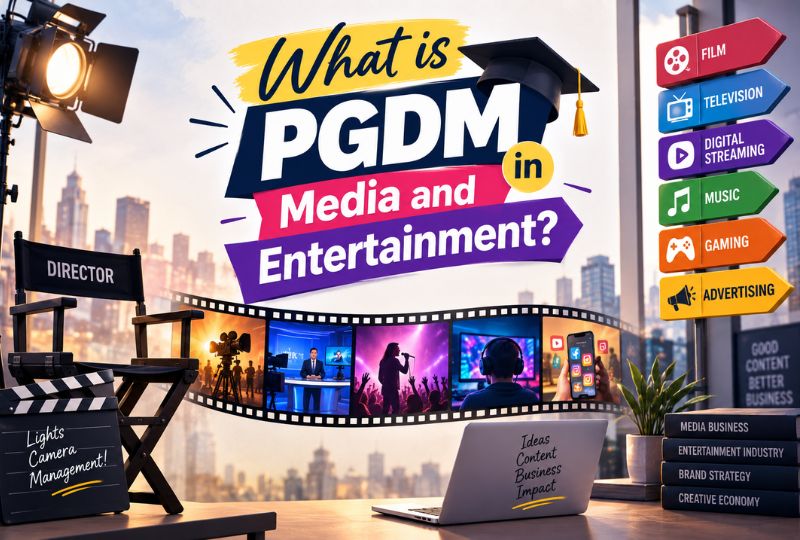
PGDM in Media and Entertainment is a specialised postgraduate management diploma that combines core business administration principles with specific knowledge of how the media and entertainment industry operates as a commercial ecosystem — spanning film, television, digital streaming, music, gaming, and advertising.
Unlike a general MBA/PGDM, this program focuses specifically on preparing students to understand and navigate the unique business dynamics of media — where revenue comes from advertising, subscriptions, licensing, box office, and brand partnerships rather than traditional product sales. The two-year curriculum typically covers both foundational management subjects and specialised media business coursework.
Why Choose PGDM in Media and Entertainment?
Considering this specialisation for your postgraduate degree? Here's why it makes strategic sense in 2026.
Why Choose PGDM in Media and Entertainment?
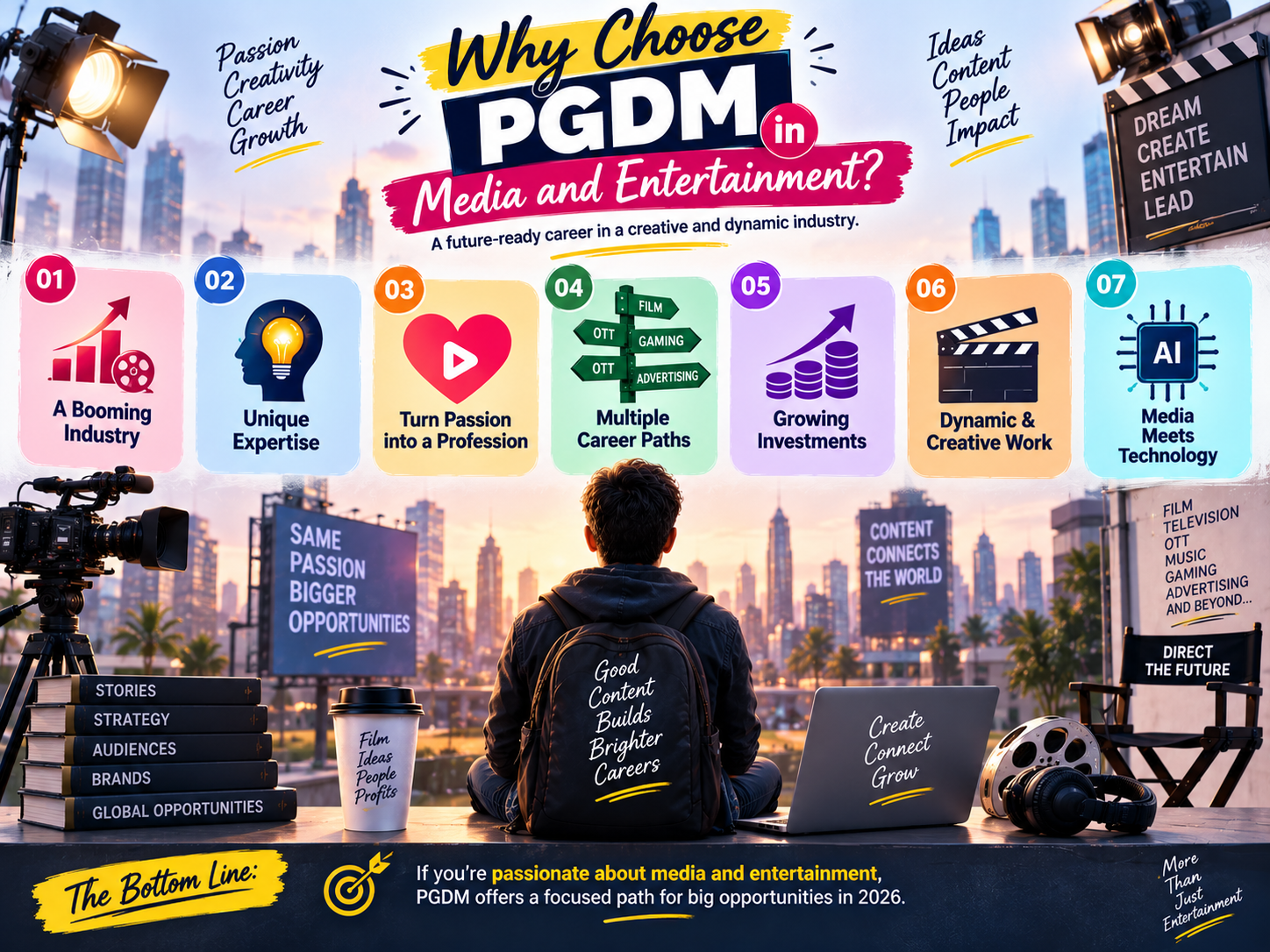
1. India's genuinely booming media and entertainment sector
Beyond traditional film and television, OTT streaming platforms, digital content, gaming, and influencer marketing continue expanding rapidly, creating fresh demand for professionals who understand the business side of media specifically.
2. Niche industry expertise with strong differentiation
Unlike most MBA graduates, you'll develop specialised knowledge in content monetisation, media rights, and entertainment marketing — a genuinely differentiated skill set valued by an industry that requires both business acumen and creative sensibility.
3. Genuine passion-driven career path
For students who love films, television, music, gaming, or digital content and want to build a career around the business side of this world rather than just consuming it, this specialisation offers a legitimate professional pathway.
4. Diverse career entry points
Graduates aren't limited to one function — opportunities span content strategy, production management, brand partnerships, digital marketing, OTT business development, and media rights management.
5. Growing corporate investment in digital and OTT content
As streaming platforms, digital advertisers, and gaming companies pour investment into India's media landscape, demand for professionals who can manage these commercial relationships continues rising.
6. Dynamic, creatively engaging work environment
For students who thrive in fast-paced, content-driven settings, media and entertainment offers genuinely engaging work built around real creative projects and campaigns rather than routine corporate operations.
7. Growing convergence of media and technology
As AI-driven content recommendation, data analytics, and digital distribution reshape the industry, professionals who understand both media business and emerging technology become increasingly valuable.
The bottom line: If you're genuinely passionate about media, content, and entertainment and want a legitimate business career built around that interest, PGDM in Media and Entertainment offers a focused, differentiated path forward in 2026.
Benefits of Studying PGDM in Media and Entertainment
Benefits of Studying PGDM in Media and Entertainment
Still weighing your options? Here's a clear breakdown of the key benefits this specialisation offers.
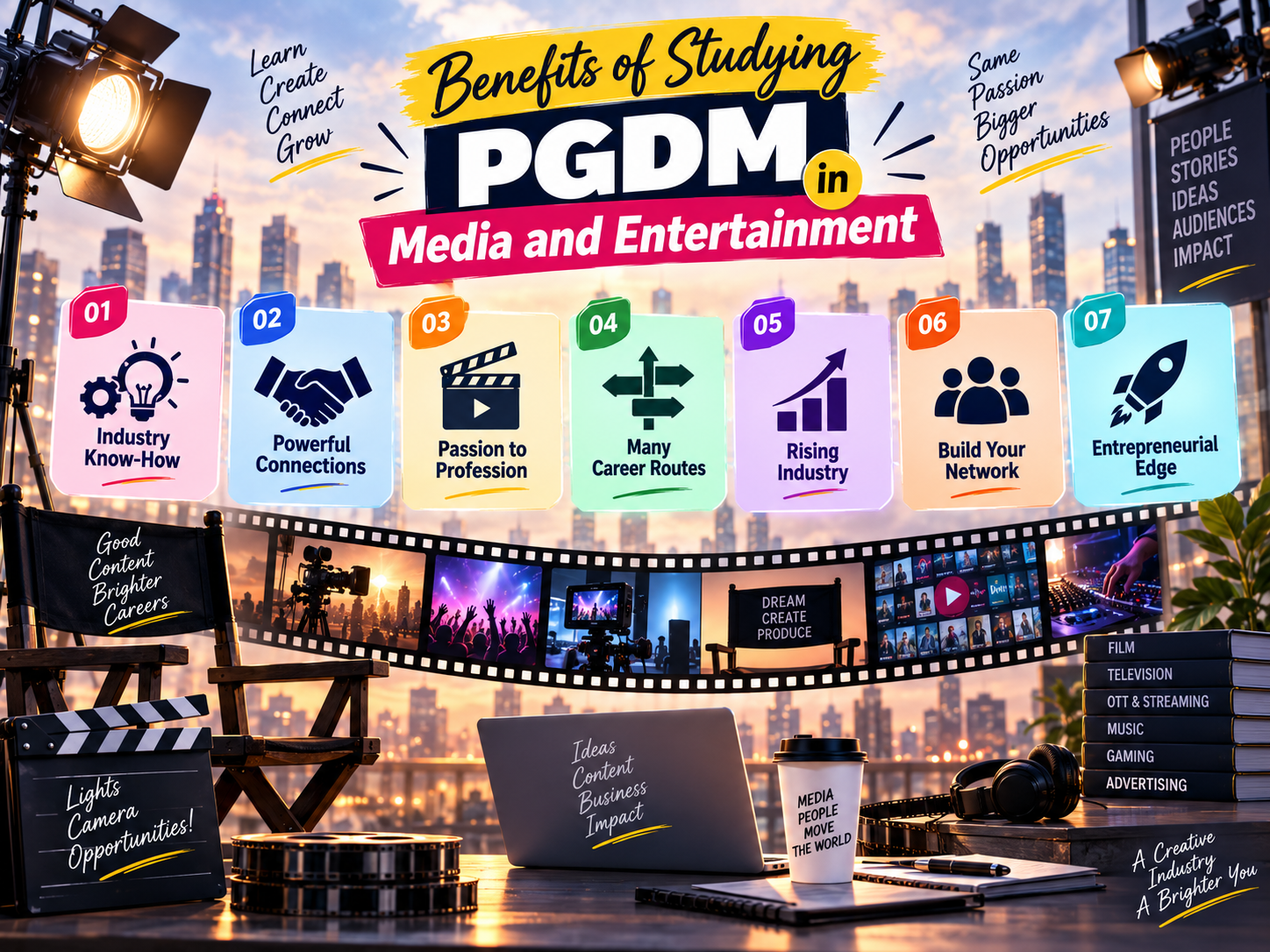
1. Specialised industry knowledge
You'll gain a deep understanding of content monetisation, media rights, distribution strategy, and entertainment marketing that general PGDM/MBA programs simply don't cover.
2. Strong industry connections (at well-established programs)
Programs with genuine media industry partnerships provide internship opportunities with production houses, OTT platforms, or advertising agencies — invaluable for entering this relationship-driven industry.
3. Passion-aligned career satisfaction
For genuinely media-passionate students, building a career around content and entertainment you already care deeply about can meaningfully improve long-term job satisfaction.
4. Diverse functional exposure
The program exposes you to production management, marketing, digital strategy, and media rights — all within the specific context of the entertainment business, helping you find your genuine niche.
5. Growing industry momentum
As India's OTT and digital content sector continues expanding, this specialisation's relevance and opportunity pool continues genuinely growing.
6. Networking within a relationship-driven industry
The media business runs heavily on personal relationships and networks — a dedicated program provides genuine early access through faculty connections, internships, and industry events.
7. Entrepreneurial potential
Graduates interested in starting production companies, content studios, or media consulting ventures gain directly applicable knowledge for building genuinely niche, passion-driven ventures.
The takeaway: PGDM in Media and Entertainment equips you with specialised, differentiated expertise in a genuinely dynamic and growing industry, translating into meaningful career satisfaction for students who bring authentic passion for media alongside solid business fundamentals in 2026.
Eligibility Criteria for PGDM in Media and Entertainment
Before applying for PGDM in Media and Entertainment, make sure you meet the following eligibility requirements for 2026 admissions.
Educational qualification:
A Bachelor's degree in any discipline from a recognised university, with a minimum aggregate score of 50% marks (45% for reserved category candidates, as per applicable institute norms)
Entrance exam requirements:
Most institutes require scores from recognised management entrance exams such as CAT, MAT, XAT, CMAT, ATMA, or NMAT
Work experience
Generally not mandatory for full-time PGDM admission, though candidates with relevant industry experience (in production, marketing, or media-adjacent roles) may have an added advantage during interviews at certain institutes
Media/creative background (not mandatory, but valued)
While formal media education isn't typically a strict eligibility requirement, genuine involvement in media-related activities (college film clubs, content creation, journalism, or event management) can meaningfully strengthen your application and interview performance
Additional requirements:
Statement of Purpose (SOP) explaining interest in media and entertainment business specifically
Letters of Recommendation (LORs)
Personal Interview and/or Group Discussion, often assessing genuine industry knowledge and creative-business sensibility.
Our advice:
Since interview panels for this specialisation often specifically probe genuine media industry awareness — not just casual entertainment consumption — prepare to discuss current OTT trends, media business models, or specific industry developments (like streaming platform strategies or box office economics) to demonstrate authentic interest during your 2026 admission cycle.
Admission Process for PGDM in Media and Entertainment 2026
Here's the step-by-step breakdown of what admission actually looks like.
Step 1: Register for entrance exams
Begin by registering for relevant management entrance exams like CAT, MAT, XAT, CMAT, or NMAT, depending on your target institutes.
Step 2: Prepare and appear for exams
Dedicate sufficient preparation time for quantitative aptitude, logical reasoning, verbal ability, and general awareness sections.
Step 3: Research and shortlist institutes
Shortlist institutes based on genuine media industry partnerships, curriculum depth, and placement records specific to this specialisation.
Step 4: Apply to shortlisted institutes
Submit applications including academic transcripts, entrance exam scores, SOP, LORs, and updated CV/resume, highlighting any relevant media or creative background.
Step 5: Shortlisting based on exam scores
Institutes shortlist candidates based on entrance exam percentiles, academic performance, and relevant profile strength.
Step 6: Group Discussion (GD) round
Shortlisted candidates participate in GD rounds, often centred on current media industry topics, testing awareness and analytical thinking about entertainment business trends.
Step 7: Personal Interview (PI) round
The PI assesses your motivation for pursuing media and entertainment management specifically, genuine industry interest, and career goals, often including questions on current developments in film, OTT, or digital content.
Step 8: Final merit list and admission offer
Based on combined performance across entrance exams, GD, and PI rounds, institutes release merit lists and admission offers.
Step 9: Document verification and fee payment
Confirm your seat by completing document verification and paying the required admission fee within specified deadlines.
Our advice: Since this niche specialisation values genuine industry interest, stay updated on current media and entertainment sector news — OTT platform strategies, box office trends, digital advertising shifts — and demonstrate this awareness clearly during GD-PI rounds for your 2026 admissions.
Entrance Exams for PGDM in Media and Entertainment
Getting into a good PGDM in Media and Entertainment program depends largely on your target institute's specific admission approach. Here's what to expect in 2026.
MICAT (MICA Admission Test)
The signature entrance exam for MICA's specialised communications and media programs, combined with your CAT/XAT/GMAT score, General Awareness, Personal Interview, academics, and extracurriculars for final selection.
CAT (Common Admission Test)
Widely accepted for MICA's PGDM-C program and several other institutes, carrying significant weightage (around 35% at MICA) alongside MICAT.
XAT (Xavier Aptitude Test)
Also accepted at MICA and several other media management institutes, with a minimum cutoff of around 80 percentile overall.
MECAT and Creative Ability Test (CAT)
Whistling Woods International uses its own specific admission route — MECAT for PG-level admission (MBA/PGDM), combined with WWI's own college counselling round, distinct from the more common national management exams.
GMAT
Also accepted at several media management institutes as an alternative to CAT/XAT for candidates with an international application profile.
General Awareness (GE) and Personal Interview (PI)
Beyond the written entrance exam, institutes like MICA weight General Awareness (10%) and Personal Interview (20%) significantly in final selection — genuine media industry knowledge and communication skills matter as much as your raw test score.
Our advice: Since MICA specifically requires the MICAT alongside CAT/XAT/GMAT (a genuinely unique dual-exam requirement), and Whistling Woods uses its own separate MECAT route, map out your target institutes' exact exam requirements early — these aren't interchangeable, and preparing for the wrong exam wastes valuable time for your 2026 admission cycle.
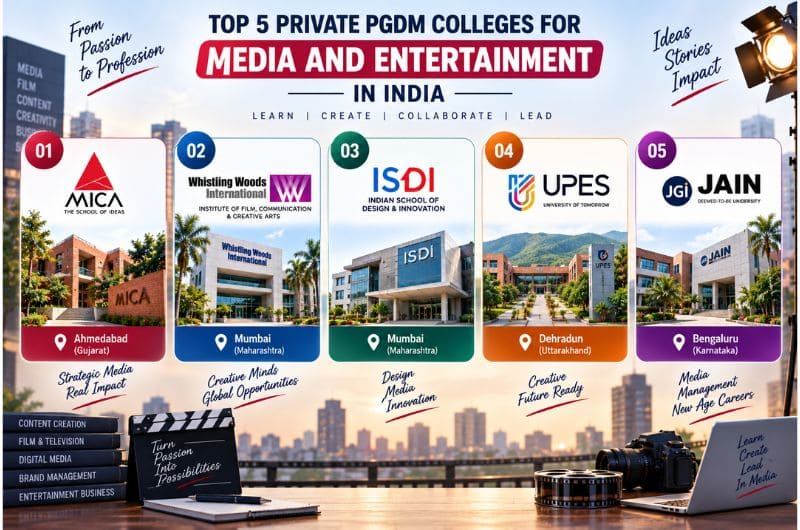
Top PGDM in Media and Entertainment Colleges in India
Choosing the right college significantly impacts your industry connections and placement outcomes. Here are India's leading institutes offering this specialisation for 2026.
Top PGDM in Media and Entertainment Colleges in India
MICA (Mudra Institute of Communications, Ahmedabad)
India's foremost institute in Strategic Marketing, Communication, and Applied Creativity — ranked #32-35 nationally (NIRF/Collegedunia), offering PGDM-C with a Media & Entertainment specialisation track alongside Brand Management, Digital Communication, Marketing Analytics, and Advertising.
Whistling Woods International, Mumbai
Established in 2006 as India's well-known Film, Communication & Creative Arts Institute, affiliated with the Tata Institute of Social Sciences (TISS). Located inside Film City, Mumbai, offering students a literal front-row seat to the Indian media and entertainment ecosystem, with a multidisciplinary curriculum combining general management subjects with niche media topics like OTT Content and Film Distribution.
Other notable institutes
Several general management institutes now offer media and entertainment electives or specialised tracks within their broader PGDM programs, though MICA and Whistling Woods remain the most dedicated, industry-recognised options specifically for this niche specialisation.
Our advice: Given how genuinely specialised this field is, MICA and Whistling Woods represent the two clear category leaders in India — MICA for its broader communications/marketing depth and stronger overall brand recognition, Whistling Woods for its literal Film City location and pure media/entertainment focus. Prioritise these two over generalist institutes offering media as just one elective among many.
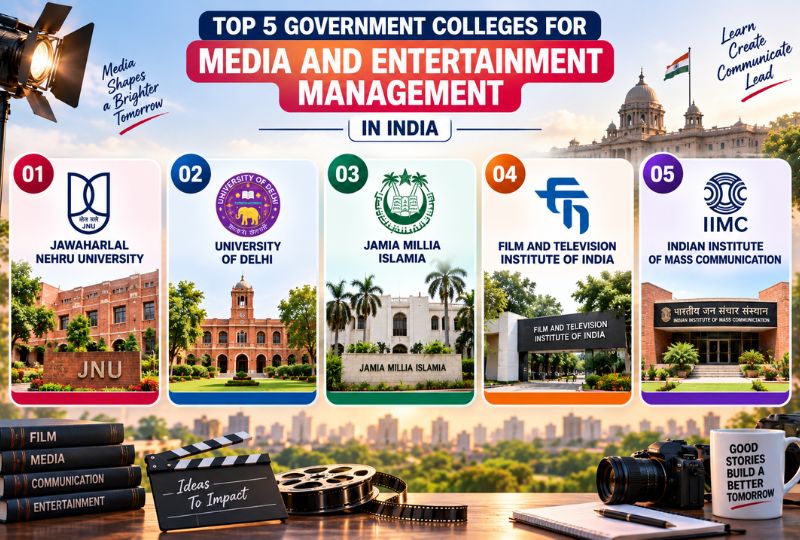
Best Government Colleges for Media and Entertainment Management
Here's an honest reality check for students specifically seeking government-institute options in 2026.
A genuinely limited landscape
Dedicated PGDM in Media and Entertainment Management programs are overwhelmingly offered by private, specialised institutes (MICA, Whistling Woods) rather than government business schools — this niche specialisation simply hasn't been widely adopted within India's government IIM/university ecosystem.
MICA's semi-autonomous positioning
While MICA is a private, AICTE-approved institute rather than a government college, it operates as an autonomous institution with strong national recognition (NIRF rank #32-35), functioning similarly to a top-tier institute in terms of academic rigour and credibility, even without government funding.
Government university media/mass communication alternatives
Some government universities offer broader Mass Communication or Media Studies postgraduate programs (distinct from a management-focused PGDM) at significantly lower fees — worth considering if you want a more affordable, communication-focused alternative, though these typically lack the specific business/management depth of a genuine PGDM.
Our advice: If a genuine government-funded PGDM specifically in Media and Entertainment Management is your priority, be aware this is a real gap in India's current higher education landscape — your realistic best options remain private, specialised institutes like MICA and Whistling Woods, which, despite their private status, carry strong industry recognition and genuine specialisation depth that generic government media programs typically don't match.
Best Private PGDM Colleges for Media and Entertainment
Looking specifically at private institutes for your PGDM in Media and Entertainment? Here are the standout options for 2026.
MICA, Ahmedabad
The clear category leader — PGDM-C offers a dedicated Media & Entertainment specialisation alongside Brand Management, Digital Communication, and Advertising tracks. NIRF rank #32 nationally, with strong placement outcomes: 2025 average package around ₹19.22 LPA, highest ₹40.91 LPA (some sources cite ₹45.67 LPA), and 100% placement, with recruiters including Accenture, Coca-Cola, Flipkart, Samsung, and The Times of India.
Whistling Woods International, Mumbai
Genuinely purpose-built for media and entertainment specifically — its MBA in Media and Entertainment is built in association with TISS, covering both business fundamentals and creative topics like OTT Content and Film Distribution, with its Film City location offering unmatched proximity to India's actual media production ecosystem.
Our advice: MICA offers stronger overall brand recognition, broader communications specialisation depth, and notably higher average placement packages — genuinely the safer, more prestigious choice if you're weighing pure ROI. Whistling Woods offers deeper, more specific media/entertainment industry immersion given its literal Film City campus — a better fit if your passion is specifically film, television, and content production rather than the broader marketing/communications umbrella MICA covers.
PGDM in Media and Entertainment Fees
Planning your budget for this specialisation? Here's a realistic breakdown of costs for 2026.
MICA (PGDM-C, Media & Entertainment specialisation)
Total fees run approximately ₹26-28 Lakhs for the complete 2-year program, with students paying roughly ₹14 Lakhs per year — additional hostel fees (mandatory, since the program is residential) add approximately ₹3.56 Lakhs.
Whistling Woods International (MBA in Media and Entertainment)
Reported fee figures genuinely vary across sources — one source cites total tuition at ₹1.5 Lakhs, another cites ₹3.5 Lakhs total, while a third places overall program fees (across various WWI courses) between ₹7.5-16 Lakhs, and yet another describes a semester-wise structure (₹2 Lakhs initial including deposit, then ₹1.5-2 Lakhs per subsequent semester) totaling roughly ₹8-9 Lakhs across the full program. Given this genuine inconsistency, always request Whistling Woods' current, official fee structure directly before making any financial commitment.
What's typically included
Tuition and academic coursework
Industry-led training components
Campus facilities access
Hostel/residential charges (charged separately at both institutes, given their residential program structure)
Caution deposit and security deposit (one-time charges at admission)
Laptop/equipment requirements for media production coursework
Our advice: Since MICA's fee structure is more consistently documented (₹26-28 Lakhs total) while Whistling Woods' figures vary significantly across sources, treat any Whistling Woods fee figure you encounter online as provisional — always confirm the exact, current fee structure directly with the institute's admissions office before finalizing your 2026 budget, since the discrepancy between sources (₹1.5 Lakhs vs. ₹9+ Lakhs) is genuinely too large to rely on secondhand aggregator data alone.
PGDM in Media and Entertainment Fees
MICA Ahmedabad — ₹8,25,000 for the full program, one of the most recognised specialised options for media and entertainment management
Welingkar Mumbai (WeSchool) — Offers a dedicated PGDM in Media and Entertainment program, with a fee-waiver scheme available for candidates whose parental income doesn't exceed ₹8 lakh (only tuition fee waived under this scheme; other charges remain payable by the beneficiary)
Overall specialised PGDM fee range — Generally aligns with broader PGDM benchmarks of ₹2-20 lakh for the full program, with niche/media-focused private institutes typically falling in the ₹6-12 lakh bracket.
Government college comparison (for context) — Government-affiliated PGDM programs broadly rangfrom ₹ 10,000 to ₹ 13,00,00000, considerably cheaper than most private media-specialisation tracks
Fee inclusions — At institutes like GIBS, quoted fees (~₹9.5 lakh) typically include tuition, study material, and other academic charges, usually payable in yearly or semester-wise instalments rather than a lump sum.
Scholarship availability — Merit scholarships for strong CAT/XAT/CMAT/GMAT scorers, along with academic-achievement and excellence-based awards, are commonly available at institutes offering this specialisation
PGDM in Media and Entertainment Syllabus
Core management foundation — Accounting, Business Communication, Economics, Finance, Marketing, Operations, and HRM form the base curriculum shared across most PGDM tracks, including media specialisations.
Media-specific coursework — Subjects focused on media production, entertainment business models, content strategy, and media law/regulation, layered on top of the core management foundation
Structure across semesters — Curriculum is typically divided into 4 semesters, with the first and second semesters covering mostly theory and core subjects, and later semesters shifting toward applied, industry-specific coursework
Compulsory internship component — A mandatory internship helps students get accustomed to real industry challenges and requirements before final placements.
Industry-aligned, frequently updated content — Institutes typically update 30-40% of their syllabus every 2-3 years to keep pace with the fast-evolving media and entertainment industry.y
Practical/applied learning emphasis — Live projects and case studies specific to media, entertainment, and communication industries are integrated throughout the program, rather than relying purely on theoretical instruction.
Popular specialisations in Media and Entertainment Management
Media Production & Content Management — Focused on the creation, production, and management of media content across formats
Advertising & Brand Communication — Covers strategic brand-building and advertising campaign management within the media ecosystem
Digital and Social Media Management — A growing specialisation aligned with the industry's shift toward digital-first content and platforms
Entertainment Business Management — Covers the business and commercial side of film, television, music, and broader entertainment industries.
Event and Talent Management — Focused on managing events, artists, and talent within the entertainment sector
Public Relations & Corporate Communication — Relevant for students targeting PR and reputation-management roles within media-adjacent organisations
Broader business analytics overlay — Since media businesses increasingly rely on data-driven decisions, several programs now blend core media specialisation with business analytics electives.
PGDM in Media and Entertainment: Course Duration
Standard duration — 2 years, consistent with the general PGDM structure across nearly all Indian institutes offering this specialisation
Semester breakdown — Typically divided into 4 semesters, with foundational/core subjects front-loaded in the first two semesters and specialisation-heavy, applied coursework in the latter half.
Internship placement timing — A compulsory internship is generally scheduled after the initial semesters, giving students real-world exposure before their final placement cycle.e
Placement eligibility timing — Based on typical batch patterns at similar institutes, students generally become eligible for final placements from the 4th trimester/later semesters onward, once internship requirements are complete.d
Consistency with broader PGDM norms — This 2-year, 4-semester structure mirrors the standard PGDM format used across specialisations (Marketing, Finance, HR, Media), rather than following a different, extended timeline specific to media and entertainment
PGDM in Media and Entertainment Placements
MICA Ahmedabad admission basis — Selection is based on CAT scores along with Group Discussion (GD) and Personal Interview (PI) rounds, with relevant work experience preferred, reflecting the competitive nature of placements from this specialised institute
Welingkar Mumbai admission basis — Accepts CAT, XAT, ATMA, CMAT, or GMAT scores for its dedicated PGDM Media and Entertainment program.
Broader PGDM placement benchmark (for context) — Top PGDMM colleges report average placement rates of 85-95% for recent batches, with freshers securing average packages ranging from ₹6-12 LPA nationally
Comparable institute example (GIBS) — Reported over 200+ companies visiting campus (including Amazon, Accenture, Wipro, Mahindra Finance), with a highest package around ₹20 LPA and an average package around ₹8.3 LPA — useful as a general private-institute PGDM placement reference point
Media-specific recruiter base — Given the specialisation focus, recruiters typically include media houses, advertising agencies, entertainment companies, digital content platforms, and PR/communication firms, alongside general corporate recruiters.
Placement data caveat — Since media and entertainment PGDM programs are more niche than general management tracks, checking each specific institute's (MICA, Welingkar) published placement report is more reliable than relying on broad national PGDM averages
Salary After PGDM in Media and Entertainment
National PGDM benchmark (general, for context) — Average salary across PGDM programs nationally ranges ₹8-18 LPA depending on the institute, with entry-level starting salaries ranging from ₹4 lakh at the lower end to ₹12 lakh and above at stronger colleges
PGDMM-specific reported range — Freshers from top PGDMM colleges secure average packages rangingfrom ₹6-12 LPA, based on 2025 batch data.
Media-sector recruiter salary alignment — Since media and entertainment specialisations connect graduates to media houses, advertising agencies, and entertainment/content companies, starting salaries generally track closer to the ₹6-10 LPA range at reputed specialised institutes like MICA and Welingkar, rather than the higher-end consulting/finance-driven PGDM averages.
Value-for-money consideration — When evaluating a college, comparing the course fee against the actual average salary at graduation is essential — a ₹12 lakh course with a ₹10 lakh average salary and a ₹5 lakh course with a ₹5 lakh average salary represent very different value propositions
Career growth trajectory — Salary growth in media and entertainment careers often depends heavily on specialisation depth (content vs. business/strategy side), company reputation, and the graduate's ability to build a portfolio of successful projects or campaigns over time.
Career Options After PGDM in Media and Entertainment
Content Strategist / Producer — Manages the creation, planning, and execution of media content across TV, digital, and film platforms
Brand Manager (Media/Entertainment sector) — Oversees brand positioning and communication strategy specifically for media, OTT, or entertainment companies
Advertising Account Manager — Manages client relationships and campaign execution at advertising and media agencies
Digital & Social Media Manager — Handles content strategy, platform management, and audience engagement across digital and social channels
Talent/Artist Manager — Manages careers, contracts, and public engagements for actors, musicians, influencers, and other talent
Event Manager (Media/Entertainment focus) — Plans and executes large-scale entertainment events, product launches, and media-industry conferences
PR & Corporate Communications Executive — Manages reputation, media relations, and public messaging for media companies or media-adjacent brands
Media Business Analyst/Consultant — Applies business analytics and strategic frameworks specifically to media industry decision-making
Entrepreneurship — Growing pathway into launching content studios, production houses, or digital media startups, leveraging the business fundamentals built during the PGDM
Top Recruiters in Media and Entertainment Industry
Media houses and broadcast networks — Traditional and digital news/entertainment organisations recruiting for content, production, and strategy roles
Advertising and creative agencies — Recruit for client servicing, campaign planning, and brand strategy roles
OTT and digital content platforms — Growing recruiter base given the industry's ongoing shift toward streaming and digital-first content
Entertainment and production companies — Film, television, and music industry companies hiring for production and business management roles
PR and corporate communication firms — Recruit for reputation management, media relations, and communication strategy positions
General corporate recruiters (cross-sector) — Companies like Amazon, Accenture, Wipro, and Mahindra Finance also recruit PGDM graduates broadly, including from media-specialisation tracks, into general management or marketing-adjacent roles
FMCG and consumer brands — Actively recruit media/brand-management specialisation graduates for marketing and brand communication roles, given the overlap in skill sets
Sector concentration — Media houses, advertising agencies, digital platforms, and PR firms collectively form the core recruiting pillars, supplemented by broader corporate marketing and brand roles at mainstream companies
Skills Required for Media and Entertainment Management
Creative and strategic thinking — Essential for content strategy, brand positioning, and campaign development in a fast-evolving media landscape
Strong communication skills — Foundational for nearly every role, from client servicing to PR and talent management
Digital media literacy — Familiarity with social media platforms, content management tools, and basic analytics dashboards
Business and financial acumen — Core management fundamentals (finance, operations, marketing) remain essential even in creative-industry roles, since media businesses ultimately run on solid commercial decision-making.
Networking and relationship-building — Particularly valuable for talent management, PR, and advertising client-servicing roles
Adaptability to industry trends — Given how quickly media consumption habits and platforms evolve, staying current with digital and content trends is a continuous requirement.t
Project and event management skills — Useful for coordinating campaigns, productions, and large-scale entertainment events
Data-driven decision-making — Increasingly important as media businesses lean more heavily on analytics for content and campaign performance evaluation
Presentation and pitching skills — Valuable for advertising, brand management, and client-facing roles where concepts need to be sold internally or externally
Future Scope of PGDM in Media and Entertainment
Growing digital-first industry — The continued shift toward OTT platforms, digital content, and social-media-driven engagement is expanding demand for business-savvy media professionals, not just creative talent.
Industry-aligned curriculum advantage — Since institutes update 30-40% of their syllabus every 2-3 years to match current industry demands, graduates typically enter the job market with genuinely current skills.
Diversifying career pathways — Beyond traditional media houses, media-and-entertainment-trained management graduates are increasingly finding roles in tech companies, FMCG brand teams, and digital marketing agencies, widening overall career scope.
Entrepreneurship opportunities —The growing creator economy, digital content startups, and independent production houses create fresh entrepreneurial pathways for graduates with strong business fundamentals.
Analytics integration — As media businesses increasingly rely on data for content and campaign decisions, graduates with strong business analytics skills alongside media specialisation are particularly well-positioned for future demand.
International opportunities — Skilled media-management professionals, particularly those with strong digital and brand-strategy expertise, can find opportunities with international media and entertainment companies as global content consumption continues to grow
Steady long-term demand — Given that entertainment and media consumption continues to grow across both traditional and digital formats, business management skills specifically tailored to this industry remain a durable, in-demand career specialisation
PGDM in Media and Entertainment vs MBA in Media Management
Curriculum orientation — PGDM programs (like those at MICA and Welingkar) are generally more industry-oriented and updated frequently (30-40% syllabus refresh every 2-3 years) to match current media industry trends, while MBA in Media Management, being university-affiliated, tends to be more theoretical and slower to update
Governing body and degree status — PGDM is a diploma approved by AICTE and offered by autonomous institutes; MBA is a formal university degree awarded under UGC oversight — though a PGDM from an AIU-recognized institute (over 100 programs currently hold this equivalence) is considered equivalent to an MBA for most practical purposes, including PhD eligibility.y
Industry exposure and placement focus — If industry exposure and a placement-driven curriculum are the priority, PGDM is generally considered the stronger choice in India specifically for this reason, given its emphasis on internships, live projects, and case studies
Institution specialisation depth — Institutes like MICA (dedicated specifically to media, communication, and strategy) and Welingkar's.PGDM Media and Entertainment program offers deeper, more focused specialisation than most general MBA programs that only offer media management as one elective track among many
Recognition and portability — Both PGDM (AIU-recognized) and MBA remain valid, recognised postgraduate specialisations in India — the choice ultimately comes down to whether you prioritise a specialised, industry-embedded PGDM experience or a more traditional, broadly recognised unspecialised degree.
Which to choose — PGDM in Media and Entertainment suits candidates who want deep, industry-aligned specialisation with strong practical exposure specifically in this sector; a recognised MBA with a media elective suits those who want broader management training with media as just one priority and a specialised skill set
Conclusion
Frequently Asked Questions (FAQs)
Q1. Which are the top colleges for PGDM in Media and Entertainment in India? MICA Ahmedabad and Welingkar Mumbai (WeSchool) are among the specialisation institutes offering a dedicated PGDM specialisation in Media and Entertainment Management.
Q2. What is the average fee for PGDM in Media and Entertainment? Fees typically range from ₹6-12 lakh at specialised private institutes, with MICA Ahmedabad charging ₹8,25,000 for the full program; broader PGDM fees nationally range from ₹2-20 lakh depending on the institute.
Q3. Which entrance exams are accepted for admission? CAT is the primary exam, especially at MICA, while institutes like Welingkar also accept XAT, ATMA, CMAT, or GMAT scores alongside a Group Discussion and Personal Interview round.
Q4. What is the average salary after PGDM in Media and Entertainment? Salaries typically range from ₹6-10 LPA at reputed specialised institutes, broadly aligning with the national PGDMM average of ₹6-12 LPA for fresh graduates, though top performers and top-ranked colleges can secure higher packages.
Q5. What career options are available after this specialisation? Graduates can pursue roles as content strategists, brand managers, advertising account managers, digital/social media managers, talent managers, PR executives, and specialised business analysts/consultants.
Q6. Is PGDM in Media and Entertainment equivalent to an MBA? Yes, when pursued through an AIU-recognized institute — over 100 PGDM programs across India currently hold this equivalence, allowing graduates the same eligibility for further studies like a PhD as MBA holders.
Q7. What is the duration of this program? It's a standard 2-year, 4-semester program, consistent with the general PGDM structure, including a compulsory internship component before final placements.
Q8. Is PGDM better than MBA for a media and entertainment career? If industry exposure, a frequently updated curriculum, and a placement-driven approach are priorities, PGDM is generally considered the stronger choice in India specifically for this reason, though both remain valid, recognised qualifications.
Conclusion
PGDM in Media and Entertainment Management offers a genuinely specialised pathway for students drawn to the business side of India's fast-growing media, advertising, and entertainment industries, moving beyond a general management degree into deep, industry-aligned coursework at institutes like MICA and Welingkar. With fees generally in the ₹6-12 lakh range and reported salaries between ₹6-10 LPA, the program offers reasonable value for students prioritising specialised content strategy, brand management, advertising, or digital media over a broader, generalist business education. Since this remains a relatively niche specialisation compared to mainstream Finance or Marketing PGDM tracks, prospective students should look closely at each specific institute's published placement report, recruiter list, and course fee-to-salary ratio rather than relying on broad national PGDM averages, which often skew toward finance and consulting outcomes.
Enter Your Details to Unlock Eligibility
Get personalized college recommendations and scholarship opportunities