PGDM in Logistics and Supply Chain Management Fees, Eligibility, Admission & Career Opportunities
PGDM in Logistics and Supply Chain Management Fees, Eligibility, Admission & Career Opportunities
August 22, 2026
17 min read
PGDM in Logistics and Supply Chain Management: Highlights 2026
Program structure — A two-year, AICTE-approved postgraduate diploma designed to develop professionals who can manage the end-to-end flow of goods, information, and finances across domestic and international supply chains
Growing demand hub — Cities like Bangalore have seen significant growth in demand for this specialisation, driven by rapid expansion of e-commerce, manufacturing, retail, pharmaceuticals, FMCG, and global trade
Fee range — Generally ₹2-15 lakh nationally, though costs can escalate depending on the university, institution type, and facilities available, with some sources citing an even broader range at certain private institutes
Part-time options available — Institutes like IISWBM Kolkata offer this specialisation in part-time mode (Saturdays, 3:00 PM-9:00 PM) at ₹1.15 lakh total, popular among working professionals
Entrance exam landscape — Colleges accept a range of national exams including CAT, XAT, CMAT, MAT, ATMA, and SNAP, alongside institute-specific tests
Strong logistics-hub city advantage — Bangalore specifically hosts numerous logistics companies, multinational manufacturers, 3PL providers, e-commerce giants, and supply chain technology firms, making it a particularly strategic city to study this specialisation
2026 exam calendar reference — MAT May 2026 session registrations were open, with the CBT exam on June 14, and ATMA 2026 (May session) results were already released for several accepting institutes
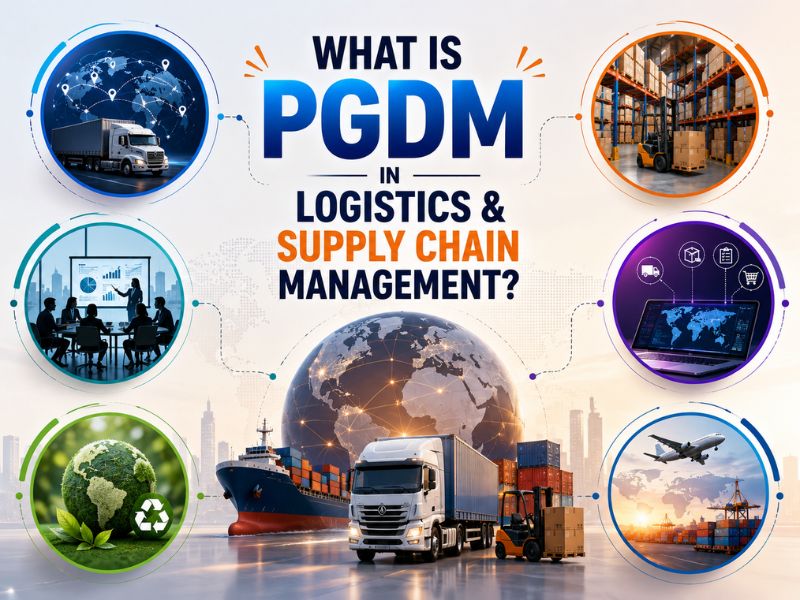
What is PGDM in Logistics and Supply Chain Management?
What is PGDM in Logistics and Supply Chain Management?
Core definition — A specialised management diploma focused on overseeing and optimising the flow of goods, services, information, and finances from raw material sourcing through to final delivery to the end customer
End-to-end scope — Covers procurement, warehousing, inventory management, transportation, distribution, and international trade logistics as core functional areas
Business management foundation — Like other PGDM specialisations, it combines core management fundamentals (finance, operations, strategy) with domain-specific supply chain coursework.
Distinct from general Operations Management — While operations management covers broader production and process efficiency, this specialisation narrows focus specifically to the movement and coordination of goods and information across the supply chain network.
Industry-aligned curriculum — Designed with a practical application focus, reflecting real-world supply chain challenges rather than purely theoretical coursework
Growing tech integration — Modern supply chain management is increasingly described as a dynamic field, incorporating current technology and digital tools into traditional logistics coursework.k
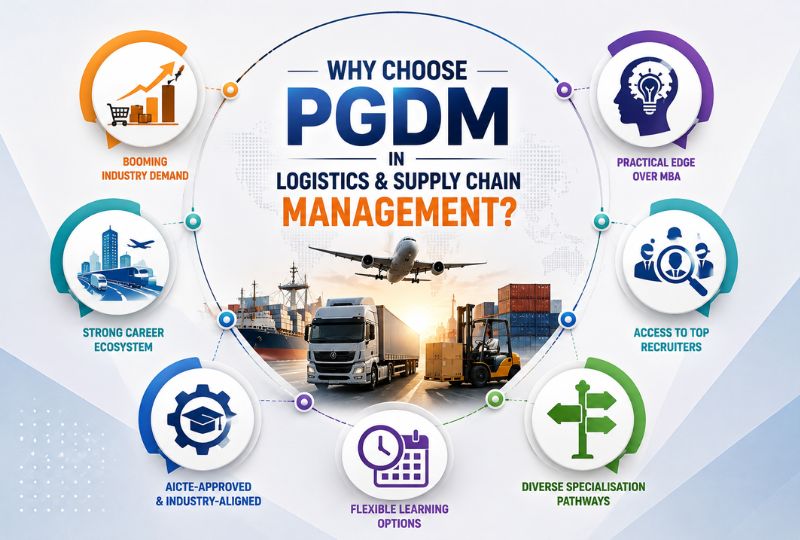
Why Choose PGDM in Logistics and Supply Chain Management?
Why Choose PGDM in Logistics and Supply Chain Management?
Booming sector demand — The rapid expansion of e-commerce, manufacturing, retail, pharmaceuticals, FMCG, and global trade has created sustained, genuine demand for skilled supply chain professionals
Strong infrastructure-linked career hubs — Cities like Bangalore offer strong road, rail, air cargo, and digital infrastructure specifically supporting logistics careers, giving students access to a concentrated ecosystem of relevant employers
AICTE-approved, industry-aligned programs — Programs are approved and regularly updated to reflect practical, real-world application rather than purely academic theory
Flexible study formats — Options for both full-time and part-time (weekend) study, like IISWBM's Saturday-only format, make this specialisation accessible to working professionals as well as fresh graduates.
Diverse specialisation pathways — Some institutes blend supply chain management with broader flagship programs (like PGDM in Business Management or HRM), giving students flexibility in how deeply they specialise.
Strong recruiter access at leading institutes — Institutes with robust placement networks (2200+ recruiters at some top colleges) connect graduates directly to major companies actively hiring for supply chain roles.
PGDM vs MBA distinction — A PGDM in this field often focuses more on practical, industry-oriented training compared to a more theoretical university-affiliated MBA, appealing to students prioritising direct career readiness
Eligibility Criteria for PGDM in Logistics and Supply Chain Management
Academic qualification — A bachelor's degree from a recognised university, generally with a minimum aggregate as specified by each institute (commonly 50% or equivalent)
Entrance exam requirement — A valid score in exams like CAT, XAT, CMAT, MAT, ATMA, or SNAP is typically required at most reputed institutes
Merit-based admission at some institutes — Certain colleges select candidates purely based on clearing the university's own eligibility criteria through academic merit, without a mandatory national entrance exam.
Work experience (optional but preferred) — Not mandatory at most colleges, but candidates with relevant work experience — especially in logistics, operations, or retail management — are often given preference.e
Additional application components — Group Discussion (GD), Personal Interview (PI), a Statement of Purpose (SOP), and Letters of Recommendation are commonly required as part of the broader selection criteria.
Growing use of aptitude-based digital assessment — For 2026 admissions, many colleges are incorporating aptitude-based testing and digital interviews alongside traditional GD/PI rounds.
No fixed undergraduate stream requirement — Students from Commerce, Science, Engineering, or Arts backgrounds are generally all eligible to apply, provided they meet the academic aggregate and entrance exam requirements
Admission Process for PGDM in Logistics and Supply Chain Management 2026
Step 1: Check eligibility — Confirm your bachelor's degree meets the minimum aggregate requirement (commonly 50%) at your target institute
Step 2: Register for relevant entrance exam(s) — Register for CAT, XAT, CMAT, MAT, GMAT, NMAT, or ATMA depending on which exams your shortlisted colleges accept
Step 3: Appear for the exam — Complete the relevant test within its specified window; CAT 2026 is scheduled for November 29
Step 4: Application & Shortlisting — Fill out the application form for your preferred college and get shortlisted based on entrance scores
Step 5: Selection Rounds — Participate in Group Discussion (GD) and Personal Interview (PI) rounds evaluating logical thinking and communication skills
Step 6: Digital/aptitude assessment (where applicable) — Some colleges now incorporate additional aptitude-based testing and digital interviews as part of 2026 admission cycles
Step 7: Final Admission — Once featured in the merit list, complete document verification and fee payment to secure your seat
Step 8: Program commencement — Begin the standard 2-year full-time program, or a 1-year intensive format at institutes offering that option
1-year intensive option available — Some institutes offer a 1-year PG diploma specifically designed for intensive training within a shorter timeframe, letting candidates enter the workforce faster
Entrance Exams for PGDM in Logistics and Supply Chain Management
CAT (Common Admission Test) — The primary and most widely accepted exam for top-tier institutes, including IIMs
XAT (Xavier Aptitude Test) — Accepted at several reputed private and government-linked institutes
NMAT — Commonly accepted, particularly by NMIMS and its supply-chain-focused programs
GMAT — Accepted at premier institutes, especially useful for candidates with international or executive-track profiles
MAT and ATMA — Broadly accepted across many private and mid-tier institutes, with more frequent exam sessions throughout the year
Institute-specific tests — Some colleges conduct their own entrance tests in addition to, or instead of, national-level exams
Since exam requirements differ significantly by college, checking the specific admission page of each shortlisted institute is important before applying
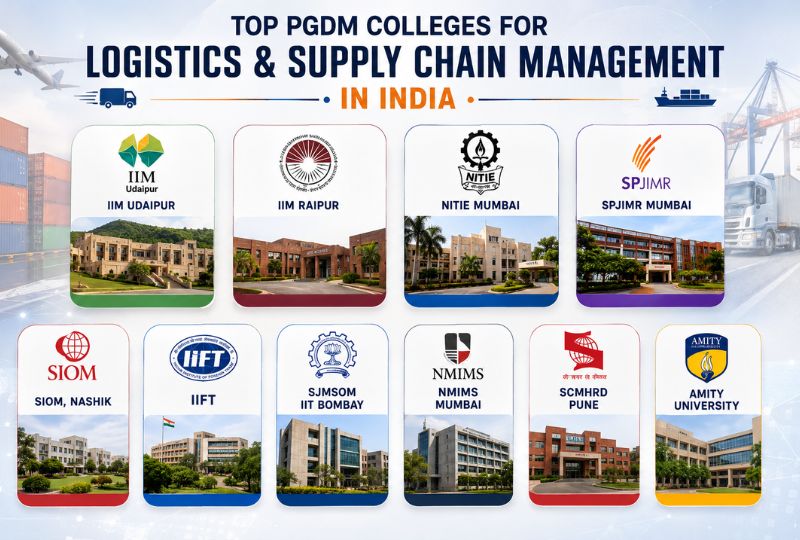
Top PGDM Colleges for Logistics and Supply Chain Management in India
Top PGDM Colleges for Logistics and Supply Chain Management in India
IIM Udaipur — Offers a distinctive One-Year MBA in Global Supply Chain Management, alongside its regular MBA and EMBA programs; a fast-growing second-generation IIM
IIM Raipur — Set up by the Government of India in 2010; offers PGP and Executive PGP programs with a strong supply-chain-adjacent curriculum
NITIE Mumbai — specialised institute long recognised as a leading destination for MBA in Logistics and Supply Chain Management
SPJIMR Mumbai — Offers a 2-year full-time PGDM alongside doctoral and fellow programs, with strong industry-oriented supply chain coursework
Symbiosis Institute of Operations Management (SIOM), Nashik — AICTE-approved private institute established in 2005, specifically offering MBA in Operations Management and Agriculture, widely regarded among top supply chain colleges
IIFT (Indian Institute of Foreign Trade) — Deemed University status since 2002, NAAC 'A' grade, specialising in international trade and business, closely linked to global supply chain careers
SJMSOM IIT Bombay, NMIMS Mumbai, SCMHRD Pune, Amity University — Consistently featured among top institutes offering MBA/PGDM in Logistics and Supply Chain Management
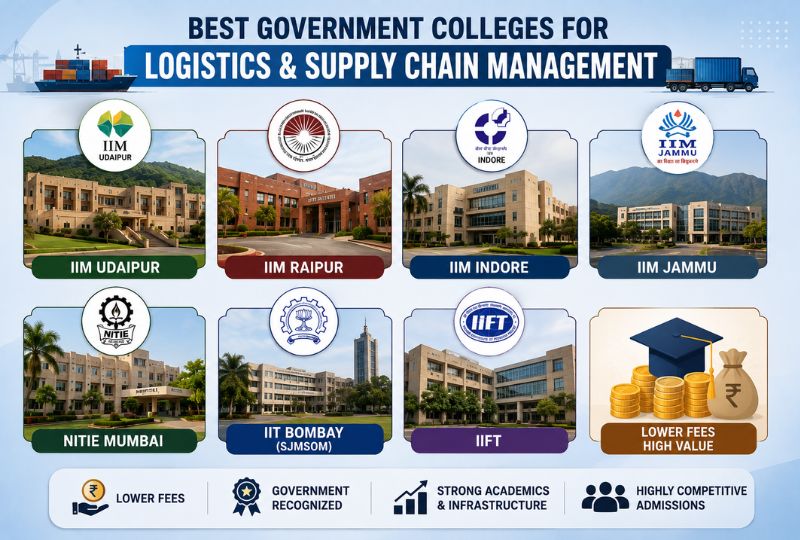
Best Government Colleges for Logistics and Supply Chain Management
Best Government Colleges for Logistics and Supply Chain Management
IIM Udaipur — Government-established second-generation IIM offering a dedicated One-Year MBA in Global Supply Chain Management
IIM Raipur — Set up by the Government of India (Ministry of Education) in 2010, located on a 203-acre campus in Atal Nagar, Naya Raipur
IIM Indore — Institute of national importance under the IIM Act 2017, with a 193-acre hillock campus and strong infrastructure supporting management education broadly, including supply-chain-adjacent coursework
IIM Jammu — Set high standards from its founding, offering government-backed management education
NITIE Mumbai — A specialised, historically government-linked institute focused specifically on industrial engineering and supply chain/operations management
IIT Bombay (SJMSOM) — Established in 1958, offering management programs with strong supply chain and operations linkages through its management school
IIFT — Promoted by the Ministry of Commerce & Industry, with Deemed University status and NAAC 'A' accreditation
General fee advantage — Government institutes typically offer significantly lower fees than private counterparts, though admission is highly competitive given limited seats and high CAT/XAT cutoff
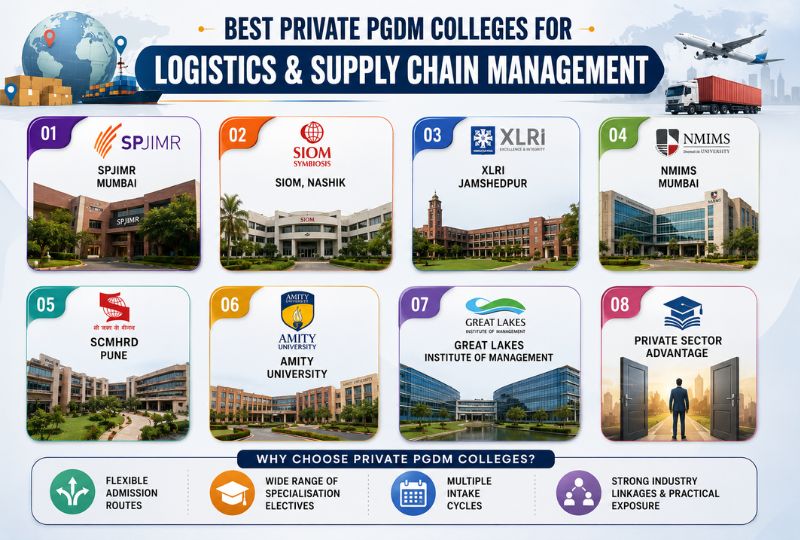
Best Private PGDM Colleges for Logistics and Supply Chain Management
Best Private PGDM Colleges for Logistics and Supply Chain Management
SPJIMR Mumbai — Private, highly reputed institute offering a 2-year full-time PGDM with strong industry linkages
Symbiosis Institute of Operations Management (SIOM), Nashik — AICTE-approved private institute, one of the most specialised private options specifically for operations and supply chain management
Xavier Labour Relations Institute (XLRI) — Established in 1949, accredited by AICTE, NBA, AMBA, and AACSB; reported a highest package of ₹37 lakh in a recent academic year.
NMIMS Mumbai — Private university consistently ranked among top colleges offering supply chain and logistics specialisation
SCMHRD Pune — Well-regarded private institute specifically noted for its supply chain management program
Amity University — Widely available across multiple campuses, offering supply chain and logistics specialisation within its broader MBA/PGDM programs
Great Lakes Institute of Management — Globally recognised by AACSB (US) and AMBA (UK), reporting an average CTC of ₹17.8 LPA for its PGPM program
General private-sector advantage — Private institutes often provide more flexible admission routes, broader specialisation electives, and additional intake cycles compared to the highly competitive government IIM route.
PGDM in Logistics and Supply Chain Management Fees
Overall national fee range — ₹2-15 lakh depending on the institution and program duration, as cited across most aggregator sources
Broader/escalated range at some private institutes — Can range even higher depending on facilities and institution type, with some very premium private options reaching into the ₹20-30 lakh+ bracket.
City-specific example (Raipur) — Fees range from ₹2,30,000 to ₹26,50,000 depending on the institute and program type, illustrating the wide spread even within a single city
Affordable part-time option — IISWBM Kolkata's part-time Saturday-only program costs ₹1.15 lakh total, among the most budget-friendly options nationally
Premium private institute example — Some private institutes charge up to ₹30.6 lakh total for flagship PGDM programs (Business Management/HRM tracks with logistics-adjacent electives), reflecting the high end of the private fee spectrum
Mid-range private example — Certain institutes offer competitive fee structures around ₹10.5-11.5 lakh total compared to other top-tier private B-schools
Government institute fee advantage — IIMs and other government-backed institutes generally charge considerably less than premium private institutes, though total IIM fees for flagship PGP programs can still run into several lakhs depending on the specific IIM and program format (regular vs. executive)
Note: Fees, entrance exam requirements, aur college rankings institute-wise aur year-wise significantly vary karte hain — publish se pehle official college websites aur specific institute admission pages se latest 2026 figures verify kar lena strongly recommend karta hoon.
PGDM in Logistics and Supply Chain Management Syllabus
Overall structure — A 1-2 year program (typically 4 semesters), blending theoretical knowledge with practical applications for handling complex supply chain challenges in the global marketplace
Core subjects — Operations Management, Advanced Supply Chain Management, and Logistics Management form the foundational coursework.k
Five essential components covered — Storage/warehousing and materials handling, packaging and utilisation, inventory management, transport, and information and control
Technical/software skill-building — Programs increasingly integrate SAP S/4HANA, Tableau, Power BI, and certifications like Six Sigma to prepare students for digital-first supply chain roles
Emerging tech integration — Curriculum now increasingly covers AI and predictive analytics for managing digital operations, reflecting how the industry has moved beyond traditional logistics.
Practical/applied components — Live projects (some programs offer 200+ hours), case studies, and mandatory internships (some programs run 5-month internships across winter and summer) are built into the curriculum.
Dual specialisation options — Several institutes allow students to combine supply chain management with Marketing, Finance, HR, or other business areas for a broader skill set
Popular Specialisations in Logistics and Supply Chain Management
Supply Chain Analytics — Focused on data modelling, analytics tools, and ERP systems to forecast demand and optimise inventory
Warehouse & Operations Management — Covers fulfilment centres, distribution hubs, and storage facility management, especially relevant to e-commerce and FMCG sectors
Procurement Management — Strategic sourcing of raw materials, components, and services, increasingly focused on building resilient, sustainable, and digital supplier ecosystems
E-commerce Logistics — A distinctly modern specialisation born from online retail growth, covering last-mile delivery and 3PL (third-party logistics) management
Global Supply Chain Management — Offered as a dedicated One-Year MBA track at institutes like IIM Udaipur, focused on international trade and cross-border logistics
Digital Enterprise Management — Another specialised track (also at IIM Udaipur) blending digital transformation with supply chain and operations strategy
International Trade & Logistics — Institutes like IIFT focus specifically on this intersection, given their historical strength in foreign trade
PGDM in Logistics and Supply Chain Management: Course Duration
Standard duration — 1 or 2 years, spread across 4 semesters, depending on the specialisation and college
1-year intensive format — Designed to provide intensive training within a shorter timeframe, allowing quicker workforce entry; example: IMBA's program is a one-year intensive course divided into two semesters
2-year standard format — The more common structure at most AICTE-approved institutes, mirroring general PGDM program length
Internship integration timing — Programs often build in structured internships (2-5 months) at various points in the curriculum, sometimes spanning both winter and summer breaks
Part-time variant — Some institutes offer weekend-only formats (like IISWBM's Saturday classes) for working professionals, without necessarily extending the total program duration
PGDM in Logistics and Supply Chain Management Placements
Placement support structure — Programs typically include dedicated placement cells offering 100% internship placement support, with some requiring a mandatory 2-month paid internship as part of the curriculum
Industry certifications boost employability — Certifications in Six Sigma, SAP S4 HANA, Tableau, and Power BI, integrated into coursework, make graduates more immediately job-ready for employers
Top recruiters across roles — Amazon, Deloitte, Accenture, Wipro, HUL, ITC (for supply chain analyst roles); DHL, Blue Dart, Delhivery, Flipkart, Tata Motors, JNPT (for logistics manager roles); Bosch, Mahindra, Sun Pharma, Reliance, P&G, Infosys BPM (for procurement roles); Amazon, Flipkart, Meesho, Big Basket (for warehouse/operations roles)
Strong sector demand — E-commerce, logistics, FMCG, and healthcare sectors offer particularly broad placement scope given the rising need for efficient supply chains
Placement rate benchmark — Programs with strong industry integration report high placement consistency, particularly at institutes combining academic rigour with practical certifications and live projects
Institute ranking context — Mid-tier private institutes like IIMS Pune (ranked 12th in Times B-School Rankings 2024, 50th in Outlook 2026) demonstrate that strong placement outcomes aren't limited only to IIMs or the most elite institutes
Salary After PGDM in Logistics and Supply Chain Management
Overall national salary range — ₹3-20 LPA depending on role and experience level, with top professionals earning significantly more in this growing field
Entry-level range (broader benchmark) — ₹6.5-9.5 LPA per some sources, with international packages reportedly reaching up to ₹66 LPA for top performers
Budget-institute salary benchmark — More affordable 1-year intensive programs (like IMBA's ₹4.5 lakh course) report starting salaries of ₹3.5-8 lakh per annum, still offering solid ROI relative to program cost
Market growth context — The global supply chain management market is projected to grow from approximately USD 26.25 billion in 2024 to USD 63.77 billion by 2032, directly driving sustained salary growth and demand for skilled professionals
Career Options After PGDM in Logistics and Supply Chain Management
Supply Chain Analyst — Uses data modelling and ERP systems to identify inefficiencies and optimise inventory across the supply chain
Logistics Manager / Senior Logistics Manager — Oversees end-to-end movement of goods, managing transport partners, warehouses, and fulfilment networks
Procurement Manager / Officer — Responsible for strategic sourcing of raw materials, components, and services at optimal quality, price, and terms
Warehouse & Operations Manager — Runs fulfilment centres, distribution hubs, and storage facilities, a high-responsibility role especially in e-commerce and FMCG
E-commerce Logistics Manager — A distinctly 2026-relevant role coordinating last-mile delivery and managing third-party logistics (3PL) partnerships
Logistician / Consultant — Broader strategic roles advising organisations on logistics efficiency and supply chain design
Sales Officer / Manager Supply Chain — Client-facing and strategic roles bridging sales and supply chain operations
Entrepreneurship — Growing opportunities for graduates to launch logistics-tech startups or specialised 3PL/consulting ventures, given the sector's rapid digital transformation
Note: Salary, placement, aur syllabus details institute-wise significantly vary karte hain, aur multiple sources ke beech figures thoda differ karte hain — publish se pehle official college placement reports aur specific institute admission pages se latest 2026 figures verify kar lena strongly recommend karta hoon.
Frequently Asked Questions (FAQs)
Q1. Which are the top colleges for PGDM in Logistics and Supply Chain Management in India?
IIM Udaipur (dedicated One-Year MBA in Global Supply Chain Management), NITIE Mumbai, SPJIMR, SIOM Nashik, IIFT, and NMIMS Mumbai are among the most recognised options, alongside government institutes like IIM Raipur and IIM Indore.
Q2. What is the average fee for this specialisation?
Fees typically range from ₹2-15 lakh nationally, though costs can escalate up to ₹26-30 lakh+ at certain premium private institutes, while affordable part-time options (like IISWBM Kolkata) start around ₹1.15 lakh.
Q3. Which entrance exams are accepted?
CAT, XAT, CMAT, MAT, GMAT, NMAT, and ATMA are the most commonly accepted exams, with some institutes also conducting their own entrance tests.
Q4. What is the average salary after this program?
Salaries range broadly from ₹3-20 LPA depending on role and experience, with entry-level supply chain analysts earning ₹6-10 LPA and senior procurement managers reaching ₹18-30 LPA; top international packages can go up to ₹66 LPA.
Q5. What is the duration of this program?
It's typically a 1 or 2-year program spread across 4 semesters, with some institutes offering an intensive 1-year format for faster workforce entry.
Q6. What career options are available after this specialisation?
Graduates can pursue roles as supply chain analysts, logistics managers, procurement managers, warehouse/operations managers, e-commerce logistics managers, or supply chain consultants.
Q7. Is PGDM better than MBA for a career in logistics and supply chain?
If industry exposure, practical certifications, and a placement-driven curriculum are your priorities, PGDM is generally considered the stronger choice specifically for this field, though both remain valid, recognised qualifications.
Q8. Which are the top recruiters for this specialisation?
Amazon, Flipkart, DHL, Blue Dart, Delhivery, Deloitte, Accenture, HUL, ITC, Tata Motors, and Reliance are among the most active recruiters across various supply chain roles.
Conclusion
PGDM in Logistics and Supply Chain Management has emerged as one of India's most future-relevant management specialisations, directly riding the wave of explosive growth in e-commerce, manufacturing, and global trade — a sector projected to nearly triple globally by 2032. With fees ranging from an accessible ₹1.15 lakh at part-time programs to premium ₹26-30 lakh+ options at top private institutes, and starting salaries spanning ₹3.5-12 LPA depending on college and role, this specialisation offers genuine flexibility across budgets while consistently delivering strong career outcomes given the sector's structural demand growth. What sets top programs apart isn't just brand name, but how deeply they integrate practical, technology-driven skills — SAP, Six Sigma, Tableau, Power BI, AI-driven predictive analytics — directly into the curriculum, since employers increasingly expect graduates to be immediately deployable rather than purely theoretically trained. Since this remains a genuinely broad specialisation spanning e-commerce, FMCG, manufacturing, and healthcare sectors, prospective students should look closely at each shortlisted institute's specific recruiter list, certification offerings, and internship structure rather than relying on generic industry-wide averages.
Enter Your Details to Unlock Eligibility
Get personalized college recommendations and scholarship opportunities