PGDM for Working Professionals Eligibility, Fees, Courses & Career Scope
PGDM for Working Professionals Eligibility, Fees, Courses & Career Scope
August 19, 2026
22 min read
PGDM for Working Professionals: Highlights 2026
Program design — A specialised 2-year AICTE-approved diploma program designed to develop management and leadership skills while enabling learners to continue working full-time
Growing 2026 demand — Admissions to PGDM Online programmes are currently open across top institutes in India, with strong ongoing interest from working professionals.
Core coverage areas — Programs cover key business areas including marketing, finance, operations, and human resources, making them a practical choice for career-focused professionals
Fee range — Overall PGDM/PGDMM programs typically cost ₹4-15 lakh for the full 2-year duration, though full-time PGDM fees can range from ₹4-24 lakh depending on the specific college
Salary outcomes — Reported average packages after online/working-professional PGDM programs reached up to ₹12,00,000 per annum in 2025
Placement support included — Online learners also receive dedicated placement support, career counselling, interview preparation, and industry networking opportunities.s
Selection basis — Candidates are typically selected for PGDM Online courses after clearing a personal interview round, following eligibility verification
Wide institutional availability — Over 1,300 AICTE-approved autonomous B-schools across India offer these 1-2 year postgraduate diploma programs
What is PGDM for Working Professionals?
What is PGDM for Working Professionals?
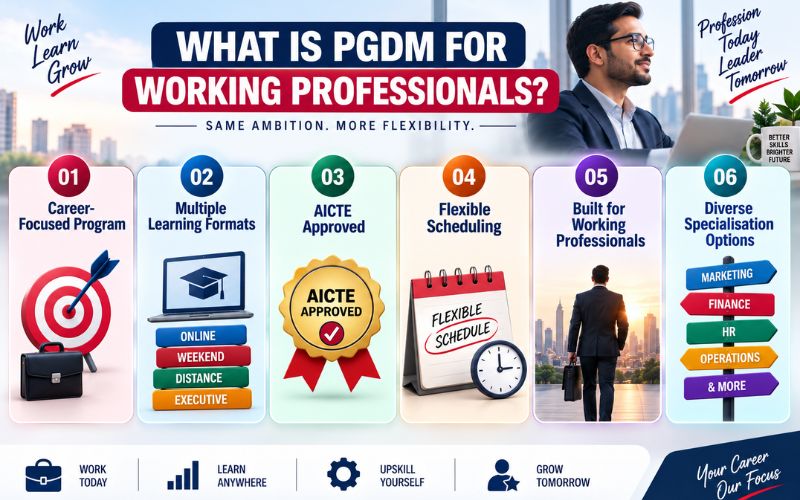
Core definition — A flexible, career-continuity-focused variant of the standard 2-year PGDM, designed specifically so learners don't need to pause full-time employment to pursue a management qualification
Delivery formats — Offered through online, distance, weekend, or executive/modular formats, differing from the traditional full-time, on-campus PGDM structure
AICTE approval — Like standard PGDM programs, these working-professional tracks are AICTE-approved, ensuring recognised credential status
Flexible scheduling advantage — A Distance PGDM specifically serves as a flexible option for students and working professionals to enhance their management skills without disrupting their current job
Distinct from standard fresher PGDM — While a regular PGDM often expects candidates straight out of undergraduate study, the working-professional variant is explicitly built around candidates already employed, with coursework and assessment schedules designed around that reality.
Diverse specialisation options — These programs offer a range of types and components, allowing students to select a program that best fits their academic background, professional goals, and preferred learning style
Why Choose PGDM for Working Professionals
Why Choose PGDM for Working Professionals?
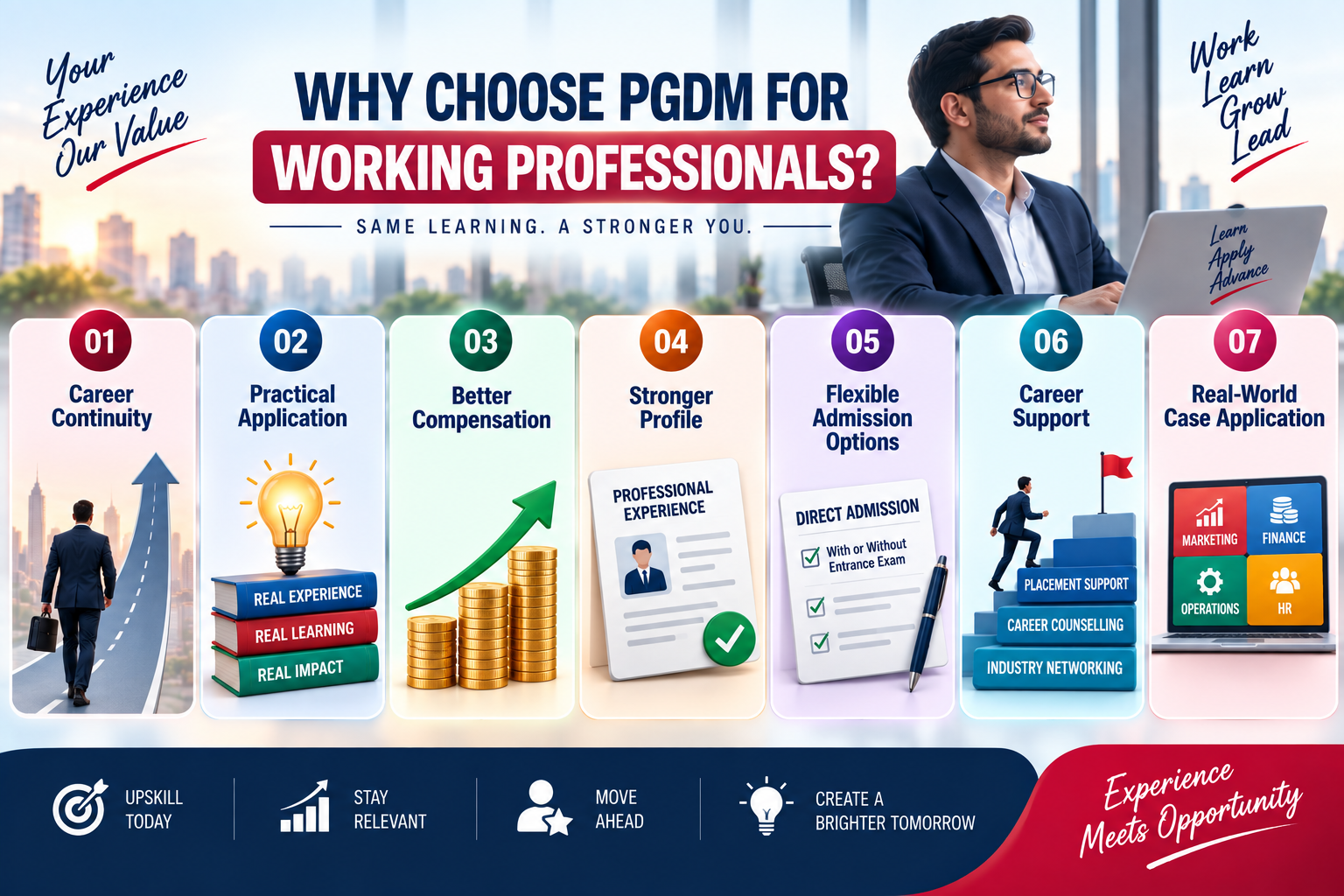
Career continuity — Allows professionals to upskill into management roles without sacrificing income or work experience during the study period.
Immediate practical application — Having 3-4 years of professional experience before applying can significantly enhance the value of your degree, leading toa better understanding of business concepts and higher chances of securing managerial roles
Improved compensation outcomes — Professionals with relevant work experience report improved salary packages after completing the program
Stronger overall profile — Work experience creates a stronger profile during the PGDM admission selection process, often improving interview outcomes.
Direct/flexible admission routes — Many professionals also explore PGDM Direct Admission or PGDM Admission Without Entrance Exam options if they meet institute-specific criteria, avoiding the need to sit a fresh competitive exam.m
Structured career support — Dedicated placement support, career counselling, interview preparation, and industry networking opportunities are commonly built into these programs.ms
Real-world case application — Coursework built around marketing, finance, operations, and HR gives working professionals the chance to apply concepts directly to their current job context, reinforcing learning
Eligibility Criteria for PGDM for Working Professionals
Base academic requirement — A minimum of 50% marks in graduation is the standard baseline eligibility across most institutes
Work experience requirement — Candidates must hold a bachelor's degree with at least 2-3 years of experience in a relevant field for most working-professional PGDM tracks
Program-specific variation — Some specialised tracks set higher thresholds — for example, MDI Gurgaon's PGDM-IB requires a minimum of one year of post-qualification work experience for 2026 admissions
Bachelor's degree requirement — A 3-year bachelor's degree (any discipline) from a recognised university is generally required, consistent with standard PGDM eligibility
No mandatory entrance exam at all institutes — Unlike full-time PGDM, several working-professional and online tracks admit based on academic record, work experience, and interview performance rather than requiring CAT/XAT/GMAT scores
Documentation required — Class XII mark sheet, graduation mark sheets, and a Resume/CV are among the core documents needed for application
Final selection step — Candidates are selected for PGDM Online courses after clearing a personal interview round, which evaluates both academic and professional readiness
Admission Process for PGDM for Working Professionals 2026
Step 1: Check eligibility — Confirm your bachelor's degree (50%+ aggregate) and relevant work experience meet your target institute's requirement — this varies from 1 year (MDI Gurgaon PGDM-IB) to 4+ years (SPJIMR's Executive programme)
Step 2: Register on the institute's official portal — Fill out the online application form directly through the institute's admissions website
Step 3: Submit required documents — Class XII mark sheet, graduation mark sheets, Resume/CV, and other supporting documents as specified
Step 4: Profile-based shortlisting — Several premium institutes (like SPJIMR) evaluate candidates through a profile-based shortlisting process rather than jumping straight to an entrance exam
Step 5: Written assessment (where applicable) — Some executive/weekend programmes include a written assessment round as part of shortlisting, in addition to or instead of a national entrance exam
Step 6: Personal Interview — Nearly all working-professional PGDM tracks conclude selection with a personal interview assessing both academic background and professional experience
Step 7: Offer and seat confirmation — Complete registration formalities and fee payment to confirm your seat
Step 8: Program commencement — Begin coursework in the weekend, online, or modular format designed around continued full-time employment
2026-27 cycle timing example — SPJIMR's PGDM admission cycle for its 2027-29 batch is expected to open around September 2026, illustrating how far in advance premium institutes plan their working-professional cohorts
Entrance Exams for PGDM for Working Professionals
CAT, XAT, GMAT, CMAT — Most top PGDM colleges (including those with working-professional tracks) accept scores from these national-level exams
No-CAT pathways available — Some institutes accept MAT, CMAT, NMAT, or their own internal tests instead of CAT, widening access for working professionals who haven't recently prepared for CAT specifically
Profile-based evaluation as an alternative — Premium executive programmes (like SPJIMR's PGPGM-Executive) rely more heavily on work experience, professional profile, and interview performance than on a fresh standardised test score
CAT cutoff reference point — For comparison, a full-time PGDM program like Welingkar Mumbai sets an overall CAT cutoff of 80 percentile across categories — working-professional tracks at the same institutes are often more flexible on this front
Institute-specific test requirements — Since exam acceptance varies significantly (CAT-only vs. MAT/CMAT/NMAT-accepting vs. no-exam-required), checking your specific shortlisted institute's admission page is essential before applying.
Top PGDM Colleges for Working Professionals in India
Top PGDM Colleges for Working Professionals in India
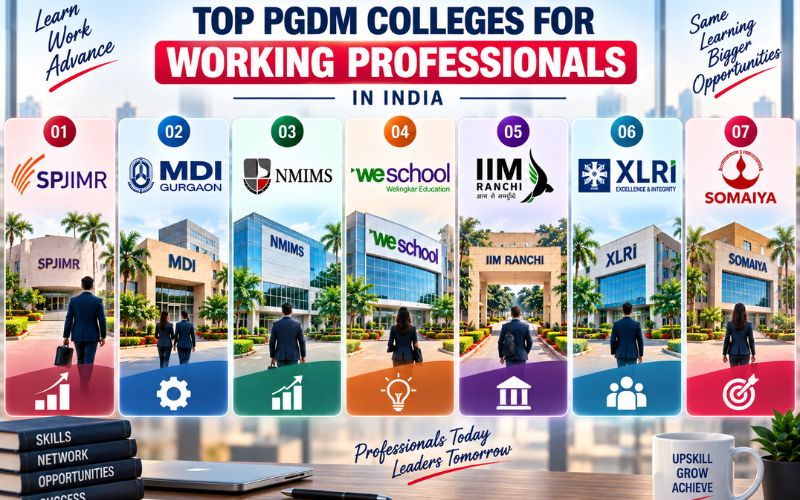
SPJIMR Mumbai — Offers the PGPGM-Executive programme (AICTE-approved diploma: 'PGDM – Executive Management Programme'); full-time PGDM fees run ₹4,69,500-11,25,000, with the executive track designed specifically for working professionals; also offered at SPJIMR Delhi
MDI Gurgaon — Offers PGDM-IB requiring a minimum of one year of post-qualification work experience for 2026 admissions
NMIMS Mumbai — Popular for career growth without a career break, part of Mumbai's strong management education cluster
Welingkar Mumbai (WeSchool) — Offers a distinctive Business Design PGDM program; full-time PGDM fees ₹14.04 lakh total; ranked 74th nationally per Collegedunia Management Ranking 2025 and 41st per India Today Management Ranking 2024
IIM Ranchi, IIM Visakhapatnam — Government IIMs increasingly offering flexible/executive-track PGDM options; IIM Ranchi's broader PGDM fee range spans ₹99,000-17,20,000
XLRI Jamshedpur, MDI Gurgaon, SPJIMR — Known for excellent placements overall, with average salary packages rangingfrom ₹20-30 LPA across their programs (including working-professional tracks where applicable)
K J Somaiya — Emerging strongly with a focus on innovation, analytics, and corporate engagement, suited for managerial and consulting-track professionals
Best Online PGDM for Working Professionals
Fee range for online PGDM/MBA nationally — ₹1-20 lakh depending on institute, offering flexibility across budget levels
Providers — Online MBA/PGDM programs are offered by a few IIMs, top PGDM colleges like XLRI Jamshedpur and MDI Gurgaon, and universities like NMIMS, Symbiosis, and IGNOU
Additional recognised providers — Amity University, ICFAI University, and Chandigarh University also offer popular online MBA/PGDM options.
NMIMS — Particularly beneficial for professionals looking for career growth without taking a career break, offering strong brand value and flexibility
Mumbai University IDOL — One of the most affordable options nationally for distance/online MBA aspirants, valued for its accessibility and credibility
Welingkar — Known for offering affordable and skill-oriented management education specifically suited to working professionals
Delivery format — AICTE-approved online PGDM programs typically include live classes, recorded sessions, and industry projects, blending flexibility with practical learning.
Recognition validity — An Online MBA/PGDM from a UGC-DEB approved or AIU-recognized institute is fully valid and recognised across India, equivalent in standing to a regular MBA degree
Best Weekend & Executive PGDM Programmes
Best Weekend & Executive PGDM Programmes
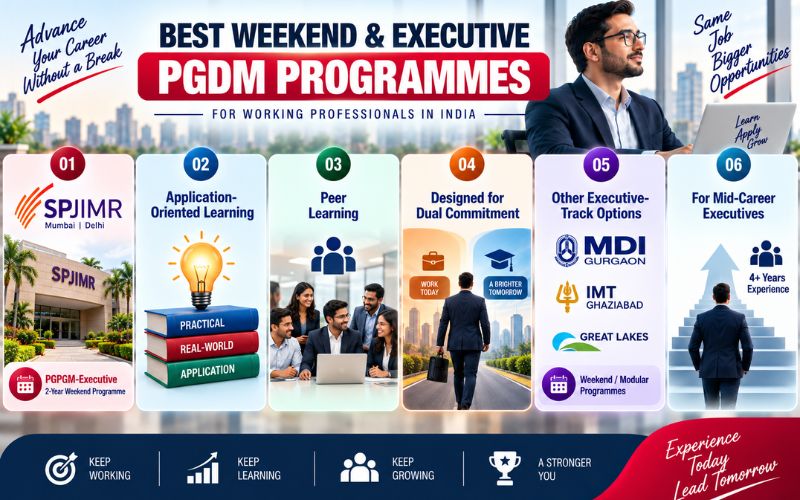
SPJIMR PGPGM-Executive — A two-year weekend programme specifically designed for working professionals with 4+ years of experience who want an Executive MBA-equivalent qualification without taking a career break; culminates in the AICTE-approved 'PGDM – Executive Management Programme' diploma; offered at both SPJIMR Mumbai and Delhi campuses
Application-oriented pedagogy — SPJIMR's world-class faculty deploys a unique application-oriented teaching style that directly relates classroom activities and assignments to each participant's real work context
Peer learning value — Stimulating classroom discussions with a cohort of highly experienced co-learners from diverse industries expose participants to a broad range of professional perspectives
Designed for dual commitment — The programme structure enables participants to maximise new learning while continuing to excel in their day jobs and simultaneously expanding their professional network
Other executive-track options — MDI Gurgaon's PGDM-IB and similar programmes at institutes like IMT Ghaziabad and Great Lakes also offer weekend/modular formats suited to mid-career executives.
General category distinction — Executive PGDM programmes are specifically positioned for mid-career executives (typically 4+years's experience), distinct from standard "Part-time PGDM" tracks aimed at slightly earlier-career working professionals.
PGDM for Working Professionals: Course Duration
PGDM for Working Professionals: Course Duration
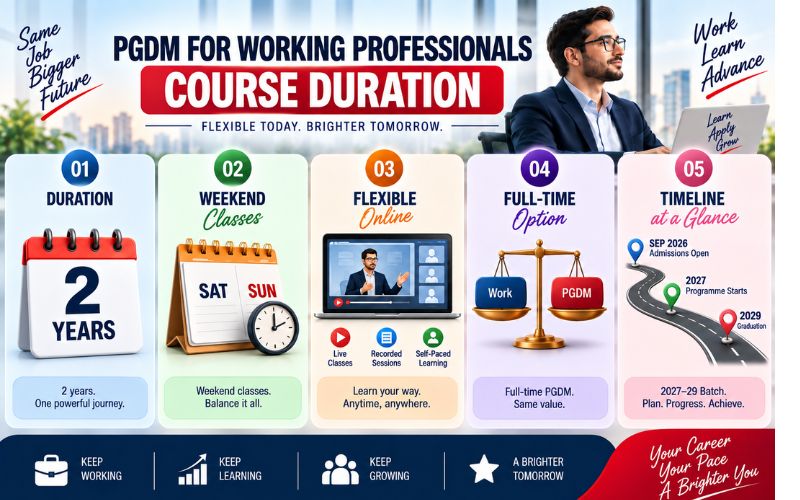
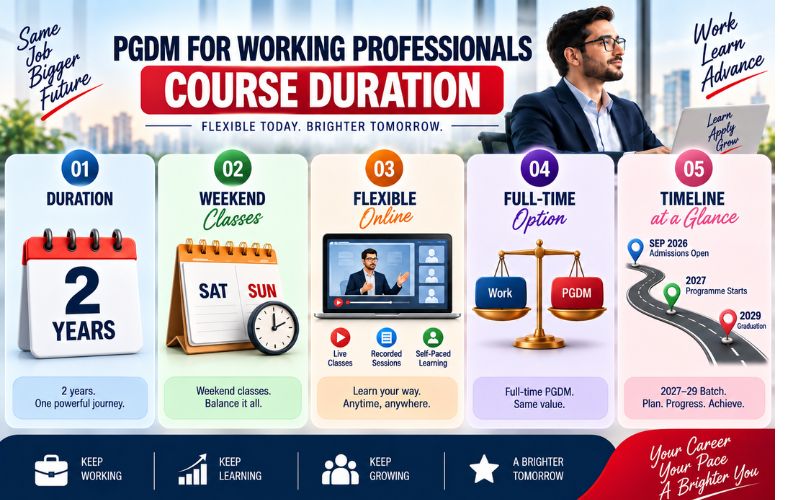
Standard duration — 2 years, consistent across nearly all working-professional PGDM tracks (SPJIMR's PGPGM-Executive, standard online PGDM programs, and most weekend formats)
Weekend format structure — Programmes like SPJIMR's Executive track are specifically structured to run on weekends over the full 2-year period, allowing continuous full-time employment
Online/distance format flexibility — While the overall duration remains 2 years, online and distance PGDM programs offer more flexible pacing through live classes, recorded sessions, and self-paced modules compared to fixed weekend schedules
Comparison to full-time PGDM — Standard full-time, on-campus PGDM programs also run 2 years, meaning the working-professional variant doesn't typically extend total program length — it changes the delivery format (weekend/online) rather than the overall duration.n
Admission-to-completion cycle example — SPJIMR's upcoming batch cycle (admissions opening around September 2026) is expected to run as a 2027-29 batch, illustrating the standard 2-year completion timeline from intake to graduation
PGDM for Working Professionals: Fees
Overall national fee range — ₹4-15 lakh for the full 2-year duration across most PGDM/PGDMM programs, with online-specific options starting even lower
Online PGDM/MBA fee range — ₹1-20 lakh depending on institute, offering broad flexibility across budget levels
Full-time PGDM benchmark (for comparison) — ₹4-24 lakh, useful as a reference point since working-professional tracks at the same institutes often price close to their full-time counterparts
Premium institute examples — SPJIMR: ₹4,69,500-11,25,000; Welingkar Mumbai: ₹14.04 lakh total (including ₹4,000 other fees, with ₹7.04 lakh payable in year one); IIM Ranchi: ₹99,000-17,20,000
Top-tier PGDM range (XLRI, SPJIMR, MDI) — ₹15-25 lakh, while mid-range colleges like IMT Ghaziabad and Great Lakes typically fall in the ₹10-20 lakh range
Affordable options — Mumbai University IDOL remains one of the most affordable distance/online options nationally, while Welingkar is known for offering relatively affordable, skill-oriented management education.on
Fee inclusions caveat — Fees at premium institutes like SPJIMR typically include tuition and basic hostel accommodation for Indian participants, but mess charges, travel, and personal expenses are usually additional — always check whether a quoted figure is all-inclusive or tuition-only
Scholarships available — Many top PGDM colleges, including SPJIMR, XLRI, and IMI, offer merit-based scholarships, need-based financial aid, and scholarships for specific categories like economically disadvantaged students.nts
Popular PGDM Specialisations for Working Professionals
Popular PGDM Specialisations for Working Professionals
Marketing — One of the most widely offered specialisations across nearly all institutes
Finance — Consistently popular given its direct relevance to corporate roles across sectors
Human Resource Management (HRM) — Widely available, particularly relevant for professionals already working in HR-adjacent roles
Operations Management — A core specialisation aligned with manufacturing, supply chain, and process-management careers
Business Analytics — A fast-growing specialisation reflecting current industry demand for data-driven decision-making skills
Information Technology — Offered at several institutes, suited for tech-sector professionals seeking a management overlay on their technical background
Elective options — Digital Marketing, International Business, Data Analytics, and Supply Chain Management are commonly available as electives alongside the core specialisations
International Business (PGDM-IB) — A specific specialisation track (e.g., at MDI Gurgaon) requiring at least one year of post-qualification work experience for 2026 admissions
General Management — The broadest track, especially popular in executive/weekend formats like SPJIMR's PGPGM-Executive, suited for professionals seeking a well-rounded leadership qualification rather than a narrow functional specialisation
PGDM for Working Professionals: Syllabus
PGDM for Working Professionals: Syllabus
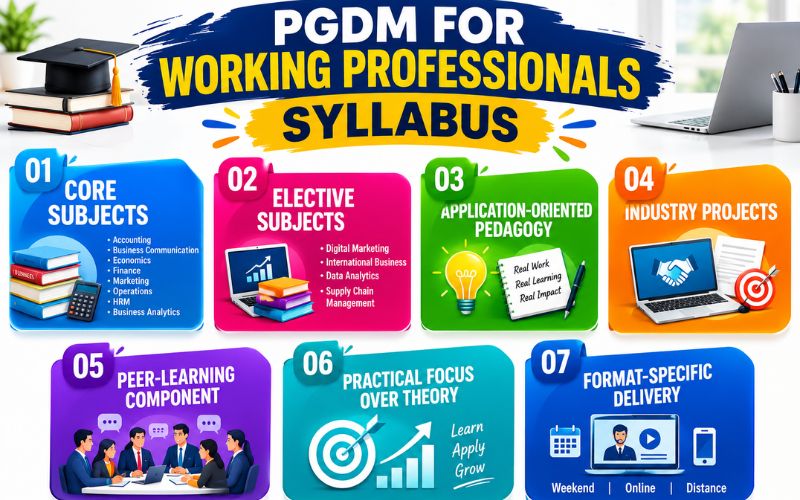
Core subjects — Accounting, Business Communication, Economics, Finance, Marketing, Operations, HRM, and Business Analytics form the standard core curriculum.
Elective subjects — Digital Marketing, International Business, Data Analytics, and Supply Chain Management are commonly offered as electives, allowing customisation based on career goals.
Application-oriented pedagogy — At institutes like SPJIMR, faculty specifically design coursework and assignments to relate directly to each participant's real work context, rather than following a purely theoretical approach
Industry projects — AICTE-approved online PGDM programs typically incorporate industry projects alongside live and recorded classes, ensuring practical, real-world skill application.n
Peer-learning component — Classroom discussions with a cohort of experienced co-learners from diverse industries are a deliberate curriculum feature, exposing participants to varied professional perspectives beyond the syllabus itself.lf
Practical focus over theory — Compared to traditional MBA programs, PGDM curricula (including working-professional tracks) are generally more industry-oriented and updated regularly to match current business practices, rather than following a fixed academic framework .ork
Format-specific delivery — Weekend programmes deliver this syllabus through concentrated weekend sessions over 2 years, while online/distance formats spread the same core content across live classes, recorded sessions, and self-paced modules
PGDM vs MBA for Working Professionals
Curriculum orientation — PGDM focuses on practical learning and an industry-oriented curriculum offered by AICTE-approved autonomous institutions, while MBA is university-affiliated and tends to be more theoretical
Governing body — PGDM programs are approved and regulated by AICTE (All India Council for Technical Education), while MBA degrees are awarded by universities under UGC oversight.
Degree vs. diploma distinction — MBA is a formal university degree; PGDM is a diploma, though a PGDM from an AIU-recognized institute is considered equivalent to an MBA degree for most practical purposes.
Curriculum update frequency — PGDM curricula are typically updated more frequently to match current industry standards, since autonomous institutes aren't bound by university syllabus revision cycles.
Placement and industry exposure — If industry exposure and a placement-driven curriculum are your priorities, PGDM is often considered the stronger choice in India specifically for this reason
Recognition validity — An Online MBA or PGDM from a UGC-DEB approved or AIU-recognized institute is fully valid and recognised across India, regardless of which format you choose
Which to choose for working professionals — PGDM (especially executive/weekend tracks like SPJIMR's PGPGM-Executive) tends to suit professionals prioritising direct industry relevance and flexible, practice-oriented learning, while MBA suits those who specifically want a formally conferred university degree.
PGDM for Working Professionals Without Entrance Exam
Direct admission routes exist — Many professionals explore PGDM Direct Admission or PGDM Admission Without Entrance Exam options if they meet institute-specific eligibility criteria, avoiding the need to sit a fresh competitive ex.am
Profile-based shortlisting alternative — Premium institutes like SPJIMR evaluate candidates for executive tracks through a profile-based shortlisting process, followed by written assessment and interview rounds — bypassing a traditional CAT/XAT score requirement
Work experience as the key qualifying factor — For no-entrance-exam pathways, sufficient relevant work experience (often 3-4+ years) combined with a strong academic record and interview performance typically substitutes for a standardised test score.ore
Fresh graduates still need standard eligibility — Those without meeting a no-exam institute's specific work-experience threshold may still need to meet standard PGDM eligibility (50% marks in graduation) and, in many cases, an entrance exam s.core
Institute-specific verification essential — Since "without entrance exam" eligibility criteria vary significantly by institute, confirming the exact work-experience and academic thresholds directly with your shortlisted college is necessary before assuming you qualify for a no-exam pa.thway
Career Opportunities After PGDM
Career Opportunities After PGDM
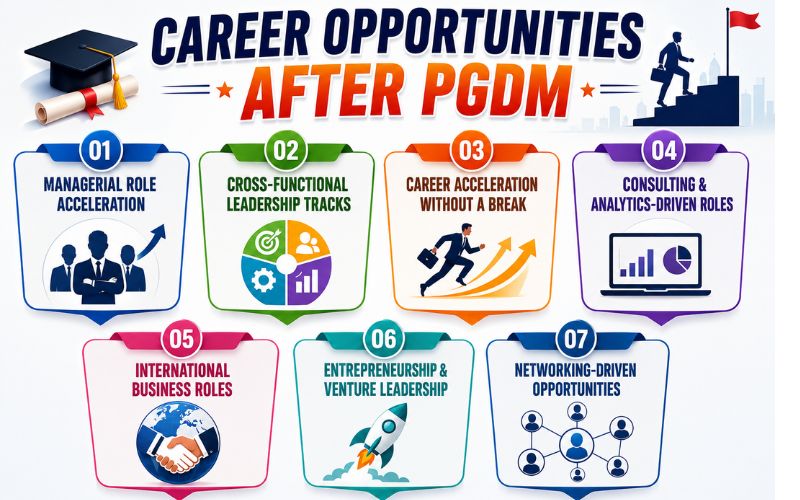
Managerial role acceleration — Working professionals with 3-4 years of experience before enrolling typically see significantly higher chances of securing managerial roles post-completion, compared to those without prior work experience
Cross-functional leadership tracks — Given the specialisation breadth (Marketing, Finance, HRM, Operations, Business Analytics, IT), graduates can move into leadership roles across nearly any business function within their existing industry
Career acceleration without a break — Since most working-professional PGDM formats (weekend, online, executive) don't require pausing employment, graduates often secure internal promotions or lateral moves into management roles at their current organisation during or immediately after the program
Consulting and analytics-driven roles — Business Analytics and Data Analytics specialisations align well with growing demand for data-driven decision-making roles across s.ectors
International Business roles — Specialisations like PGDM-IB (offered at institutes like MDI Gurgaon) open pathways into export-import, global trade, and multinational corporate roles
Entrepreneurship and venture leadership — The practical, industry-oriented nature of PGDM curricula also supports graduates who want to launch or scale their own ventures using newly acquired management frameworks
Networking-driven opportunities — Peer cohorts of experienced professionals from diverse industries (a deliberate feature at institutes like SPJIMR) often translate into genuine cross-industry career opportunities beyond the immediate job search.
PGDM for Working Professionals: Salary & Career Growth
Reported average package — Online/working-professional PGDM programs report average packages reaching up to ₹12,00,000 per annum as of 2025 data
Top-tier institute benchmark (for context) — Graduates from top PGDM colleges like XLRI, SPJIMR, and MDI Gurgaon can expect average salaries rangingfrom ₹ 18- 333 LPA, though this reflects primarily full-time program outcomes rather than working-professional-track-specific figures
Improved compensation with prior experience — Professionals who already had 3-4 years of experience before enrolling report meaningfully improved salary packages after completing the program, compared to those without pre-existing work experience
Career growth beyond salary alone — Benefits extend beyond compensation to include a better understanding of business concepts, higher chances of securing managerial roles, and a stronger overall professional profile
Placement support structure — Dedicated placement support, career counselling, interview preparation, and industry networking opportunities are commonly built into these programs, supporting both internal promotions and external job transitions..
Growth trajectory consideration — Since many working professionals pursue PGDM specifically to accelerate an existing career path rather than pivot entirely, salary growth often shows up as promotion-linked increases at the current employer rather than purely as a fresh-market starting salary
Top Recruiters After PGDM
Consulting and professional services firms — Actively recruit PGDM graduates, particularly from top-ranked institutes with strong industry-oriented curricula.
Banking and financial services — A consistent recruiting sector across PGDM programs, especially for Finance-specialisation graduates
IT and technology companies — Recruit PGDM graduates into techno-managerial and product/project management roles, particularly those with an Information Technology or Business Analytics specialisation
FMCG and consumer goods companies — Regular recruiters for Marketing-specialisation PGDM graduates
Manufacturing and operations-heavy industries — Recruit Operations Management specialisation graduates into supply chain and process-management leadership roles
Multinational corporations (via International Business track) — Recruit PGDM-IB graduates into global trade, export-import, and cross-border management roles
Internal promotion "recruiter" — For many working professionals, their existing employer effectively becomes the primary "recruiter," using the PGDM credential to justify internal promotion into management-track roles rather than an external job switch
Since exact recruiter lists vary significantly by institute reputation and specialisation, checking your shortlisted college's specific placement report or recruiter partnerships is more reliable than relying on generic industry-wide assumptions
ROI of PGDM for Working Professionals
Fee vs. salary consideration — With online/working-professional PGDM fees generally ranging ₹1-15 lakh and reported average packages reaching up to ₹12 lakh per annum, many programs offer a genuinely fast payback period, particularly for professionals who secure a promotion during or shortly after the program.
No career-break advantage — Since most working-professional formats don't require pausing employment, there's no opportunity cost of lost salary during the study period — a meaningful ROI advantage over full-time programs that require quitting a job
Work-experience multiplier effect — Candidates entering with 3-4 years of prior experience see amplified ROI, since the combination of existing domain expertise and new management credentials creates a stronger case for promotion or lateral career moves
Premium institute trade-off — Higher-fee options (SPJIMR's ₹4.69-11.25 lakh range, Welingkar's ₹14 lakh) offer stronger brand recognition and placement/promotion leverage, but require weighing the higher upfront cost against your specific career acceleration goals
Affordable options preserve strong ROI too — Institutes like Mumbai University IDOL and Welingkar's more budget-friendly offerings can deliver solid ROI for professionals prioritising credential recognition over premium brand name.
Scholarship impact on ROI — Merit-based and need-based scholarships available at institutes like SPJIMR, XLRI, and IMI can further improve ROI by reducing upfront cost without compromising credential quality
General ROI trend — Given the combination of no lost income during study, relatively moderate fees compared to full-time MBA programs, and direct promotion potential at your current employer, working-professional PGDM programs often deliver among the fastest payback periods across all postgraduate management education formats
How to Choose the Best PGDM Programme for Working Professionals
Match format to your work schedule — Decide between weekend (SPJIMR PGPGM-Executive), fully online, or hybrid formats based on what realistically fits alongside your current job's demands
Check AICTE approval and AIU equivalency — Ensure your shortlisted institute's PGDM is AICTE-approved and, ideally, AIU-recognized as MBA-equivalent for maximum credential portability
Confirm work-experience eligibility threshold — Since requirements range from 1 year (MDI Gurgaon PGDM-IB) to 4+ years (SPJIMR Executive), make sure your current experience level aligns with your target programme
Compare total cost, not just tuition — Check whether quoted fees include hostel, mess, and other charges (as clarified at SPJIMR) or are tuition-only, to avoid budget surprises
EEvaluate specialisationfit to your career goals — Choose a specialisation (Marketing, Finance, Business Analytics, Operations, International Business) that directly supports your intended career trajectory, whether that's internal promotion or an external move
Check for no-entrance-exam pathways if relevant — If you don't want to prepare for CAT/XAT fresh, look at institutes offering direct admission or profile-based shortlisting based on your work experience
Look at placement and promotion outcomes, not just brand name — Ask specifically about outcomes for working-professional cohorts (internal promotions, salary increments) rather than relying solely on full-time program placement statistics.
Talk to current or past working-professional cohort participants — Since much of the value of these programs comes from peer networking and real-world application, first-hand feedback from someone who balanced the program with full-time work is especially valuable
Frequently Asked Questions (FAQs)
Q1. Is PGDM for working professionals equivalent to a regular MBA?
Yes, a PGDM from an AIU-recognized, AICTE-approved institute is considered equivalent to an MBA degree, even when pursued through a weekend, online, or executive format.
Q2. Do I need to quit my job to pursue PGDM as a working professional?
No, that's the entire point of these programs — weekend, online, and executive formats (like SPJIMR's PGPGM-Executive) are specifically designed so you can continue working full-time throughout the 2-year duration.
Q3. Is CAT mandatory for PGDM admission as a working professional?
Not always — many institutes accept MAT, CMAT, or NMAT scores instead, while premium executive programmes often rely on profile-based shortlisting, written assessments, and interviews rather than a fresh CAT score, especially for candidates with 3-4+ years of experience.
Q4. What is the average fee for PGDM for working professionals?
Fees typically range from ₹1-15 lakh for online/working-professional tracks, though premium institutes like SPJIMR (₹4.69-11.25 lakh) and Welingkar (₹14 lakh) sit at the higher end.
Q5. What is the average salary after completing PGDM as a working professional?
Reported average packages reach up to ₹12 lakh per annum, with meaningfully better outcomes for candidates who already had 3-4 years of experience before enrolling.
Q6. How much work experience do I need for PGDM as a working professional?
It varies by institute and track — some require as little as 1 year (MDI Gurgaon's PGDM-IB), while executive-focused programmes like SPJIMR's PGPGM-Executive expect 4+ years.
Q7. Which is better for working professionals — PGDM or MBA?
It depends on priorities: PGDM is generally more industry-oriented, practical, and placement-driven, while MBA is a formal university degree that's more theory-focused — both are well-recognised qualifications when pursued through accredited institutes.
Q8. Can I pursue a top-tier PGDM without taking a career break?
Yes, institutes like SPJIMR, MDI Gurgaon, NMIMS, and Welingkar all offer working-professional-friendly formats (weekend, online, or executive tracks) specifically so you don't need to pause your career.
Conclusion
PGDM for working professionals has become one of the most practical pathways for career-focused Indians to earn a genuinely valuable management credential without sacrificing income or professional momentum. With formats ranging from SPJIMR's intensive weekend PGPGM-Executive to fully online options from NMIMS, Welingkar, and Mumbai University IDOL, professionals across experience levels and budgets — from ₹1 lakh distance programs to premium ₹14+ lakh executive tracks — can find a genuinely suitable option. What sets these programs apart isn't just flexibility; it's the compounding ROI advantage of applying new management frameworks directly to your current job in real time, often translating into internal promotions or stronger external offers well before the two years are even complete.
Enter Your Details to Unlock Eligibility
Get personalized college recommendations and scholarship opportunities