Get Your College logo
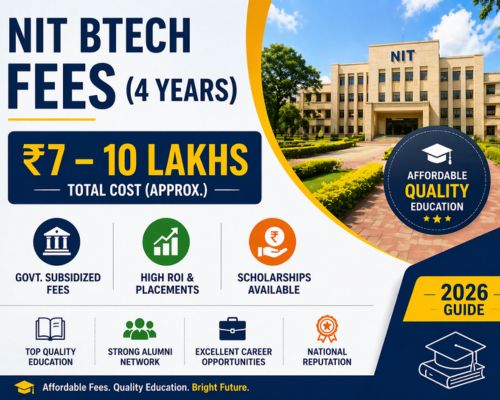
NIT BTech fees 4 years infographic showing total cost ₹7 to ₹10 lakhs with government subsidized education and high ROI benefits.

NIT Fees for 4 Years BTech 2026: Complete Fee Structure, Hostel Cost, Scholarships & ROI Guide

April 23, 2026

Planning to join an NIT but confused about the total cost of a 4-year BTech? You’re not alone. Many students focus only on tuition fees, but the real cost includes hostel, mess, and other expenses.

The good news? Compared to private colleges, National Institutes of Technology (NITs) offer top-quality engineering education at a much more affordable cost, with strong placement outcomes.

In this guide, you’ll get a complete breakdown of NIT fees for 4 years BTech. along with scholarships, eligibility, and ROI in 2026.

What are NITs?

NITs (National Institutes of Technology) are a group of top-tier government engineering institutes in India, known for delivering high-quality technical education at an affordable cost. These institutes are recognised as Institutes of National Importance, which means they play a key role in India’s engineering and technological development.

For students who want a balance of quality education, strong placements, and lower fees, NITs are one of the best options after IITs.

Why NITs Stand Out

  • High-Quality Education
    NITs follow a well-structured curriculum with experienced faculty, modern labs, and industry-focused learning.
  • Strong Placement Records
    Top companies like Google, Microsoft, and TCS regularly hire from NITs, offering attractive salary packages.
  • Affordable Fee Structure
    Being government-funded, NITs provide education at a much lower cost compared to private colleges.
  • National-Level Reputation
    NITs are highly respected across India and recognised globally for their academic excellence.

Key Insights 

  • Government-backed institutes = high trust + credibility
  • Lower fees + strong placements = excellent ROI
  • Top recruiters = better career opportunities
  • Second only to IITs in India’s engineering ecosystem, NITs offer a powerful combination of affordability, quality education, and strong career outcomes, making them a top choice for engineering aspirants in India.

  • NIT Fees Structure for 4 Years BTech (2026)

If you’re planning for NIT, here’s the reality: tuition fees are just one part of the total cost. The real investment includes hostel, mess, and other charges.

Let’s break it down.

Tuition Fees

  • ₹62,500 per semester
  • ₹1,25,000 per year

👉 4-Year Total: ₹5,00,000

Insight: This is the core academic cost, and it’s heavily subsidised by the government.

Hostel Fees

  • ₹20,000 – ₹40,000 per year

👉 4-Year Total: ₹80,000 – ₹1,60,000

Insight: Varies by campus and room type, but still budget-friendly.

Mess Charges

  • ₹3,000 – ₹5,000 per month

👉 4-Year Total: ₹1.5 – ₹2.5 Lakhs

Insight: This is your biggest living expense over time.

Other Charges

  • ₹10,000 – ₹20,000 per year

👉 Total: ₹40,000 – ₹80,000

Insight: Includes labs, exams, and campus facilities.

Total NIT Cost (4 Years)

👉 ₹7 Lakhs – ₹10 Lakhs (All-In Cost)

Key Takeaways (Backlinko Style)

  • ₹5L = Tuition (fixed core cost)
  • ₹2L–₹4L = Living expenses (hostel + mess)
  • Total cost = far lower than that of private colleges
  • Strong placements = high ROI degree

👉 Bottom Line:
NITs deliver a premium engineering degree at a fraction of private college costs. If you’re looking for maximum ROI with minimum financial burden, this is one of the smartest choices you can make.

Key Highlights of NIT Fees

Here’s the simple truth: NITs are designed to deliver top-tier engineering education without the premium price tag. That’s exactly why they offer one of the best value-for-money degrees in India.

What Makes NIT Fees Stand Out

  • Much Cheaper Than Private Colleges
    While private engineering colleges can cost ₹15–₹25 Lakhs, NITs typically fall in the ₹7–₹10 Lakhs range—almost half the cost.
  • Government-Subsidised Education
    Tuition fees are partially funded by the government, which keeps education accessible and affordable for students.
  • Multiple Scholarship Options Available
    From SC/ST fee waivers to income-based concessions and central scholarships, many students pay significantly reduced fees.
  • High ROI Due to Strong Placements
    With average packages ranging from ₹6–₹12 LPA, students often recover their investment quickly after graduation.

Key Takeaways (Backlinko Style)

  • Lower cost + strong placements = high ROI
  • Government support = affordable education
  • Scholarships = reduced financial burden
  • Better value than most private colleges

👉 Bottom Line:
NIT fees aren’t just affordable—they’re strategically structured to give you a high-quality education with maximum return on your investment.

Scholarships & Fee Waivers in NITs

Here’s the part most students miss: you may not have to pay the full NIT fees. With the right category and income eligibility, your cost can drop significantly.

Available Benefits

  • Full Fee Waiver for SC/ST Students
    Tuition fees are completely waived for eligible SC/ST candidates in most NITs.
  • Income-Based Fee Reduction (EWS/OBC)
    Students from lower-income families can get partial or major fee reductions based on annual income criteria.
  • Central & State Government Scholarships
    Schemes like NSP and state scholarships provide financial support for tuition, hostel, and other expenses.

Key Insights 

  • Many students don’t pay full fees
  • Income criteria = big cost advantage
  • Scholarships can cover tuition + living expenses
  • Proper application = maximum savings

If you apply smartly, you can reduce your NIT fees by 50% to even 100%. Don’t ignore scholarships—they can make a huge difference in your total investment.

Eligibility for BTech in NIT 12th with PCM (Physics, Chemistry, Math,) Qualify JEE Main ex, am Participate in JoScounsellingiIsakesake liye bhi likh do

Eligibility for BTech in NIT

Getting into an NIT isn’t complicated—but it is competitive. You need the right academic background + a strong JEE Main score.

Here’s exactly what you need.

Basic Eligibility Requirements

  • 12th with PCM (Physics, Chemistry, Mathematics)
    You must complete your Class 12 with core science subjects. Most NITs require a minimum percentage (usually 75% or equivalent criteria).
  • Qualify JEE Main Exam
    Admission to NITs is strictly based on your JEE Main rank. The better your rank, the higher your chances of getting top NITs and branches.
  • Participate in JoSAA Counselling
    After JEE Main, you must register for JoSAA (Joint Seat Allocation Authority) counselling to secure your seat.

Key Insights 

  • PCM in 12th = mandatory foundation
  • JEE Main rank = make-or-break factor
  • JoScounsellinging = final admission step
  • Better rank = better college + branch options

To get into an NIT, focus on strong PCM basics and high JEE Main performance. Crack this, and you unlock one of the best engineering opportunities in India.

NIT vs Private College Fees

When it comes to engineering, the biggest difference between NITs and private colleges is cost vs return on investment (ROI).

Fee Comparison

TypeTotal Cost (4 Years)
NIT₹7–₹10 Lakhs
Private Colleges₹15–₹25 Lakhs

What This Means

  • NITs
    Offer high-quality education at a much lower cost, thanks to government subsidies. You pay less but still get strong placements.
  • Private Colleges
    Charge significantly higher fees, but the return depends heavily on the college’s reputation and placement record.

Key Insights 

  • NIT = lower cost + strong placements
  • Private colleges = higher cost, variable ROI
  • NIT graduates recover fees faster due to better packages
  • Best choice depends on rank, budget, and career goals

If you’re looking for maximum ROI with minimum investment, NITs clearly have the edge over most private engineering colleges.

Career Scope After BTech from NIT

A BTech from an NIT doesn’t just give you a degree—it opens doors to multiple high-growth career paths. Thanks to strong academics, campus placements, and industry exposure, NIT graduates are highly valued across sectors.

Top Career Opportunities

  • Software Engineer
    One of the most popular paths. Top companies hire NIT graduates for roles in development, testing, and system design.
  • Data Analyst / Data Scientist
    With the rise of AI and analytics, students can move into data-driven roles with strong salary growth.
  • Core Engineering Jobs
    Mechanical, Civil, Electrical, and other core branches offer roles in top companies, PSUs, and manufacturing sectors.
  • Government Jobs
    Many students prepare for exams like UPSC, GATE, SSC, and PSU recruitment for stable and prestigious careers.
  • Higher Studies (MTech, MBA, MS Abroad)
    Students often pursue advanced degrees in India or abroad to specialise and boost career opportunities.

Key Insights (Backlinko Style)

  • NIT = multiple career paths, not just one
  • IT + Data roles offer the highest salaries
  • Core jobs + government roles = stability + growth
  • Higher studies = long-term career boost. An NIT degree gives you flexibility and strong career options—whether you want a high-paying tech job, a stable government role, or global opportunities through higher studies.

Average Salary After NIT

One of the biggest advantages of studying in an NIT is the strong placement outcome, which directly impacts your return on investment.

  • Average Package: ₹6 LPA – ₹12 LPA
  • Top NITs: ₹15 LPA+
  • Highest Packages: ₹40 LPA+

👉 What this means: Even with a total investment of ₹7–₹10 Lakhs, many students recover their fees within the first few years of working.

Key Insights (Backlinko Style)

  • ₹6–₹12 LPA = solid starting salary
  • Top NITs = premium salary advantage
  • High packages = excellent ROI potential

  • NITs offer one of the best salary-to-fee ratios, making them a smart investment for engineering aspirants.

  • Benefits of Studying in NIT

NITs are not just affordable—they provide a complete ecosystem for career growth and skill development.

Key Benefits

  • Affordable Fees
    Government-funded structure makes quality education accessible.
  • Strong Placement Network
    Top companies regularly recruit from NIT campuses.
  • Industry Exposure
    Internships, projects, and training programs prepare students for real-world challenges.
  • Alumni Network
    A strong alumni base helps in networking, mentorship, and career opportunities.
  • Government Recognition
    NITs are among India’s most respected engineering institutes.

Key Insights (Backlinko Style)

  • Low cost + strong placements = high value degree
  • Industry exposure = job-ready skills
  • Alumni network = career growth advantage

NITs provide a perfect balance of affordability, quality education, and career opportunities.

NITs are evolving rapidly to match industry demands and global standards.

  • Growth in AI & Data Science Courses
    New-age technologies are becoming core parts of the curriculum.
  • Increased Startup Culture
    More students are launching startups with support from incubation centres.
  • International Collaborations
    Partnerships with foreign universities are increasing global exposure.
  • Focus on Skill-Based Learning
    Practical learning, coding, and real-world projects are gaining importance.

Key Insights (Backlinko Style)

  • AI & Data Science = future-focused education
  • Startups = entrepreneurial growth
  • Skills > theory = industry readiness

In 2026, NITs are not just engineering colleges—they are becoming innovation and skill development hubs.

Pros and Cons of Studying in NIT

Before choosing any college, it’s important to look at both sides.

Pros

  • Affordable Education
  • High ROI
  • Strong Placement Opportunities

Cons

  • Highly Competitive Admission (JEE Main)
  • Hostel Availability Issues in Some NITs
  • Fees Slightly Increased in Recent Years

Key Insights (Backlinko Style)

  • Pros clearly outweigh cons for most students
  • Main challenge = getting admission
  • Once inside, opportunities are highly rewarding

If you can clear the entrance barrier, NITs offer one of the best engineering experiences in India with strong long-term benefits.

Common Mistakes to Avoid While Planning for NIT

Getting into an NIT is a big achievement—but many students still make avoidable mistakes that impact their financial planning, career direction, and overall experience. Avoiding these errors can save you time, money, and stress.

Mistakes You Should Avoid

  • Ignoring the Total Cost (Hostel + Mess + Other Expenses)
    Many students only look at tuition fees and forget about living costs. This leads to poor financial planning later. Always calculate the complete 4-year investment.
  • Not Applying for Scholarships
    A large number of students miss out on scholarships simply because they don’t apply. This can cost you lakhs of rupees unnecessarily.
  • Choosing Branch Over Interest
    Selecting a branch just for reputation (like CSE) without a genuine interest can lead to poor performance and a lack of career satisfaction.
  • Poor JEE Preparation Strategy
    Studying without a clear plan, consistency, or proper guidance can reduce your chances of getting into top NITs.

Key Insights (Backlinko Style)

  • Small mistakes = big long-term impact
  • Financial planning = must for 4 years
  • Interest > hype when choosing a branch
  • Strategy matters more than hard work alone

Avoiding these common mistakes can make your NIT journey smoother, more affordable, and more successful.

Expert Tips to Crack NIT & Maximise ROI

Success in NIT admission and career isn’t just about hard work—it’s about smart planning and execution. Here are some proven strategies that can give you an edge.

Detailed Breakdown of NIT Fee Components

When people talk about NIT fees, they usually mention tuition. But the actual cost is a combination of multiple components, and understanding each one helps you plan your budget better.

Main Fee Components

  • Tuition Fees
    The largest portion is usually ₹62,500 per semester for General/OBC students.
  • Hostel Fees
    Covers room rent, maintenance, and basic facilities.
  • Mess Charges
    Monthly food expenses depend on consumption and hostel rules.
  • Institute Fees
    Includes library, lab, internet, and student activity charges.
  • One-Time Charges
    Admission fee, caution deposit (refundable), and registration charges.

Key Insights  

  • Tuition ≠ total cost
  • Hidden charges can add ₹2–₹4 Lakhs extra
  • Always calculate all components before deciding

👉 Bottom Line: The real NIT cost is a combination of academic + living expenses, not just tuition fees.

Semester-Wise Fee Structure in NITs

NITs follow a semester-based payment system, which makes it easier for students to manage finances instead of paying everything at once.

How It Works

  • Fees are paid every 6 months (per semester)
  • Each semester includes:
    • Tuition fee
    • Hostel fee (if applicable)
    • Mess advance
    • Miscellaneous charges

👉 Average Per Semester Cost: ₹80,000 – ₹1.5 Lakhs

Key Insights  

  • Pay in parts = better financial planning
  • First semester cost is usually higher (one-time charges included)
  • Later semesters are slightly cheaper

👉 Bottom Line: Semester-wise payment reduces the burden and makes NIT more affordable.

Branch-Wise Fee Differences in NITs

A common question students ask: Do different branches have different fees?

👉 The answer: Mostly No (with small exceptions).

What to Know

  • Tuition fees are generally the same for all branches (CSE, Mechanical, Civil, etc.)
  • Minor differences may occur due to:
    • Lab usage
    • Specialized equipment
    • Project costs

Key Insights (Backlinko Style)

  • Branch choice should be based on interest, not fees
  • The fee difference (if any) is very minimal
  • ROI varies by branch, not fees

👉 Bottom Line: Your branch affects your career and salary, not your fees significantly.

State Quota vs Other State Quota Fees

Many students think fees change based on quota—but that’s not how NITs work.

Reality Check

  • NIT fees are the same for all students, regardless of:
    • Home State quota
    • Other State quota
  • The quota only affects seat allocation, not fees.

Key Insights (Backlinko Style)

  • Quota impacts admission chances, not cost
  • No fee advantage for home state students
  • Focus on rank, not quota confusion

👉 Bottom Line: Whether you get admission through your home state or another state, your fees remain the same.

Cost of Living in Different NIT Locations

Your total expense can vary depending on where your NIT is located. Some cities are more expensive than others.

Cost Comparison

  • Metro Cities (Higher Cost)
    Example: Delhi, Surathkal
    • Higher food and personal expenses
    • More lifestyle spending
  • Tier-2 Cities (Moderate Cost)
    Example: Warangal, Jaipur
    • Balanced cost of living
  • Smaller Cities (Lower Cost)
    Example: Silchar, Agartala
    • Lower daily expenses
    • Budget-friendly lifestyle

Estimated Monthly Living Cost

  • ₹8,000 – ₹15,000 (including mess + personal expenses)

Key Insights (Backlinko Style)

  • Location affects living costs, not tuition
  • Smaller cities = better savings
  • Metro cities = better exposure but higher cost

👉 Bottom Line: Choosing the right NIT location can help you manage your budget more efficiently without compromising education quality.

Detailed Breakdown of NIT Fee Components

When people talk about NIT fees, they usually mention tuition. But the actual cost is a combination of multiple components, and understanding each one helps you plan your budget better.

Main Fee Components

  • Tuition Fees
    The largest portion is usually ₹62,500 per semester for General/OBC students.
  • Hostel Fees
    Covers room rent, maintenance, and basic facilities.
  • Mess Charges
    Monthly food expenses depend on consumption and hostel rules.
  • Institute Fees
    Includes library, lab, internet, and student activity charges.
  • One-Time Charges
    Admission fee, caution deposit (refundable), and registration charges.

Key Insights (Backlinko Style)

  • Tuition ≠ total cost
  • Hidden charges can add ₹2–₹4 Lakhs extra
  • Always calculate all components before deciding

👉 Bottom Line: The real NIT cost is a combination of academic + living expenses, not just tuition fees.

Semester-Wise Fee Structure in NITs

NITs follow a semester-based payment system, which makes it easier for students to manage finances instead of paying everything at once.

How It Works

  • Fees are paid every 6 months (per semester)
  • Each semester includes:
    • Tuition fee
    • Hostel fee (if applicable)
    • Mess advance
    • Miscellaneous charges

👉 Average Per Semester Cost: ₹80,000 – ₹1.5 Lakhs


Key Insights (Backlinko Style)

  • Pay in parts = better financial planning
  • First semester cost is usually higher (one-time charges included)
  • Later semesters are slightly cheaper

👉 Bottom Line: Semester-wise payment reduces the burden and makes NIT more affordable.


Branch-Wise Fee Differences in NITs

A common question students ask: Do different branches have different fees?

👉 The answer: Mostly No (with small exceptions).

What to Know

  • Tuition fees are generally the same for all branches (CSE, Mechanical, Civil, etc.)
  • Minor differences may occur due to:
    • Lab usage
    • Specialized equipment
    • Project costs

Key Insights (Backlinko Style)

  • Branch choice should be based on interest, not fees
  • The fee difference (if any) is very minimal
  • ROI varies by branch, not fees

👉 Bottom Line: Your branch affects your career and salary, not your fees significantly.


State Quota vs Other State Quota Fees

Many students think fees change based on quota—but that’s not how NITs work.

Reality Check

  • NIT fees are the same for all students, regardless of:
    • Home State quota
    • Other State quota
  • The quota only affects seat allocation, not fees.

Key Insights (Backlinko Style)

  • Quota impacts admission chances, not cost
  • No fee advantage for home state students
  • Focus on rank, not quota confusion

👉 Bottom Line: Whether you get admission through your home state or another state, your fees remain the same.

Cost of Living in Different NIT Locations

Your total expense can vary depending on where your NIT is located. Some cities are more expensive than others.

Cost Comparison

  • Metro Cities (Higher Cost)
    Example: Delhi, Surathkal
    • Higher food and personal expenses
    • More lifestyle spending
  • Tier-2 Cities (Moderate Cost)
    Example: Warangal, Jaipur
    • Balanced cost of living
  • Smaller Cities (Lower Cost)
    Example: Silchar, Agartala
    • Lower daily expenses
    • Budget-friendly lifestyle

Estimated Monthly Living Cost

  • ₹8,000 – ₹15,000 (including mess + personal expenses)

Key Insights (Backlinko Style)

  • Location affects living costs, not tuition
  • Smaller cities = better savings
  • Metro cities = better exposure but higher cost

👉 Bottom Line: Choosing the right NIT location can help you manage your budget more efficiently without compromising education quality.

Actionable Expert Tips

  • Start JEE Preparation Early
    Begin your preparation in Class 11 to build strong concepts and reduce last-minute pressure.
  • Focus on Top NITs for Better ROI
    Higher-ranked NITs generally offer better placements, exposure, and opportunities.
  • Apply for All Scholarships
    Don’t rely on just one scheme. Apply for central, state, and private scholarships to reduce your overall cost.
  • Choose Branch Wisely
    Pick a branch based on your interest + future demand, not just trends or peer pressure.

Key Insights (Backlinko Style)

  • Early start = strong foundation
  • Better NIT = better placement outcomes
  • Scholarships = major cost savings
  • Right branch = long-term career success
  • If you combine smart preparation, correct decision-making, and financial planning, you can not only crack NIT but also maximise your career growth and return on investment.

Q1: What are the total NIT fees for 4 years BTech?

₹7–₹10 Lakhs approx.

Q2: Is NIT cheaper than private colleges?

Yes, significantly cheaper.

Q3: What is the tuition fee at NIT?

₹1.25 Lakhs per year.