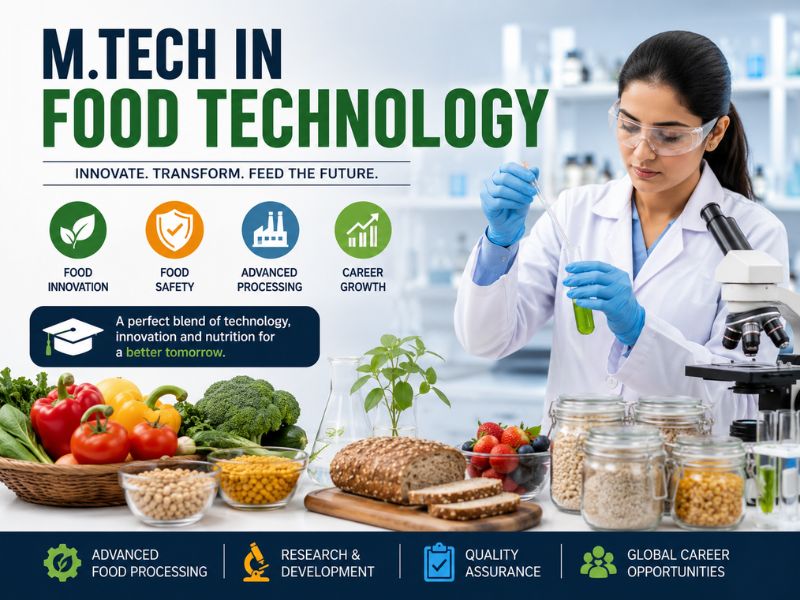
Let's cut to the chase.
M.Tech in Food Technology is your ticket to becoming a specialist, not just another engineer.
This two-year postgraduate program takes your BTech knowledge and pushes it further — deep into research, advanced processing, and product innovation.
Why does it matter right now?
India's food processing industry is booming. Government initiatives are pushing food safety and export-focused manufacturing hard. And companies need people who actually understand the science behind it — not just the basics.
Here's what you'll dive into:
Getting in? Most top institutes want a solid GATE score. That's your main gateway.
Here's the interesting part: 2026 programs are leaning hard into sustainable packaging, biotech innovations, and automation. That's where the industry is heading — and that's exactly what you'll be trained in.
The payoff? R&D roles, quality assurance leadership, plant management, even academic positions.
Bottom line: if you want to stand out in a crowded food tech job market, this degree does the heavy lifting.
Simple version: M.Tech = BTech knowledge, levelled up.
Think of your undergraduate degree as the foundation. M.Tech is where you build the actual house — specialised, research-driven, and technically deep.
This two-year program takes everything you learned at the BTech level and goes further. Advanced Food Engineering. Food Biotechnology. Process Optimisation. Plant Design and Management. Food Safety Systems.
But here's the real differentiator: the thesis.
Unlike your undergrad degree, M.Tech forces you to pick a real problem and solve it. Independently. That's not busywork — that's the exact skill employers (and PhD programs) are looking for.
You'll also get access to serious lab infrastructure — pilot plants, advanced research equipment, tools you simply didn't touch during your BTech.
The bigger picture: this program isn't about breadth anymore. It's about depth. You emerge specialised, research-capable, and ready for either advanced industry roles or academia.
That's exactly why M. Tech in Food Technology carries real weight in 2026's competitive food industry.
Still deciding? Here's why this move makes sense.
1. You go from generalist to specialist.
BTech gives you the basics. M.Tech gives you expertise. That difference matters when you're competing for senior technical roles.
2. Companies are hungry for R&D talent.
As food companies pour money into sustainable packaging and process innovation, they need people who can actually lead that work — not just execute basic tasks.
3. It's your bridge to research or a PhD.
Thinking about academia? The thesis work you do here is exactly the foundation you'll need.
4. Better starting salary.
Postgraduate specialisation typically means better pay and faster career progression than stopping at BTech.
5. You're leadership-track material.
M.Tech grads are often first in line for managerial roles in plant operations, QA, and R&D — because they've already proven they can solve complex problems independently.
6. Government and PSU doors open up.
Many research institutions and public sector food safety bodies specifically prefer M.Tech-qualified candidates.
7. You're positioned at the industry's cutting edge.
Functional foods. Sustainable packaging. Processed food innovation. This is where the industry is going — and you'll already be trained for it.
The bottom line: If you want deeper expertise, real research chops, and faster career acceleration, this is the move for 2026.
Here's what you actually gain.
1. Real technical depth
Not surface-level knowledge — deep expertise in food engineering, biotech, and process optimisation.
2. Genuine research experience
The independent thesis isn't a formality. It builds real problem-solving and research skills that employers notice.
3. Access to serious lab facilities
Pilot plants. Advanced equipment. Hands-on experimentation you simply couldn't do at the undergrad level.
4. Stronger paychecks
M.Tech grads typically out-earn BTech-only candidates in comparable roles — the specialisation pays off.
5. A clear path to leadership
Technical depth plus research experience equals faster movement into management roles.
6. A smoother path to a PhD
If academia is on your radar, this degree eases that transition significantly.
7. Room to specialise further
Want to focus on biotech? Packaging? Food safety? Most programs let you pick an elective track.
8. Access to government research roles
Postgraduate technical qualifications often unlock eligibility for government and agricultural research positions that BTech alone won't get you.
The takeaway: This isn't just "more school." It's a strategic move that compounds your technical value, your salary, and your leadership potential.
Here's exactly what you need to get in.
The basics:
You need a BTech/BE in Food Technology, Food Engineering, Chemical Engineering, Biotechnology, or something closely related, from a recognised university.
Minimum marks?
Most institutes want 55-60% aggregate marks. Reserved category candidates typically get a 5% relaxation.
What about GATE?
Here's the big one: top institutes — IITs, NITs, premier technical universities — require a valid GATE score, specifically in Food Technology, Chemical Engineering, or Biotechnology papers.
No GATE? Don't panic. Several state and private universities run their own entrance exams as an alternative pathway.
Work experience?
Not mandatory. But if you've got relevant industry experience, it can give you an edge during interviews at select institutes.
What else do you need?
One more thing: GATE scores don't just get you in — they often determine your stipend eligibility too. So if you're eyeing a top institute, start your GATE prep early. That single exam can shape both your admission chances and your financial situation throughout the program.
Getting into a solid M.Tech program starts with picking the right exam. Here's what actually matters in 2026.
1. GATE (Graduate Aptitude Test in Engineering)
The big one. Mandatory for IITs, NITs, and most premier technical institutes. Relevant papers include Food Technology (XE-H), Chemical Engineering (CH), or Biotechnology (BT), depending on your undergraduate background.
2. State-Level PG Entrance Exams
Most states run their own postgraduate engineering entrance exams — useful if GATE isn't your strongest suit or you're targeting state universities specifically.
3. University-Specific Entrance Tests
Several private and deemed universities conduct their own M.Tech entrance exams, especially for candidates without a GATE score. These tend to be less competitive but still test core engineering and technical fundamentals.
4. TANCET (Tamil Nadu Common Entrance Test)
Relevant if you're targeting institutes in Tamil Nadu — widely accepted for PG engineering admissions across the state.
5. AP PGECET / TS PGECET
State-specific entrance tests for Andhra Pradesh and Telangana institutes, following a similar structure to GATE but at a regional level.
Here's the real strategy:
Don't rely on just one exam. Prep for GATE first since it opens the most doors — including stipend eligibility — then back it up with a state-level or university-specific exam as a safety net.
Want to actually crack GATE or other M.Tech entrance exams? Here's a practical prep strategy for 2026.
1. Start early — ideally 8-10 months out
GATE and similar exams cover extensive syllabi. Cramming doesn't work here; consistent, structured study over months does.
2. Know the syllabus inside out
Get the official GATE syllabus for your relevant paper (Food Technology/Chemical Engineering/Biotechnology) and map out which topics carry the most weight.
3. Prioritise core subjects
Focus heavily on Food Chemistry, Food Microbiology, Food Engineering fundamentals, and Process Calculations — these form the backbone of most entrance exams.
4. Practice previous years' papers religiously
Nothing builds exam-day confidence like solving 8-10 years of past papers. It also reveals recurring question patterns.
5. Take regular mock tests
Simulate exam conditions with timed mock tests. This builds speed and helps you identify weak areas before the actual exam.
6. Strengthen your fundamentals in math and reasoning
GATE isn't just subject knowledge — it tests engineering mathematics and general aptitude too. Don't neglect these sections.
7. Join a structured coaching program (optional but helpful)
If self-study feels overwhelming, coaching institutes or online platforms can provide structured guidance and peer accountability.
8. Revise consistently, don't just learn new topics
Dedicate the final 4-6 weeks purely to revision and mock tests rather than new content.
Our advice: Track your mock test scores over time — steady improvement matters more than one great score. Consistency is what actually gets you into a top program in 2026.
Want to land a seat at a premier M.Tech Food Technology program? Here's what actually moves the needle in 2026.
1. Score well in GATE — it's your biggest lever
Top institutes like IITs and NITs weigh GATE scores heavily. A strong percentile alone can open doors that a weak one simply closes.
2. Build a strong academic track record
Your BTech GPA still matters, especially for institutes using a combined merit system blending GATE scores with academic performance.
3. Gain relevant research or internship experience
Even a short internship or research project during your BTech signals genuine interest and gives you an edge during interviews.
4. Write a compelling SOP
For research-focused institutes, your Statement of Purpose needs to clearly articulate why you want this specific specialisation and what problem you want to solve.
5. Secure strong recommendation letters
Ask professors who actually know your work — generic letters from unfamiliar faculty rarely help.
6. Apply to a strategic mix of institutes
Don't put all your eggs in the IIT/NIT basket. Apply across a realistic range — premier, mid-tier, and state institutes — based on your GATE score.
7. Prepare thoroughly for interviews
Many top programs include a personal interview assessing technical depth and research interest. Practice explaining your BTech projects and career goals clearly.
8. Track application deadlines closely
Different institutes and state counselling boards have different timelines — missing one can cost you a full year.
Our advice: Your GATE score gets you shortlisted, but your SOP, research background, and interview performance are what actually seal admission at top institutes for 2026.
Here's the step-by-step breakdown of what admission actually looks like.
Step 1: Register and appear for GATE
Begin by registering for GATE in your relevant paper (Food Technology, Chemical Engineering, or Biotechnology) and preparing thoroughly.
Step 2: Check institute-specific eligibility
Once you have your GATE score, shortlist institutes based on their specific cutoff trends and eligibility requirements.
Step 3: Apply through COAP or direct institute portals
Many IITs and NITs use the Common Offer Acceptance Portal (COAP) for centralised M.Tech admissions, while other institutes require direct applications.
Step 4: Submit required documents
Upload academic transcripts, GATE scorecard, SOP, LORs, and other supporting documents as specified.
Step 5: Shortlisting based on GATE score and academics
Institutes shortlist candidates using a combination of GATE percentile and undergraduate academic performance.
Step 6: Attend counseling/interview rounds
Shortlisted candidates are called for counselling sessions or personal interviews, where technical knowledge and research interest are assessed.
Step 7: Seat allotment and acceptance
Based on your performance and preferences, seats are allotted. You'll need to accept your offer within the specified deadline.
Step 8: Document verification and fee payment
Complete document verification and pay the admission fee to confirm your seat.
Our advice: Since GATE score validity typically lasts three years, plan your exam attempt timing carefully around your intended admission year to maximise your options for 2026.
Here's what you'll actually be studying across the two years.
Semester 1-2: Foundation and core subjects
Semester 3-4: Specialised and research-focused subjects
Elective specialisations (vary by institute):
Practical and research components:
Assessment methods:
Programs typically combine written examinations, lab practicals, seminar presentations, and thesis evaluation, with the final semester heavily weighted toward independent research work.
Our advice: Since thesis quality significantly impacts both your final grade and job prospects, choose a research topic aligned with current industry trends (like sustainable packaging or food biotech) to maximise its real-world relevance for 2026.
Choosing the right college significantly impacts your research opportunities and career outcomes. Here are India's leading institutes offering M.Tech in Food Technology for 2026.
Indian Institute of Technology (IIT) Kharagpur
Home to a dedicated Agricultural and Food Engineering department, offering strong research infrastructure and excellent placement records with top food companies and research institutions.
National Institute of Food Technology Entrepreneurship and Management (NIFTEM), Haryana
India's premier dedicated food technology institute, established specifically to provide specialised education, research, and entrepreneurship training in the food sector.
CFTRI (Central Food Technological Research Institute), Mysore
A globally recognised research institute offering M.Tech programs through academic collaborations, known for cutting-edge food research and strong industry connections.
National Institute of Technology (NIT) Rourkela
Offers a well-regarded M.Tech Food Process Engineering program with solid infrastructure and consistent placement outcomes.
Punjab Agricultural University (PAU), Ludhiana
Known for its strong focus on food processing and agricultural engineering, particularly valuable for students interested in dairy and cereal technology specialisations.
GB Pant University of Agriculture and Technology, Uttarakhand
Offers comprehensive food technology postgraduate programs with strong ties to agricultural research and rural food processing initiatives.
SLIET (Sant Longowal Institute of Engineering and Technology), Punjab
A well-regarded institute offering specialised M.Tech Food Technology programs with practical, industry-aligned coursework.
Anna University, Chennai
Offers M.Tech Food Technology through its affiliated colleges, known for solid academic standards and reasonable fee structures.
Our advice:
When shortlisting colleges, prioritise research infrastructure, faculty publication records, and industry partnerships over general institute rankings alone — these factors matter more for M.Tech-level specialisation.
Comparing your options side by side makes decision-making easier. Here's how top institutes stack up across key factors for 2026.
Research infrastructure
Placement strength
Fee affordability
Specialization depth
Industry connections
Our advice:
If pure food technology specialisation and research depth matter most, prioritise NIFTEM or CFTRI. If you want broader engineering brand value alongside food tech, IITs or NITs may serve you better for 2026 admissions.
Can't commit to a full-time, on-campus program? Here's what distance and online options look like for 2026.
Availability caveat
Since M.Tech Food Technology is a research and lab-intensive program, fully online options remain limited compared to more theory-based postgraduate degrees. Practical lab work and thesis research are difficult to replicate remotely.
Distance learning options
Some universities offer distance-mode M.Tech programs, though these typically require periodic on-campus lab sessions or contact classes to fulfil practical components.
Who offers these programs?
Certain state open universities and select technical institutes offer distance or part-time M.Tech options, primarily designed for working professionals already employed in the food industry who can apply workplace experience toward practical requirements.
What to expect:
Important consideration:
Given the hands-on, lab-dependent nature of food technology research, on-campus full-time programs generally provide significantly better research quality, mentorship, and industry exposure compared to distance alternatives.
Our advice:
Unless you're already working in the food industry and need flexible study options, prioritise full-time, on-campus M.Tech programs for meaningfully better lab access, mentorship, and placement outcomes in 2026.
Trying to decide between these two related specialisations? Here's an honest comparison for 2026.
Core focus difference
M.Tech Food Technology focuses specifically on food processing, preservation, packaging, and quality management. M.Tech Biotechnology takes a broader approach, covering genetic engineering, cellular processes, and biotechnological applications across pharmaceuticals, agriculture, and industrial sectors — not just food.
Curriculum comparison
Food Technology programs emphasise food engineering, food chemistry, and process optimisation specific to the food industry. Biotechnology programs cover molecular biology, genetic engineering, bioprocess technology, and fermentation science with broader industrial applications.
Career path differences
Food Technology graduates typically move into food manufacturing, quality assurance, and food R&D roles. Biotechnology graduates have more diverse career options spanning pharmaceuticals, agriculture, healthcare, and industrial biotechnology, in addition to food-related roles.
Industry demand
Food Technology offers focused, steady demand within the growing food processing sector. Biotechnology offers broader industry applicability but also faces more competition given the wider talent pool competing across multiple sectors.
Who should choose which?
Salary comparison
Both fields offer competitive salaries, though Biotechnology sometimes commands slightly higher packages in pharmaceutical and biotech-focused roles, while Food Technology offers more stable, consistent demand specifically within food manufacturing.
Our advice: If your passion is specifically food-related, Food Technology offers deeper, more focused expertise. If you want broader scientific versatility across industries, Biotechnology provides more flexible long-term career options for 2026.
Planning your budget for M.Tech Food Technology? Here's a realistic breakdown of costs for 2026.
Government institute fees:
Private institute fees:
Additional costs to consider:
GATE-qualified stipend advantage:
GATE-qualified students at many government institutes receive a monthly stipend (typically around ₹12,400/month as per current government norms), significantly offsetting living expenses throughout the program.
Our advice:
Since government institutes offer dramatically lower fees combined with GATE stipend benefits, prioritise GATE preparation early — the financial difference between government and private institutes can easily exceed ₹2-3 Lakhs over the full program duration for 2026 admissions.
Placement outcomes are a major deciding factor when choosing your M.Tech program. Here's what to expect in 2026.
Overall placement trends
Given the steady growth of India's food processing industry, M.Tech Food Technology programs at reputed institutes generally report solid placement percentages, particularly for graduates from IITs, NITs, and NIFTEM.
Who's hiring?
Common job roles offered
Factors affecting placement quality
Placement support systems
Top institutes typically maintain dedicated placement cells, organise campus recruitment drives, and leverage faculty industry connections built through collaborative research projects.
Our advice: Since M.Tech placements often weigh research quality and specialisation heavily, choose a thesis topic aligned with current industry priorities (like sustainable packaging or food safety technology) to strengthen your placement prospects for 2026.
Curious which companies actively hire M.Tech Food Technology graduates? Here's a look at major recruiters across sectors in 2026.
Food manufacturing and FMCG:
Beverage companies:
Dairy companies:
Government and research organisations:
Packaging and technology companies:
Consulting and quality certification bodies:
Our advice:
These recruiters typically prioritise candidates with strong research backgrounds, relevant thesis work, and internship experience with food processing companies. Building connections through your institute's industry collaborations significantly improves your chances of landing roles with these top employers in 2026.
Here's a realistic breakdown of what you can expect to earn after completing M.Tech in Food Technology in India for 2026.
Average starting salary
Fresh graduates typically earn between ₹4-8 LPA, though this varies significantly based on institute reputation, specialisation, and individual performance during placements.
Salary by institute tier
Salary by job role
What influences your salary?
Career growth potential
With 3-5 years of experience, professionals often see salaries rise to ₹10-15 LPA, particularly in R&D leadership or plant management roles.
The bigger picture
While M.Tech Food Technology salaries may not match tech-sector packages, the field offers strong job stability, government sector opportunities, and steady growth as India's food processing industry continues expanding through 2026 and beyond.
Wondering what skills actually matter in this field? Here's a comprehensive breakdown for 2026.
Technical skills
Emerging technical skills
Business and analytical skills
Soft skills
Our advice:
While your M.Tech coursework builds strong technical foundations, actively seeking internships and staying updated on emerging trends like sustainable packaging and automation will significantly strengthen your employability in 2026's competitive food industry.
Let's talk about what your career actually looks like after this degree.
Immediate job roles
Industries actively hiring
Career progression path
Academic and research pathways
Given the thesis-driven nature of M.Tech, graduates interested in research can pursue a PhD or join government research institutions like CFTRI and DFRL for long-term research careers.
Entrepreneurial opportunities
With growing consumer interest in health foods, sustainable packaging, and innovative food products, many M.Tech graduates also explore food-based startups, leveraging their technical expertise to launch niche food businesses.
The bigger picture
As India's food processing sector continues its steady growth, backed by government initiatives and rising export demand, M.Tech Food Technology graduates are well-positioned for long-term career stability and growth across manufacturing, research, and regulatory roles well into 2026 and beyond.d
MBA Strategic Management offers excellent long-term career growth. As businesses increasingly rely on strategic planning and innovation, demand for skilled professionals continues to rise.
Graduates can pursue senior leadership positions, management consulting, entrepreneurship, international business management, or doctoral studies (PhD). Professionals with experience can progress to roles such as Director of Strategy, Vice President, Chief Operating Officer (COO), and Chief Executive Officer (CEO).
The course duration is generally 2 years.
Graduates from any recognised discipline with the required minimum marks can apply.
CAT, MAT, XAT, CMAT, NMAT, SNAP, ATMA, CUET PG, and various state-level MBA entrance exams.
Graduates can earn between ₹6 LPA and ₹18 LPA, depending on skills and experience.
Yes, many UGC-approved universities offer online and distance MBA programs.
Yes. It offers excellent career growth, leadership opportunities, and competitive salary packages.
Consulting, IT, Manufacturing, Banking, Healthcare, FMCG, Retail, E-commerce, and Logistics.