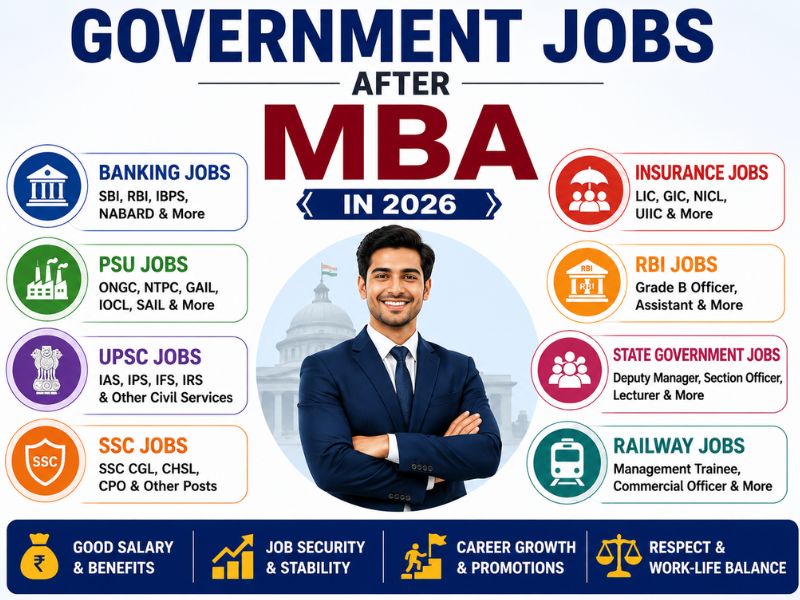
An MBA no longer means you're locked into a corporate-only career path. In 2026, a growing number of management graduates are turning toward the public sector for the stability, prestige, and structured growth it offers. From public sector banks to regulatory bodies and PSUs, government organisations are actively hiring MBA talent to fill strategic, leadership-driven roles. This guide breaks down everything you need to know about government jobs after an MBA — the top roles, exams, salaries, and colleges that can get you there.
Government jobs after an MBA are not limited to clerical or administrative work. Most roles are managerial in nature, requiring graduates to apply the analytical, financial, and people-management skills built during their MBA. Typical responsibilities include:
Driving operational efficiency and strategic planning in PSUs
Managing credit appraisal, risk assessment, and treasury functions in banks
Leading HR functions like recruitment, training, and policy implementation in ministries and PSUs
Framing and executing public policy in regulatory and economic roles
Overseeing rural development and financial inclusion programs (NABARD, RBI)
Recruitment usually follows a structured, exam-based process — a preliminary test, a mains exam, and a Group Discussion (GD) or Personal Interview (PI) round, depending on the organisation.
India has over 320 Central Public Sector Enterprises, and most of them actively recruit MBA graduates for managerial roles. Add to this the thousands of openings released annually by public sector banks, regulatory bodies, and civil services, and the scale of opportunity becomes clear. Government job listings for MBA graduates show thousands of open vacancies across various organisations and departments in 2026 alone.
What's driving this momentum?
Digital and policy expansion: Government bodies are expanding their digital transformation and data-driven decision-making functions, creating new openings for management graduates.
Retirement-driven vacancies: A wave of retirements in PSUs and nationalised banks is opening up management-level positions.
Specialisation-based hiring: Recruiters are now hiring MBA graduates by specialisation (Finance, HR, Marketing, Operations) rather than as generalists, improving the odds for niche skill-holders.
Key Highlights
Aspect | Details |
Sectors Hiring | Banking, PSUs, RBI/SEBI/NABARD, Railways, Ministries, Civil Services |
Common Exams | IBPS PO, SBI PO, RBI Grade B, SEBI Grade A, UPSC CSE, SSC CGL, GATE (for PSU MT roles) |
Entry-Level Salary | ₹55,000 to ₹2,25,000 per month, depending on the role and organisation |
Eligibility | MBA/PGDM from a UGC/AICTE-recognised university |
Age Limit | Generally 21–30 years, varying by department, with relaxations for reserved categories |
Selection Process | Prelims → Mains → GD/Interview |
Online MBA Validity | Valid if from a UGC-approved Indian university meeting the required criteria |
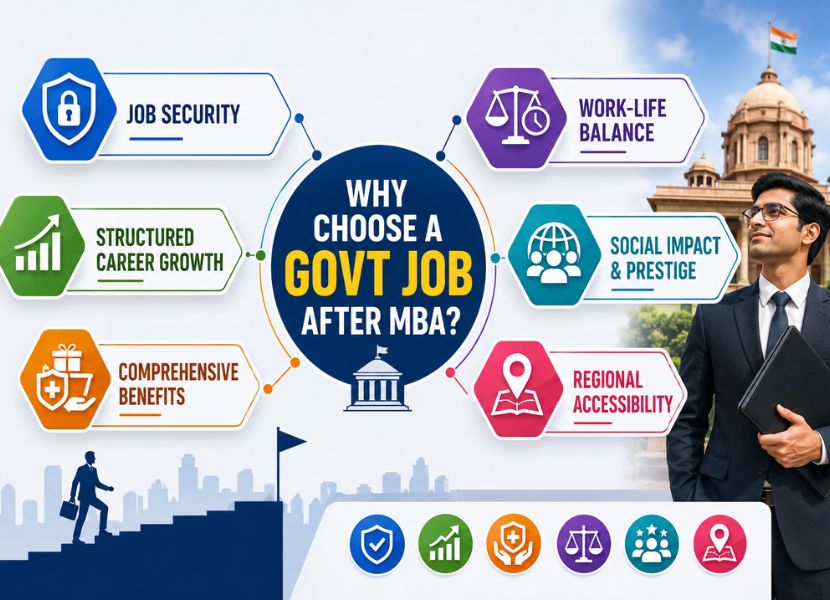
Private sector roles often promise faster pay hikes, but government jobs bring a different — and increasingly attractive — value proposition for MBA graduates in 2026:
Job Security: Once selected, roles are largely insulated from layoffs and market cycles, unlike many private-sector management positions.
Structured Career Growth: An MBA Finance graduate can move from Assistant Manager to Chief Manager in a public sector bank within 7–8 years through a defined promotion ladder.
Comprehensive Benefits: Government roles come with fixed pay scales, housing allowance, medical benefits, and pension benefits that most private-sector roles don't offer at the same level.
Work-Life Balance: Roles such as UGC NET-qualified teaching positions and many PSU functions offer a healthier work-life balance compared to high-pressure corporate jobs.
Social Impact & Prestige: Roles in NABARD, RBI, and civil services let MBA graduates directly influence financial inclusion, rural development, and public policy.
Regional Accessibility: For MBA graduates from Tier-2 and Tier-3 cities, this stability matters a great deal, since many of these jobs don't require relocation to metro hubs.
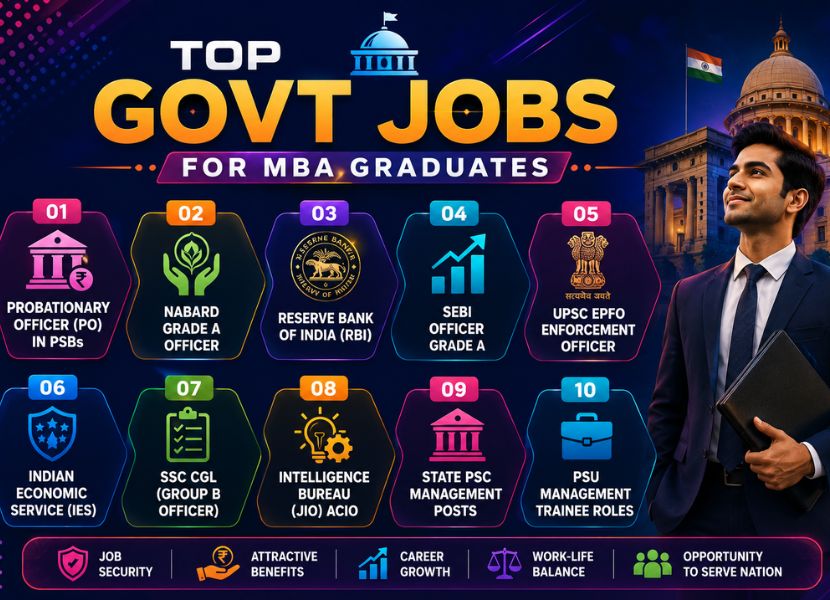
Bank PO / Specialist Officer (SBI, IBPS) Banking remains one of the most accessible and scalable avenues for MBA graduates, with POs and SOs recruited through exams such as IBPS PO and SBI PO. These roles come with a salary range of ₹7–10 LPA, growing up to ₹12–15 LPA within a few years, including allowances such as HRA and DA.
Management Trainee in PSUs (ONGC, NTPC, BHEL, GAIL, Coal India, IOCL). PSUs offer Management Trainee positions starting at ₹8–12 LPA, rising to ₹15–18 LPA with experience and promotions, along with accommodation and medical benefits. These roles are usually filled through the GATE entrance exam,m followed by a group discussion and interview. Some companies, like Coal India, HAL, and SAIL, recruit MBA graduates directly without requiring a GATE score.
RBI Grade B Officer: A premier role for Finance/Economics MBA graduates, offering policy-level exposure within India's central bank, along with strong pay and perks.
NABARD Officer (Grade A) NABARD's starting package for officers ranges between ₹9–14 LPA, with scope for growth in policy-making and financial planning related to rural credit systems and financial inclusion.
Civil Services (IAS/IPS/IRS via UPSC) Civil services compensation begins around ₹10–12 LPA and can rise beyond ₹20 LPA over time, excluding additional benefits. MBA graduates tend to do well in civil services because of their grounding in management, economics, and policy thinking.
SEBI Grade A Office:r A regulatory role suited to Finance MBA graduates interested in capital markets, investor protection, and corporate governance.
Government College/University Faculty (via UGC NET) A strong option for MBA graduates inclined toward teaching, research, and mentoring rather than purely operational roles, with a notably balanced work-life structure.
If you're fresh out of business school, certain government routes are more fresher-friendly than others. Top government jobs for MBA freshers include SBI PO, RBI Grade B Officer, UPSC administrative jobs, SSC CGL/CHSL, IBPS PO/Clerk, and RRB posts — all of which offer good pay, job security, growth, and career stability.
SSC CGL: A strong platform for MBA freshers; after qualifying, candidates are placed as financial officers, auditors, and administrators with government perks and promotional opportunities.
IBPS PO/Clerk: No prior work experience required; ideal for first-time job seekers.
RRB (Railway Recruitment Board) Posts: Open to freshers and offer long-term career mobility within Indian Railways.
Choosing the right exam depends on your specialisation and career goals:
General/any specialisation: IBPS PO, SBI PO, SSC CGL, UPSC CSE
Finance specialisation: RBI Grade B, SEBI Grade A, NABARD Grade A
Operations/Core management: GATE (for PSU Management Trainee roles)
HR specialisation: SSC CGL (for administrative roles), PSU-specific HR recruitment drives
Focus your preparation on quantitative aptitude, reasoning, and English, along with general awareness and economics, as these form the core syllabus of most government exams. Practising mock tests and previous years' papers consistently is one of the most effective ways to improve your selection chances.
MBA Marketing graduates have a narrower — but still valuable — set of government opportunities. Marketing MBA graduates can find roles in organisations like SBI, PNB, LIC, GIC, NABARD, and State Marketing Boards, which hire for product promotion, financial inclusion, and public outreach functions. Within banks and insurance PSUs, Marketing MBA graduates are often absorbed into roles focused on customer acquisition strategy, brand positioning for government schemes, and outreach campaigns for financial inclusion programs like Jan Dhan Yojana or crop insurance schemes.
The most realistic entry point remains bank PO exams (IBPS/SBI), where marketing skills are valued for retail banking and cross-selling functions, alongside PSU Management Trainee (Marketing) roles in companies like IOCL and BHEL.
MBA HR professionals can work in Public Sector Undertakings, Central and State Ministries, Defence Establishments, and Public Universities, which hire them for managing training, recruitment, policy implementation, and employee welfare.
Government job roles after an MBA in HR carry an average salary package of ₹5 lakhs to ₹15 lakhs, with placement opportunities spanning human resources, policy-making, and administration. The Staff Selection Commission conducts government exams for HR graduates to recruit candidates into various ministries and departments for roles such as HR officer, assistant, administrative officer, and Industrial Relations Manager.
Other popular destinations include HR roles in PSU Management Trainee programs (where HR is one of the core functional tracks) and recruitment/welfare roles within defence establishments and public sector universities.
Here's a consolidated view of what MBA graduates can expect to earn across various government roles in 2026:
Role | Starting Salary | Growth Potential |
Bank PO/SO (SBI, IBPS) | ₹7–10 LPA | Up to ₹12–15 LPA |
PSU Management Trainee | ₹8–12 LPA | Up to ₹15–18 LPA |
RBI Grade B / SEBI Grade A | ₹13–16 LPA (with allowances) | ₹25+ LPA at senior levels |
NABARD Officer | ₹9–14 LPA | Higher with policy-level roles |
Civil Services (UPSC) | ₹10–12 LPA | ₹20+ LPA over time |
MBA Finance roles (overall) | ₹8–13 LPA | Based on experience and seniority |
MBA HR roles (overall) | ₹5–15 LPA | Based on department and seniority |
Both regular and UGC-approved Online MBA graduates are fully eligible for these stable, growth-oriented public sector careers under the 7th Central Pay Commission (CPC). Compensation in most government roles also includes House Rent Allowance (HRA), Dearness Allowance (DA), medical benefits, and pension contributions — factors that often make the effective take-home value higher than the base figures suggest.
This is one of the most common questions among working professionals considering an online MBA. The short answer: yes, with conditions.
An online MBA from a UGC-DEB-approved university is valid for most government job applications in India. UGC-DEB stands for University Grants Commission – Distance Education Bureau, the official body that approves online and distance learning programs in India, and a degree from a UGC-DEB-approved university carries the same legal standing as a regular on-campus MBA for government job purposes.
Key points to verify before applying:
The university must be UGC-DEB approved (not just any private online provider).
Some GATE-linked PSU roles specify their own eligibility conditions, so it's important to read the official recruitment notification carefully before applying.
UPSC Civil Services accepts any degree from a recognised university, whether online or on-campus.
The teaching approach at top B-schools directly shapes how well-prepared graduates are for government-sector roles, where analytical rigour and policy understanding matter as much as managerial skill. Most reputed programs combine:
Case-based learning: Real-world business and policy case studies that mirror the decision-making graduates will face in PSU and regulatory roles
Quantitative and economics-heavy coursework: Directly useful for exams like RBI Grade B, SEBI Grade A, and NABARD, which test economics and financial reasoning extensively
Industry immersion and internships: Exposure to PSUs, banks, and government-linked organisations during summer internships
Group discussions and structured presentations: Build the communication skills tested in GD/PI rounds of bank and PSU recruitment
Specialisation tracks (Finance, HR, Marketing, Operations): Allow students to align their coursework with the specific government exam pathway they intend to pursue
Institutes with strong faculty-research output and industry tie-ups (a key NIRF ranking parameter) tend to produce graduates who perform better in the conceptual portions of government exams, particularly RBI Grade B and UPSC.
Conclusion
Government jobs after an MBA in 2026 offer a compelling mix of stability, structured growth, and meaningful impact — whether through banking, PSUs, regulatory bodies, or civil services. The path forward is straightforward: identify the exam pathway that matches your specialisation, stay consistent with preparation in quantitative aptitude, reasoning, and general awareness, and track official notifications closely. With the right strategy, an MBA can open doors to a respected and financially secure public-sector career.
1. Can MBA graduates apply for government jobs without clearing UPSC? Yes. UPSC Civil Services remains the top prestige route, but it's far from the only one. Routes like IBPS PO, SBI PO, RBI Grade B, SEBI Grade A, NABARD, and GATE-based PSU Management Trainee programs don't require UPSC at all.
2. Is an online MBA accepted for PSU and bank job applications? Yes, provided it is from a UGC-DEB-approved university. Some GATE-linked PSU roles have additional eligibility conditions, so always check the official notification.
3. Which MBA specialisation offers the best government job prospects? MBA Finance, HR, and Marketing are the three most in-demand specialisations across the government sector, with Finance typically offering the widest range of high-paying roles (RBI, SEBI, NABARD, bank POs).
4. What is the typical age limit for government jobs after an MBA? Age limits vary by department, but 21–30 years is common for most positions, with relaxations for reserved categories.
5. Do PSU Management Trainee roles always require a GATE score? Not always. Companies like Coal India, HAL, and SAIL recruit MBA graduates directly without requiring a GATE score, through their own recruitment drives.
6. What is the realistic salary range for a govt job after an MBA in 2026? Starting salaries across govt MBA roles generally range between ₹55,000 and ₹2,25,000 per month, depending on the organisation, role, and specialisation, with additional allowances under the 7th CPC structure.
7. How long does it typically take to get promoted in a government role after an MBA? In public sector banks, for instance, an MBA Finance graduate can move from Assistant Manager to Chief Manager within 7–8 years, following a structured promotion ladder.