

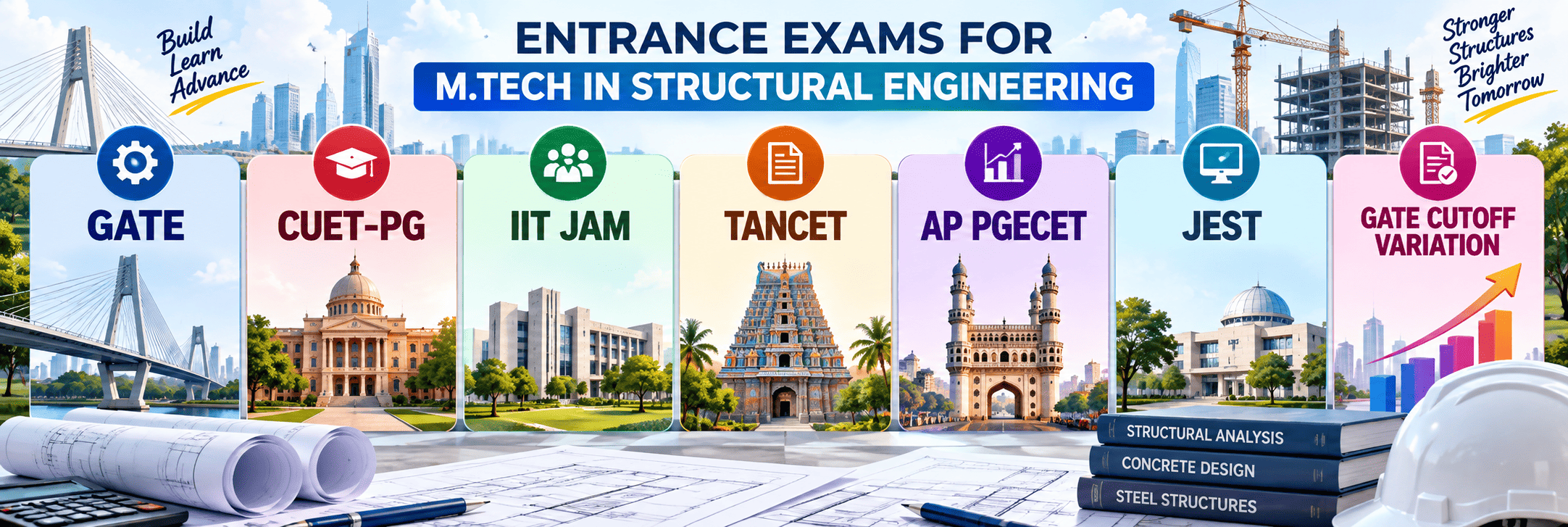
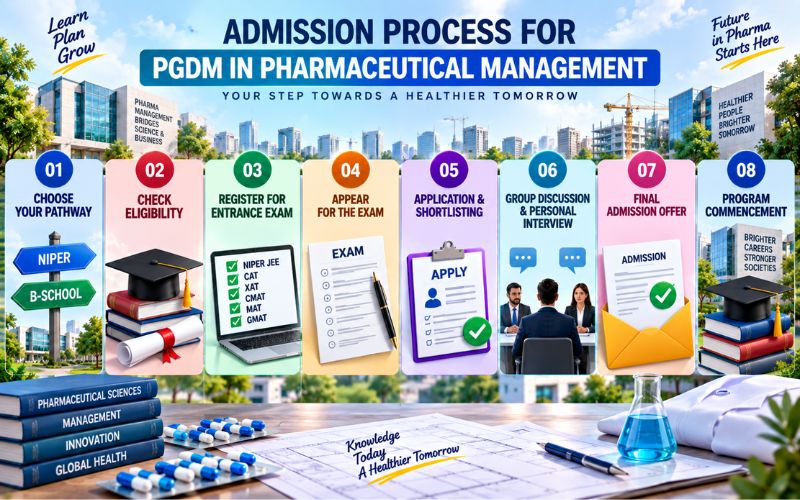
- CAT (Common Admission Test) — Accepted at broader B-schools offering pharma management as a specialisation, alongside NIPER's own entrance route
- NIPER JEE — The dedicated entrance exam specifically for NIPER's MBA (Pharm) in Pharmaceutical Management, followed by Group Discussion and Personal Interview
- XAT, MAT, CMAT, NMAT, ATMA, GMAT, SNAP, DMAT — Widely accepted across institutes like IIHMR Delhi, IIHMR Jaipur, NMIMS Mumbai, Jamia Hamdard, and SIES College of Management Studies
- IIHMR Delhi's multi-exam acceptance — Admission is based on CAT/MAT/XAT/ATMA/GMAT/CMAT/NMAT/DMAT, followed by group discussion and personal interview rounds
- No fixed single national exam — Since this specialisation is offered across dedicated pharma-focused institutes (NIPER) and general B-schools with a pharma elective, exam acceptance varies significantly by institute type
- Post-exam selection stages — Nearly all institutes follow the entrance exam with a Group Discussion (GD) and Personal Interview (PI) round before final selection
- Since exam requirements differ meaningfully by college, checking the specific admission page of each shortlisted institute is essential before applying
Top PGDM Colleges & Institutes Offering Pharmaceutical Management
- NIPER Mohali, NIPER Hyderabad, NIPER Ahmedabad — Dedicated National Institute of Pharmaceutical Education and Research campuses offering a specialised MBA (Pharm) in Pharmaceutical Management; NIPER Hyderabad holds 5th position in NIRF Ranking 2025
- IIHMR Delhi — Offers PGDM (Hospital & Health Management) with Pharmaceutical Management as one specialisation option; Fees: ₹9.25 lakh; seat intake expected at 180 for batch 2026-28
- IIHMR University Jaipur — Fees up to ₹12 lakh for the complete course; a leading choice among private institutes for this specialisation
- IIHMR Bangalore — Trains students specifically in pharmaceutical management, technology management, and advanced business concepts for the healthcare industry
- NMIMS Mumbai, Jamia Hamdard, SIES College of Management Studies / SIESCOMS Navi Mumbai — Well-regarded institutes offering industry-oriented syllabus, seasoned faculty, and solid placement contacts
- DIPSAR Delhi — Most affordable option cited, with fees around ₹44,000 per semester
- SBM Mumbai, SIHS Pune, MIT Vishwaprayag University — Additional private colleges offering this specialisation
- Selection consideration — Candidates with a pharmacy, life sciences, biotechnology, or medical background typically find this program more relevant and useful, though most colleges accept graduates from any discipline
PGDM in Pharma Management Syllabus & Curriculum Breakdown
- Core focus areas — Healthcare marketing, regulatory compliance, supply chain administration, and pharmaceutical sales form the central pillars of the curriculum
- Foundational business skills — Courses hone skills related to planning, consultancy, problem-solving, and general management techniques, layered with pharma-specific applications
- Specialised coursework — Students are trained in pharmaceutical management, technology management, and advanced business concepts specific to the pharmaceutical industry
- Program duration — A standard 2-year, full-time postgraduate program at nearly all institutes offering this specialisation
- Mandatory internship component — IIHMR Delhi, for example, requires a mandatory Summer Training of at least 8 weeks after the first year, where students work with hospitals, NGOs, pharmaceutical firms, and public health organisations, then submit a training report and present findings before a panel.
- Second-year dissertation — Many programs (like IIHMR Delhi) require students to complete a dissertation in the second year, ensuring strong research and industry exposure
- Practical, industry-embedded approach — Colleges partner with prominent pharma companies for research, skill development, and hiring, ensuring the curriculum stays grounded in real industry practice rather than purely theoretical instruction
Key Specialisations within Pharmaceutical Management
- Pharmaceutical Marketing — Focused on brand strategy, product positioning, and marketing campaigns specifically for pharmaceutical products
- Pharmaceutical Sales Management — Covers sales strategy, territory management, and distributor/channel relationships within the pharma supply chain
- Regulatory Affairs — Training in navigating drug approval processes, compliance, and regulatory documentation — a distinctly specialised and in-demand track
- Supply Chain and Distribution Management — Covers the logistics of manufacturing, warehousing, and distributing pharmaceutical products, critical given India's role as a major global generics exporter
- Hospital and Health Management (related track) — Offered alongside Pharmaceutical Management at institutes like IIHMR Delhi, useful for those wanting a broader healthcare management foundation
- Product Management — A distinct career-track specialisation within pharma, focused on managing a drug or product's lifecycle from development through commercialisation
- Health Information Technology — Another related specialisation at multi-track institutes like IIHMR Delhi, reflecting the industry's ongoing digital transformation
PGDM Fees in Pharmaceutical Management
- Overall national fee range — ₹2 lakh to ₹20 lakh for the full program, depending on institute type and brand
- Most affordable option — DIPSAR Delhi at approximately ₹44,000 per semester
- NIPER Hyderabad specific breakdown — Total tuition fee of ₹4,07,156 for the entire 2-year course, plus a one-time admission fee of ₹44,391 and an optional hostel fee of ₹20,033
- IIHMR Delhi — ₹9.25 lakh total, including ₹5.25 lakh tuition fee
- IIHMR University Jaipur — Up to ₹12 lakh for the complete course, among the higher-fee private options
- Private college fee range (broader) — Generally recognised for state-of-the-art infrastructure and corporate tie-ups, with fees scaling accordingly compared to NIPER's more affordable, government-institute pricing
- Fee-to-outcome consideration — Since salary outcomes range widely (₹5-22 LPA depending on role and institute), comparing fees against realistic placement data — not just brand name — is the more useful evaluation approach when shortlisting a college
Note: Fees, entrance exam requirements, aur institute-specific admission details NIPER campuses, IIHMR institutes, aur general B-schools ke beech significantly vary karte hain — publish se pehle official college websites se latest 2026-27 admission cycle, fee structure, aur syllabus details verify kar lena strongly recommend karta hoon.
Scholarships and Educational Loans for Pharma Management Students
Government national scholarship portals provide financial assistance based on merit and category.
Major national public banks offer specialised education loans covering tuition fees and living expenses with flexible moratorium periods.
Merit-based institutional scholarships are often provided directly by business schools based on entrance exam scores or academic track records.
State-level financial aid schemes support resident students pursuing professional postgraduate management programs.
Specialised banking schemes for professional degrees feature competitive interest rates and collateral-free loan limits for eligible students.
PGDM in Pharma Management Placements & Top Recruiters
Top business schools achieve high placement percentages with dedicated corporate relations cells for healthcare sectors.
Leading pharmaceutical multinational companies recruit graduates for marketing, supply chain, and product management roles.
Top consulting firms hire management graduates for healthcare advisory, market research, and strategic operations.
Prominent healthcare and medical device corporations offer diverse leadership and brand management positions.
Evolving digital health platforms and pharmaceutical tech enterprises actively hire graduates for business development roles.
Average Salary After PGDM in Pharmaceutical Management
Entry-level compensation packages for specialised management graduates typically range between competitive industry averages.
Top-tier business schools report higher median and average annual CTCs due to strong corporate networks.
Specialised roles in pharmaceutical marketing and product management generally command premium starting salaries.
Performance-based bonuses and annual incentives significantly enhance the total take-home compensation structure.
Rapid career progression within the healthcare sector leads to substantial salary growth within the first few years.
Part-Time Work Opportunities During PGDM
Campus internships and corporate live projects provide practical industry exposure alongside financial stipends.
Research assistantships under faculty members offer academic engagement and flexible earning options.
Freelance content writing and digital marketing tasks allow students to work remotely around academic schedules.
Weekend corporate consulting assignments help build professional networks while earning supplemental income.
On-campus student coordinator roles often include fee waivers or stipends managed by institutional bodies.
Career Opportunities After PGDM in Pharmaceutical Management
Product Managers oversee brand strategy, promotional campaigns, and product lifecycle management for pharmaceutical portfolios.
Business Development Managers drive market expansion, institutional sales, and strategic healthcare partnerships.
Supply Chain and Operations Managers optimise logistics, inventory control, and manufacturing distribution networks.
Market Research Analysts evaluate industry trends, competitor positioning, and consumer data to guide business decisions.
Healthcare Consultants provide strategic guidance to pharmaceutical firms on regulatory compliance and market entry.
Internship & Project Work Opportunities in the Pharma Sector
Summer internships bridge theoretical classroom concepts with real-world corporate operations in pharmaceutical enterprises.
Corporate live projects allow students to solve active business, supply chain, and marketing challenges for healthcare firms.
Research-based institutional assignments focus on drug lifecycle analysis, market trends, and competitive health intelligence.
Cross-functional internships span regulatory affairs, market research divisions, and digital health tech startups.
Practical exposure during these programs helps students build valuable professional networks for future job placements.
ROI of PGDM in Pharma Management (Fees vs Salary)
Program fees for specialised postgraduate management courses typically balance out quickly against high initial placement packages.
Entry-level compensation figures for specialised graduates consistently outperform standard general management counterparts.
Strong industry demand ensures steady mid-career salary increments within the fast-growing healthcare and life sciences sector.
Specialised domain expertise eliminates the struggle of generic profiling, accelerating overall career progression and financial returns.
High placement conversion rates across reputed business schools secure a reliable financial payback timeline for students.
Frequently Asked Questions (FAQs)
Is a background in pharmacy or science mandatory to pursue a PGDM in Pharmaceutical Management?
What core job profiles are available for graduates entering the pharmaceutical and healthcare consulting sectors?
How does specialised pharma management training differ from a traditional general MBA program?
What types of entrance examinations are typically accepted for admission into these postgraduate diploma programs?
How do corporate internships contribute to final placement opportunities in pharmaceutical multinational companies?
Conclusion: Shaping the Future of Healthcare
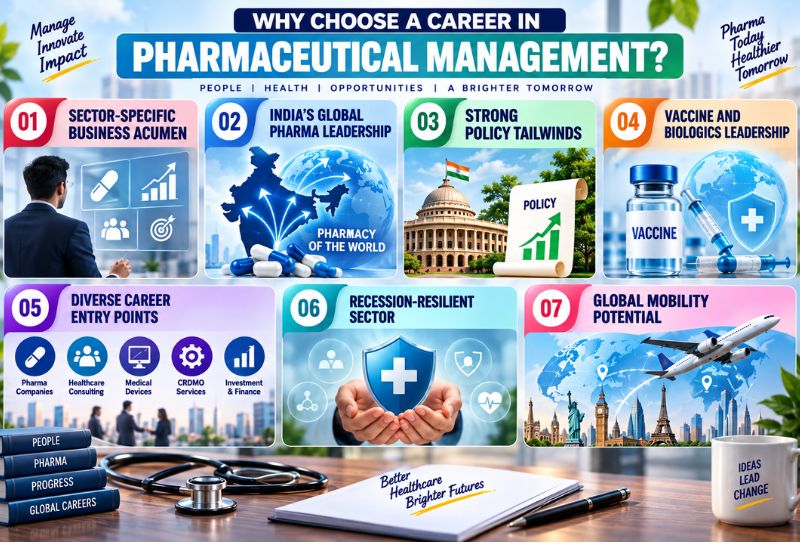
The pharmaceutical and healthcare sector provides stable, recession-proof growth driven by rising domestic consumption and global exports. Specialised management education equips professionals with the exact regulatory, operational, and marketing skills required by top employers.
Bridging scientific innovation with corporate strategy creates high-value leadership opportunities for modern graduates.
Continuous industry evolution ensures long-term career resilience, dynamic roles, and continuous professional development.
Choosing a focused postgraduate pathway sets the foundation for a rewarding and impactful career in global health management.