
As the world becomes increasingly digital, cyber threats are growing faster than ever. From banking systems and government networks to social media platforms and multinational companies, cybersecurity has become one of the most critical areas in modern technology.
In 2026, cyber attacks, data breaches, ransomware, ethical hacking, AI-based threats, and digital fraud are major global concerns. Because of this, organisations across the world are investing heavily in cybersecurity professionals who can protect systems, networks, and sensitive information.
B.Tech. in Cyber Security is one of the fastest-growing engineering programs today. It combines computer science, networking, ethical hacking, data protection, cloud security, and artificial intelligence to prepare students for high-demand technology careers.
This complete guide covers everything students need to know about B.Tech. in Cyber Security, including eligibility, fees, admission process, syllabus, top colleges, placements, salary, career scope, future opportunities, latest trends, and expert career tips.
B.Tech.h in Cyber Security is a 4-year undergraduate engineering program focused on protecting computer systems, digital networks, applications, and data from cyber threats and unauthorised access.
The course teaches students how to identify vulnerabilities, prevent hacking attempts, secure cloud systems, manage digital risks, and build secure IT infrastructure.
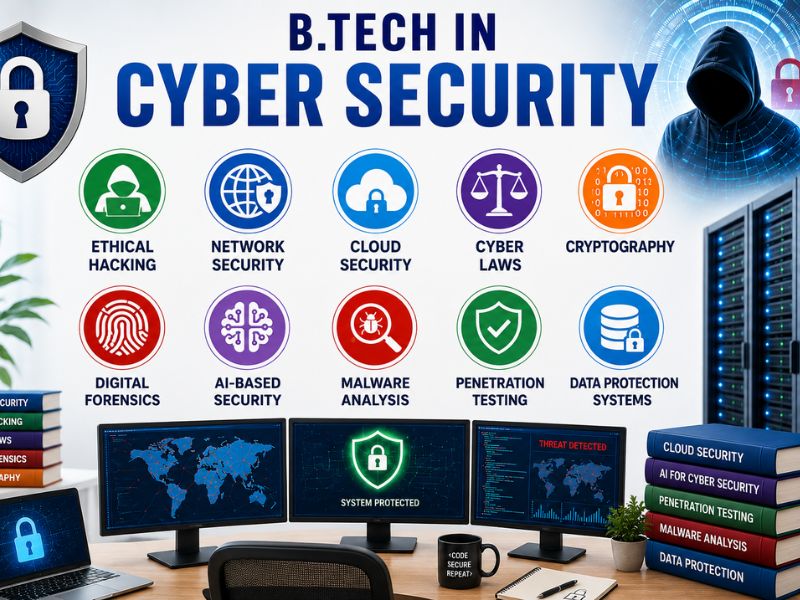
Ethical Hacking
Students learn how ethical hackers identify vulnerabilities and security weaknesses in computer systems and networks. Ethical hacking helps organisations strengthen their digital security by testing systems against cyber threats in a legal and controlled manner.
Network Security
Network security focuses on protecting computer networks, servers, and communication systems from unauthorised access, cyberattacks, malware, and data breaches. Students learn firewall management, intrusion detection, and secure networking techniques.
Cloud Security
Cloud security teaches students how to secure cloud-based applications, online data storage, and digital business systems. As companies increasingly use cloud technologies, cloud security has become one of the most important cybersecurity domains.
Cyber Laws
Students learn about cyber laws, digital regulations, data privacy policies, intellectual property rights, and legal frameworks related to online activities and cybercrime management.
Cryptography
Cryptography focuses on encryption techniques used to secure sensitive digital information and online communication. Students understand how encryption protects confidential data from hackers and unauthorised access.
Digital Forensics
Digital forensics involves investigating cybercrimes, recovering digital evidence, analysing hacked systems, and tracking cybercriminal activities. Students learn forensic tools and cyber investigation techniques used in real-world security operations.
AI-Based Security Systems
Artificial Intelligence is increasingly used in cybersecurity for threat detection, automated monitoring, predictive analysis, and intelligent cyber defence systems. Students learn how AI improves modern security infrastructure.
Malware Analysis
Malware analysis teaches students how viruses, ransomware, spyware, and malicious software operate. Students learn techniques to identify, analyse, and prevent different types of cyber threats.
Penetration Testing
Penetration testing focuses on simulated cyberattacks used to evaluate system security. Students learn how security professionals test applications and networks to identify vulnerabilities before real hackers exploit them.
Data Protection Systems
Students learn how organisations secure sensitive customer information, financial records, and confidential business data through advanced data protection technologies, privacy frameworks, and security management systems.
Cybersecurity education helps students develop practical technical skills, analytical thinking, and advanced digital security knowledge required to protect modern organisations from evolving cyber threats. With increasing cybercrime and digital transformation worldwide, cybersecurity remains one of the fastest-growing and most future-focused technology career fields.
Cybercrime is growing at an unprecedented rate as businesses, governments, and individuals increasingly depend on digital systems and online platforms. From ransomware attacks to large-scale data breaches, organisations across industries are investing heavily in cybersecurity to protect sensitive information and digital infrastructure.
The rising frequency of cyberattacks is creating a strong long-term demand for skilled cybersecurity professionals worldwide.
Digital Economy = Rising Security Demand
The expansion of the digital economy, cloud computing, e-commerce, fintech, and online services has significantly increased the need for advanced cybersecurity solutions. Companies now require strong digital protection systems to secure customer data, online transactions, and business operations.
As digital transformation accelerates globally, cybersecurity is becoming a critical business priority rather than just an IT function.
Artificial Intelligence is rapidly transforming modern cybersecurity systems through intelligent threat detection, predictive analytics, automated monitoring, and real-time security response mechanisms. AI-driven cyber defence systems are helping organisations identify and prevent cyber threats more efficiently.
Professionals with knowledge of both AI and cybersecurity are expected to have excellent future career opportunities in advanced security technologies.
Both government organisations and private companies are aggressively hiring cybersecurity professionals to strengthen digital protection systems and reduce cyber risks. Industries such as banking, healthcare, defence, e-commerce, IT services, and fintech are continuously increasing cybersecurity investments.
Government sectors are also expanding cyber defence infrastructure and digital security programs, creating strong job opportunities for skilled cybersecurity graduates.
Cybersecurity has become one of the fastest-growing and most future-oriented technology career fields due to rising cybercrime, digital business expansion, AI integration, and increasing global demand for digital protection systems.
BTech in Cyber Security has emerged as one of the most in-demand engineering programs due to the rapid growth of digital technologies, online businesses, cloud computing, and cyber threats worldwide. Today, cybersecurity professionals are essential across industries such as banking, healthcare, e-commerce, defence IT services, fintech, and government organisations.

As companies continue shifting toward digital operations, the need for skilled cybersecurity experts is increasing rapidly across global markets.
Cyberattacks, data breaches, ransomware incidents, and online fraud are increasing globally. Organisations constantly require skilled cybersecurity professionals to protect networks, systems, and sensitive digital information from security threats.
Strong Salary Potential
Cybersecurity is considered one of the highest-paying technology career domains. Skilled professionals in ethical hacking, cloud security, penetration testing, and digital forensics often receive attractive salary packages and rapid career growth opportunities.
Global Career Opportunities
Cybersecurity professionals are in demand across multiple countries, including the USA, Canada, Germany, Australia, the UAE, and Singapore. Since cyber threats affect organisations worldwide, skilled professionals can explore international career opportunities in both private and government sectors.
As digital transformation continues expanding, cybersecurity will remain one of the most future-focused technology fields. Businesses, governments, and digital platforms will continue investing heavily in cyber defence systems and data protection technologies.
Remote Job Opportunities
Many cybersecurity roles support remote and hybrid working models because security monitoring, threat analysis, and network protection can often be managed digitally. This creates flexible work opportunities for professionals across global companies.
Cybersecurity plays a critical role in modern IT infrastructure, cloud computing, software development, artificial intelligence, and digital business systems. The field continues growing alongside the expansion of the global technology industry.
Startups, fintech companies, SaaS businesses, and digital platforms increasingly require cybersecurity professionals to secure applications, user data, and online business operations from cyber threats and compliance risks.
The increasing frequency of cyberattacks and online security breaches ensures long-term demand for skilled cybersecurity professionals across industries worldwide.
As businesses adopt cloud technologies, AI systems, digital payments, and online services, the demand for cybersecurity experts continues to expand rapidly.
The rise of remote work environments and cloud-based systems has created additional security challenges, increasing the need for professionals who can manage secure digital operations remotely.
Data privacy, digital security regulations, and information protection have become major global priorities for businesses and governments, making cybersecurity one of the most important technology sectors.
B.Tech. in Cyber Security offers strong career opportunities, excellent salary potential, global demand, and long-term industry relevance. With cyber threats increasing and digital transformation accelerating worldwide, cybersecurity remains one of the most future-proof and high-growth engineering fields in 2026 and beyond.
BB.Tech.Cybersecurity is ideal for students interested in technology, ethical hacking, AI, and digital security systems.
Students interested in pursuing BTech in Cyber Security must fulfil specific academic and admission requirements set by engineering colleges and universities. The eligibility criteria are designed to ensure students have a strong foundation in science, mathematics, and analytical thinking required for technology-based education.