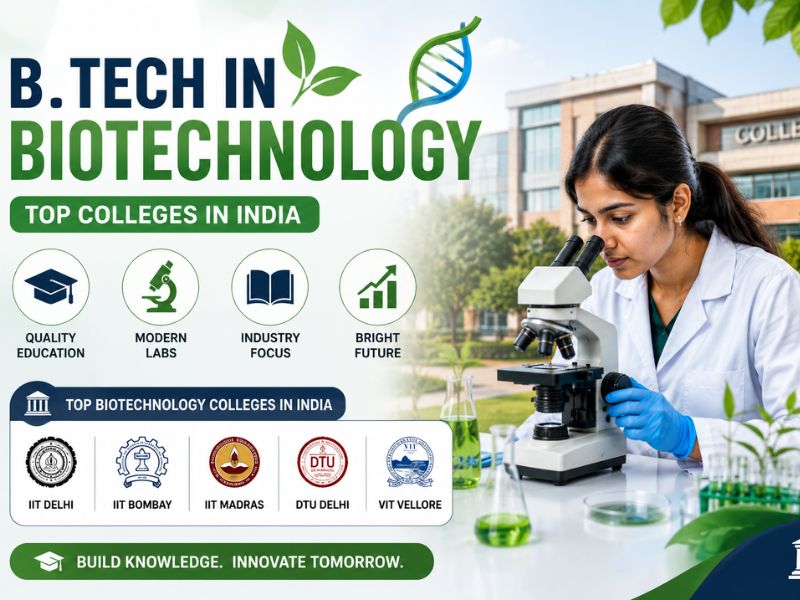
B.Tech in Biotechnology is a four-year engineering programme that blends biology, chemistry, and engineering to solve real-world problems in healthcare, agriculture, and the environment.
With India's biotech sector on a steep growth curve, this degree has become a serious alternative to traditional engineering branches for science students. Here's everything you need to know before you apply for the 2026-2027 academic session.
Understanding B.Tech in Biotechnology
B.Tech in Biotechnology is an undergraduate engineering degree that applies engineering principles to living systems - cells, genes, enzymes, and microorganisms - to create useful products and processes. Unlike a B.Sc. in Biotechnology, which is more theory-driven, the B.Tech version has a stronger engineering core: process design, bioreactor engineering, instrumentation, and computational tools sit alongside molecular biology and genetics.
The course is spread across eight semesters and trains students in areas like recombinant DNA technology, genetic engineering, bioprocess technology, immunology, and bioinformatics. Over four years, students move from foundational sciences (physics, chemistry, mathematics, biology) in the first year to specialised biotech subjects, lab-intensive coursework, and a final-year project or industry internship.
Key Highlights
Four-year, eight-semester undergraduate engineering programme
Combines core engineering with molecular biology, genetics, and bioprocessing
Strong lab component: molecular biology labs, tissue culture labs, bioinformatics labs
Pathways into pharma, agri-biotech, healthcare, environmental biotech, and research
Higher education routes open into M. Tech, M.Sc., MBA, and PhD.
Department curricula typically include biological sciences and engineering with laboratory programmes and a compulsory research project in the final year.
Growing presence of CRISPR, synthetic.IC biologics and AI-driven drug discovery in updated curricula
IIT Delhi
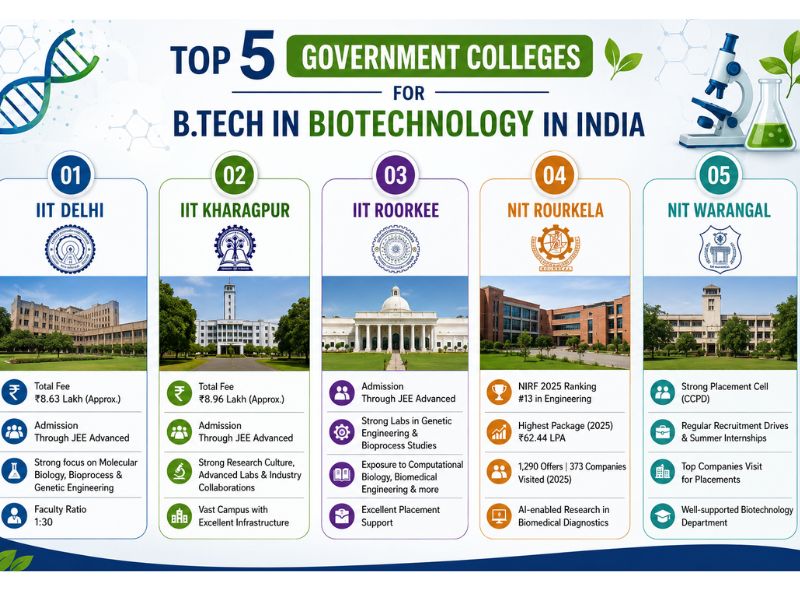
IIT Delhi offers B.Tech in Biotechnology and Biochemical Engineering with a total course fee of around ₹8.63 lakh, the lowest among the top IITs offering this branch. Admission is solely through JEE Advanced rank, with no interviews or additional tests, and the institute maintains a favourable faculty ratio of 1:30, with faculty drawn from leading global institutions. The programme blends molecular biology, bioprocess engineering, and genetic engineering with strong R&D exposure.
IIT Kharagpur
One of India's oldest biotechnology departments, IIT Kharagpur charges a total course fee of around ₹8.96 lakh for its B.Tech in Biotechnology and Biochemical Engineering. The institute is known for strong interdisciplinary research, well-equipped molecular biology and bioprocess labs, and consistent industry tie-ups with pharmaceutical and biotech firms. Admission is exclusively through JEE Advanced. Students benefit from a vast campus, an active research culture, and access to advanced instrumentation.
IIT Roorkee
IIT Roorkee's B.Tech in Biosciences and Bioengineering combines rigorous engineering training with applied biological sciences, supported by strong laboratory infrastructure for genetic engineering and bioprocess studies. As an Institute of National Importance, it offers a highly reputed faculty base and consistent placement support across the medical, healthcare, and research sectors. Entry is strictly through JEE Advanced, making it competitive but rewarding. The institute's research culture, combined with access to interdisciplinary departments, gives students strong exposure to emerging fields like computational biology and biomedical engineering alongside traditional biotech coursework.
NIT Rourkela
NIT Rourkela's Department of Biotechnology and Medical Engineering is known for applied research — its researchers have developed AI-enabled autofocusing technology to improve microscopic imaging for biomedical diagnostics. It is ranked 13th nationally under Engineering by NIRF 2025. Overall BTech placements in 2025 saw a highest package of ₹62.44 lakh, with 1,290 offers made and 373 companies visiting campus, though biotech-specific packages trend lower than CSE. Admission is via JEE Main, and the infrastructure rivals.
NIT Warangal
NIT Warangal offers B.Tech in Biotechnology with strong institutional support through its Centre for Career Planning and Development, which runs regular recruitment drives and summer internships across departments, including Biotechnology. Well-known corporate organisations visit the campus regularly for placement.s
VIT Vellore
VIT Vellore's B.Tech Biotechnology programme is ranked 12th in NIRF, with emphasis on computational biology and synthetic biology. Students engage in projects through VIT's bio-incubator, several leading to patents, supported by advanced spectrometry and chromatography equipment. Admission is through VITEEE, with total fees around ₹7.83-8.5 lakh for the full course.
SRM Institute of Science and Technology (Chennai/Kattankulathur)
One of the most popular private choices for biotech is admission via SRMJEE. Known for large, well-funded labs, strong industry tie-ups, and a wide range of biotech specialisations (genetic engineering, food tech). Good infrastructure and decent placements, though slightly less research-intensive than VIT.
Manipal Institute of Technology (MIT, Manipal)
Part of Manipal Academy of Higher Education, MAHE. Offers B.Tech Biotechnology with modern labs and a strong emphasis on biomedical and bioprocess engineering. Benefits from Manipal's broader life-sciences ecosystem (it also has a medical college on campus), giving students unique interdisciplinary research exposure. Admission through MET (Manipal Entrance Test).
Amity University (Noida)
One of the recognised options for PCB-stream studying.Tech.h Biotechnology. Large campus with dedicated biotech research centres, da ecentcentresry connect iconnectionsiotech corridor and flexible admission criteria (institute-level test/CUET). Good option for students who didn't take Maths in Class 12. Zollege
BITS Pilani
Among the well-regarded private options for Biotechnology, particularly for students without Maths in some allied programs, though its core B. Tech generally requires PCM. Known for rigorous academics, strong faculty, flexible dual-degree options, and excellent placement brand value (BITSAT-based admission) — among the strongest private options academically, comparable to NIT Tiruchirappalli.
Return on Investment (ROI) — rigourValue Colleges
College | Fees (Total) | Avg/Highest Package | ROI Verdict |
IIT Guwahati | ~₹9.03 lakh | Avg ₹21.6 LPA | Best ROI in India at 139% |
IIT Hyderabad | ₹9.43 lakh | High avg + top packages | "Excellent ROI" with strong placement rate |
NIT Trichy | ~₹6.63 lakh | Strong core + tech placements | Very high — lowest fees among top NITs |
VIT Vellore | ₹7.83 lakh | ₹8-12 LPA avg | Strong mid-tier ROI, no JEE Advanced needed |
Mysore University (govt) | ₹0.2–2.0 lakh total | Median ₹3.8 LPA | High value-for-money, low tuition |
1. IIT Madras — Consistently India's #1 NIRF-ranked engineering institute over the last three years. Its biotechnology and bioengineering programs benefit from world-class research infrastructure and the IITM Research Park, which connects students directly to biotech and pharma startups. Placements are elite, with strong R&D and core-sector hiring alongside tech-sector crossovers. It's the gold standard for students aiming at research careers, doctoral pathways, or high-paying corporate biotech roles. Entry is purely through JEE Advanced, so competition is intense — but the brand value, faculty depth, and alumni network make it worth the effort for top-ranking science students.
2. IIT Delhi — A close second nationally, IIT Delhi's biotech-adjacent programs combine engineering rigour with biological sciences research. It has reported the highest placement package in Biotechnology Engineering in India, reaching ₹4 crore per annum for an exceptional candidate. The university has deep industry connections in Delhi-NCR's pharma and healthcare corridor. Recommended for students who want both academic prestige and immediate access to India's policy and R&D ecosystem.
3. IISc Bangalore — Considered the gold standard in 2026, consistently ranked #1 in the NIRF research category, IISc offers world-class interdisciplinary programs with strong AI-in-drug-discovery exposure. Its proximity to Bengaluru's biotech startups and Bio-Innovation Centre gives unmatched exposure to cutting-edge science. Best suited for research-oriented students rather than those chasing campus placements alone.
4. VIT Vellore — Ranked 12th in NIRF, VIT's program emphasises computational biology and biology, with students engaging in projects through VIT's bio-incubator that lead to patents. A strong private alternative to IITs with excellent labs and consistent placement performance — ideal for students who want IIT-level exposure without the JEE Advanced bottleneck.
5. BHU Varanasi — Ranked #16 in the NIRF 2025 research category, BHU's Central Instrumentation Facility gives access to high-end NMR and electron microscopy, and it holds "DBT Star College" status. A great government option for students who want serious research credentials at modest fees.
BHU Varanasi (Institute of Science) — Government-subsidised fees with DBT/ICMR-funded labs; serious academics at minimal cost.
Jamia Millia Islamia — Low fees of around ₹15,000 per year, with labs funded by DBT and ICMR offering access to PCR machines and fermenters, plus a strong alumni network in government research bodies.
State government engineering colleges (e.g., under Anna University, various NITs) -Annual tuition often between ₹5,000-₹35,000 for government seats.
Loyola College (autonomous, Madras University) — Affordable fees around ₹50,000/year, focused on microbial biotechnology and enzyme technology, with biosafety level-2 labs, though placement rate is moderate at around 70%.
Mysore University — Extremely low total fees (₹0.2-2 lakh) with respectable placement medians, ideal for budget-conscious students.
Several private universities admit students purely on Class 12 marks, bypassing JEE/CUET:
Chandigarh University — Admission based purely on Class 12 marks for PCM students; average placement package around 8 LPA; NIRF ranking of 38.
Manav Rachna University — Admission via Class 12 marks (minimum 60% aggregate), also accepting JEE Main or MRNAT scores; merit list prepared from qualifying exam.
Manipal University Jaipur — Accepts candidates with 60% in PCM/PCB-equivalent subjects (including Biotechnology or Biology) directly for admission.
Sharda University, Mangalayatan University — Offer direct merit-based seats using 10+2 scores, with management quota seats (typically 15-25% of total intake) reserved for non-exam applicants.
LPU — High-achievers with a very high JEE Main percentile or 90%+ in 10+2 may be eligible for direct admission and top-tier scholarship brackets, effectively bypassing standard entrance competition.
Highest Placement Packages
IIT Madras: Highest package recorded at ₹4.30 crore per annum (CPA), with median packages reported as high as ₹17-21.6 LPA across top IITs.
IIT Delhi: Reported the highest Biotechnology Engineering package of ₹4 crore per annum for an exceptional offer.
Lovely Professional University (LPU): Highest package among B.Sc. Biotechnology-offering colleges at ₹3 crore per annum — notable since most B.Sc. programs don't offer this level of placement support.
IIT campuses (general): Top IIT students often earn ₹20-30 lakh per year, while other IITs report ₹10-20 lakh per year, with R&D-specific roles seeing fresh salary hikes in the 2026-27 cycle.
Senior/leadership roles industry-wide: The highest-paying job for biotechnology graduates is typically a senior management position in life sciences research, reaching up to ₹50 lakh per annum, though this requires significant experience.
Course Details at a Glance
Particular | Details |
Full Form | Bachelor of Technology in Biotechnology |
Duration | 4 years (8 semesters) |
Level | Undergraduate |
Eligibility | 10+2 with PCB/PCM, minimum 50% |
Admission Mode | Entrance exam + merit, or direct merit-based |
Common Entrance Exams | JEE Main, BITSAT, WBJEE, state CETs, university-level tests |
Average Fees | ₹2 lakh – ₹9 lakh (full course, varies by institute) |
Average Starting Salary | ₹3.5 LPA – ₹8 LPA |
Top Recruiters | Biocon, Serum Institute, Dr Reddy's, Cipla, Intas Pharmaceuticals |
Admission Eligibility and Fee Structure
Eligibility criteria:
Candidates must complete 10+2 from a recognised board with Physics, Chemistry, and Biology or Mathematics (PCB/PCM)
A minimum aggregate of 50% in 10+2 is generally required, with SC/ST/OBC candidates often getting a relaxation of about 5%
Some private universities also accept students without Mathematics, admitting them through the PCB route.
There is no upper age limit for most. B.Tech Biotechnology programmes
Lateral entry is available for diploma holders in biotechnology directly into the second year at many colleges, though IITs typically do not offer lateral entry seats
Fee structure: Fees vary significantly depending on whether the institute is government-funded or private.
Government colleges/IITs/NITs: Roughly ₹2 lakh to ₹6 lakh for the entire four-year course, sometimes ₹2-3 lakh per year at premier institutes
Private universities: Typically ₹5 lakh to ₹9 lakh for the full course, with some charging ₹1.5 lakh to ₹4 lakh per year
Additional costs include hostel and mess fees, lab fees, and a one-time admission/registration fee (commonly ₹1,000-₹2,500 for application processing)
Scholarships based on merit, entrance exam scores, or family income are available at most institutions, so it's worth checking each college's scholarship policy separately.
The admission journey generally follows these steps:
Check eligibility - Confirm your 10+2 PCB/PCM percentage meets the cutoff (usually 50%).
Register for entrance exams - Apply for JEE Main, BITSAT, WBJEE, CUET UG, or the relevant state-level CET depending on the colleges you're targeting.
Appear for the exam - Exams typically test Physics, Chemistry, Mathematics/Biology.
Application to colleges - Many private universities also run direct, merit-based admission alongside entrance scores.
Counselling and seat allotment - Candidates register for counselling, fill in their preferences, and lock B.Tech Biotechnology as their preferred branch.
Document verification - Upload or submit marksheets, ID proof, category certificates, and passport photographs.
Fee payment and confirmation - Candidates visit the allotted institute, complete document verification, pay fees, and submit certificates to confirm their seat.
Documents typically required: Class 10 and 12 mark sheets, entrance exam scorecard, transfer/migration certificate, character certificate, category certificate (if applicable), and passport-size photographs.
Selection generally rests on one or a combination of:
Entrance exam rank/score - JEE Main rank for NITs and many private universities; BITSAT for BITS campuses; state CETs for state government colleges
Class 12 marks - Used either as a baseline eligibility filter or, at many private universities, as the primary merit criterion
Salary expectations vary quite a bit depending on the institute tier, specialisation, and role:
Freshers (overall average): Around ₹3.5 LPA to ₹5.5 LPA, with graduates from top-tier institutions or those skilled in bioinformatics or genetic engineering starting closer to ₹6 LPA
Entry-level (0-3 years): Roughly ₹2.5-6 LPA, covering roles like lab technicians and junior biotechnologists
Mid-level (4-9 years): Around ₹6-12 LPA for research associates and process engineers
Senior level (10+ years): Approximately ₹13-25 LPA for managerial and principal scientist roles
High-growth specialisations: Roles in bioinformatics and AI-driven drug discovery can start at ₹6 LPA and cross ₹15 LPA with experience
Salaries are generally higher in metro cities like Bangalore, Hyderabad, and Mumbai, where most major pharma and biotech companies are headquartered. Government research roles (CSIR, ICMR, DBT) offer relatively modest starting pay but come with job security and long-term benefits.
India's biotechnology sector is being positioned as one of the country's major growth engines. With government schemes supporting biomanufacturing, vaccine production, and agri-biotech, plus rising global demand for skilled biotech professionals, a B.Tech in Biotechnology can place graduates at the centre of this momentum. The presence of over 700 biotechnology startups in India shows there's also a growing entrepreneurial path for graduates who want to build something of their own rather than just join an existing company.
Specialising early in bioinformatics, synthetic biology, or precision medicine - and combining your degree with internships or research exposure will matter more than the degree title alone in determining how far you go.
Conclusion
B.Tech in Biotechnology is a solid choice for science students who want an engineering degree rooted in biology, with real opportunities across pharma, healthcare, agriculture, and research. While starting salaries may trail behind branches like CSE, the long-term scope - especially with specialisation or higher studies - makes it a career worth considering for the right kind of student.
Frequently Asked Questions (FAQs) About B.Tech in Biotechnology
Q1. Is NEET required for B.Tech in Biotechnology? No, B.Tech Biotechnology does not require NEET. Admission can be taken directly at private or government colleges through other entrance routes like JEE Main or institute-level exams.
Q2. Can I pursue B.Tech Biotechnology without Mathematics in 12th grade? Yes, it is possible at certain private universities that accept PCB students without Mathematics, though most colleges still prefer or require it.
Q3. What is the course duration? The B.Tech Biotechnology course lasts four years, divided into eight semesters.
Q4. What are the typical entrance exams for this course? JEE Main, JEE Advanced (for IITs), BITSAT, WBJEE, CUET UG, and various state-level CETs.
Q5. What is the average fee for the entire course? Government colleges generally charge ₹2-6 lakh for the full programme, while private universities range between ₹5-9 lakh.
Q6. What jobs can I get after B.Tech in Biotechnology? Common roles include Biotechnologist, Research Associate, Quality Control Analyst, Clinical Research Associate, Bioprocess Engineer, Regulatory Affairs Specialist, and Bioinformatics Analyst.
Q7. Is higher education necessary after B.Tech in Biotechnology? Not mandatory, but an M.Tech, M.Sc., or PhD significantly improves access to PhDearchh roles and higher-paying positions, especially in core R&D.