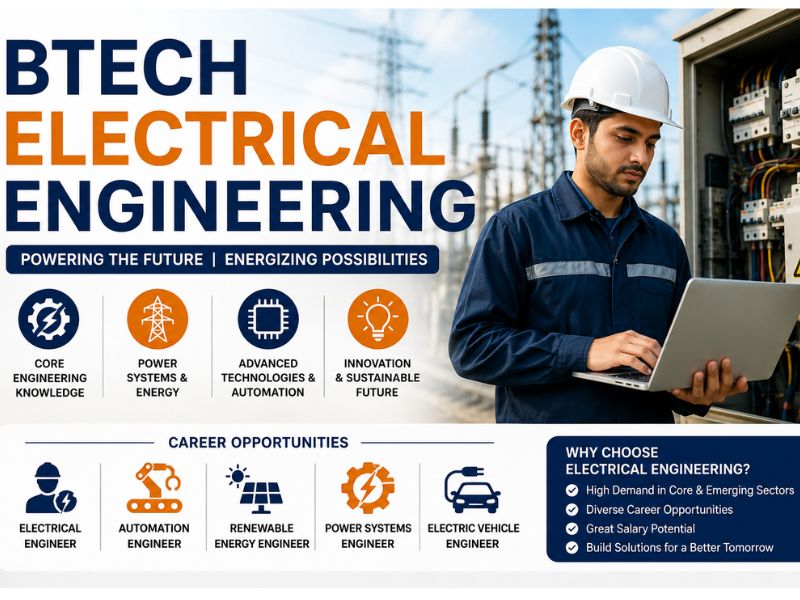
Electrical Engineering remains one of the most important and evergreen branches of engineering in the world. From power generation and smart grids to electric vehicles and renewable energy systems, electrical engineers play a critical role in building modern infrastructure and advanced technologies.
In 2026, the demand for skilled electrical engineers is increasing rapidly due to industrial automation, sustainable energy solutions, AI-driven systems, and global electrification projects. A BTech in Electrical Engineering not only provides strong technical knowledge but also opens opportunities in government sectors, multinational companies, research organisations, and emerging technology industries.
This guide covers everything students need to know about BTech Electrical Engineering, including eligibility, admission process, fees, syllabus, career scope, salary, top colleges, latest trends, and future opportunities.
BTech Electrical Engineering is a 4-year undergraduate engineering program focused on electricity, electronics, electromagnetism, power systems, and electrical machines.
The course combines theoretical concepts with practical engineering applications used in industries, infrastructure, energy systems, automation, and advanced technologies.
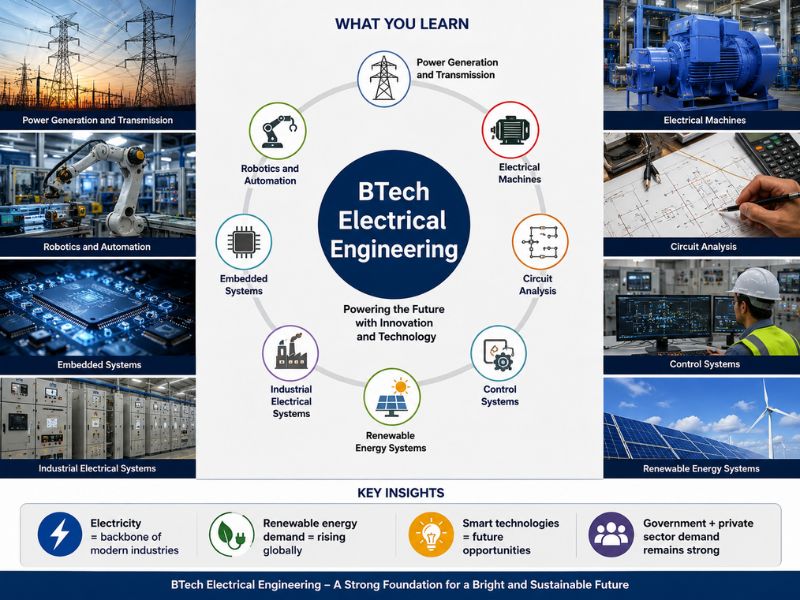
Students learn how electrical power is produced, transmitted, and distributed efficiently across cities and industries. This subject helps students understand power plants, transmission lines, substations, and modern energy management systems.
This subject focuses on the working principles and applications of motors, generators, and transformers used in industries and power systems. Students also gain practical knowledge about machine performance, maintenance, and electrical operations.
Circuit analysis helps students understand the behaviour of electrical circuits, including voltage, current, resistance, and network design. It builds strong analytical and problem-solving skills required in electrical engineering.
Students learn how automatic control systems operate in electrical and industrial environments. The subject plays an important role in automation, robotics, manufacturing systems, and intelligent machine control.
This area focuses on sustainable energy technologies such as solar, wind, hydro, and green power systems. Students explore clean energy solutions and modern methods of efficient electricity generation.
Robotics and automation introduce students to smart machines, automated manufacturing systems, and industrial robotics technologies. It helps develop skills related to AI-driven systems and advanced industrial automation.
Embedded systems teach students about microcontrollers, hardware programming, and smart electronic devices used in modern technology. This field is widely used in automotive systems, consumer electronics, and IoT devices.
Students study industrial power systems, electrical safety, industrial wiring, and large-scale electrical operations used in factories and manufacturing units. This subject prepares students for real-world industrial engineering applications.
Electrical Engineering offers excellent long-term career stability because electricity and energy systems are essential across every industry.
Electrical engineering is considered an evergreen engineering branch because electricity and power systems are essential in every industry. The demand for skilled electrical engineers remains strong across both traditional and modern technology sectors.
This field offers excellent government job opportunities through PSUs, railways, power departments, and public sector organisations. Many students prefer electrical engineering for its stable and secure career pathways in government sectors.
The rapid expansion of solar, wind, and sustainable energy projects has increased the demand for electrical engineers globally. Students gain opportunities to work in clean energy technologies and future-focused power systems.
Electrical engineers are highly required in manufacturing, automation, construction, and industrial operations. Industries depend heavily on electrical systems for efficient production and technological advancement.
Electrical engineering provides a strong international career scope in countries like the USA, Germany, Canada, Australia, and Gulf nations. Skilled professionals are in demand worldwide due to rapid industrial and technological growth.
Students can choose from multiple specialisations such as power systems, robotics, embedded systems, automation, renewable energy, and control systems. These options help students build expertise in high-demand technical fields.
Electrical engineering offers excellent opportunities for higher education, research, and technical specialisation through MTech, MS, MBA, and PhD programs. Advanced education can significantly improve career growth and salary potential.
Electrical Engineering is ideal for students interested in technology, innovation, infrastructure, and long-term career growth.
Students must complete 10+2 with Physics, Chemistry, and Mathematics from a recognised board to become eligible for engineering admission. Most colleges require a minimum of 50%–75% aggregate marks, depending on the institution and competition level.
Admission to top engineering colleges is usually based on entrance examinations such as JEE Main, JEE Advanced, and various state-level engineering entrance exams. These exams evaluate students’ problem-solving ability, conceptual understanding, and technical aptitude.
Engineering students should possess strong analytical thinking skills to understand technical concepts and solve complex engineering problems. This ability helps in designing systems, improving processes, and handling practical challenges effectively.
Problem-solving is one of the most important skills in engineering because students regularly work with calculations, circuits, systems, and technical designs. Strong logical reasoning improves both academic and professional performance.
A genuine interest in technology, machines, electrical systems, and innovation is highly beneficial for engineering students. Technical curiosity helps students stay motivated and adapt to rapidly evolving industries.
Mathematics forms the foundation of engineering education, especially in areas like circuit analysis, control systems, and power calculations. Strong mathematical skills help students understand engineering concepts more effectively.
Engineering projects require precision, accuracy, and careful analysis to avoid technical errors and system failures. Students with strong attention to detail generally perform better in practical applications and industrial environments.
The total fees for BTech Electrical Engineering in 2026 can vary significantly depending on whether students choose government or private engineering colleges. Factors such as college reputation, infrastructure, placements, and specialisation options also influence the overall cost of the program.
Government engineering colleges generally offer the most affordable B.Tech. Electrical Engineering programs in India. The total course fees usually range between ₹50,000 and ₹3 Lakhs, making them highly attractive for students seeking strong ROI and quality education at lower costs.
Private engineering colleges typically charge higher tuition fees due to modern infrastructure, advanced laboratories, industry partnerships, and campus facilities. The total course fees in private institutions generally range between ₹4 Lakhs – ₹12 Lakhs, depending on the college and specialisation.
Government colleges are often considered the best ROI option because of lower fees and strong placement opportunities. Many institutions also provide scholarships, financial aid, and fee concessions for deserving students. On the other hand, private colleges are preferred for their advanced infrastructure, modern learning environment, flexible admissions, and industry-oriented training programs.
Students should compare fees, placements, infrastructure, faculty quality, and long-term career opportunities before selecting a BTech Electrical Engineering college in 2026.
This subject teaches students about motors, generators, transformers, and their industrial applications. It helps build a strong understanding of machine operations, efficiency, and electrical energy conversion systems.
Power systems focus on electricity generation, transmission, distribution, and grid management. Students learn how large-scale electrical networks operate safely and efficiently in real-world environments.
Control systems help students understand automation, stability, and system response in electrical engineering applications. This subject is widely used in robotics, manufacturing, and industrial automation technologies.
Students study signal processing, system behaviour, and communication fundamentals used in modern electrical and electronic systems. It develops analytical and mathematical problem-solving skills.
This subject focuses on electronic devices used for power conversion and energy control. Students learn about converters, inverters, and advanced power management technologies used in industries and EV systems.
Electrical measurements teach students how to measure voltage, current, resistance, and other electrical parameters accurately. This subject is essential for testing, maintenance, and system analysis.
Students learn about logic gates, digital circuits, microprocessors, and modern electronic systems. Digital electronics form the foundation of computing and intelligent automation technologies.
Microprocessors focus on hardware programming, embedded systems, and smart electronic device operations. This subject is highly important in automation, robotics, and IoT-based technologies.
Students explore solar, wind, hydro, and sustainable power generation technologies. The subject prepares students for careers in green energy and future-focused power industries.
Lab sessions help students gain practical experience with electrical equipment, circuit design, and testing procedures. It strengthens technical understanding through hands-on learning.
Industrial training exposes students to real industrial environments, machine operations, and professional engineering practices. It helps bridge the gap between theoretical and practical knowledge.
Internships provide students with industry exposure, technical skills, and workplace experience before graduation. They also improve employability and placement opportunities.
Major projects allow students to apply engineering concepts to real-world technical problems. These projects enhance innovation, teamwork, research ability, and practical problem-solving skills.
This specialisation focuses on advanced power generation, transmission networks, and electrical grid management. It offers strong opportunities in power plants, PSUs, and energy companies.
Students learn about sustainable energy technologies such as solar, wind, and smart energy systems. This field is growing rapidly due to increasing global demand for clean energy solutions.
Control systems specialisation focuses on automation, intelligent machines, and industrial control technologies. It is highly valuable in manufacturing, robotics, and process industries.
Embedded systems teach students about smart devices, microcontrollers, and hardware-software integration. This field is widely used in electronics, automotive, and IoT industries.
This specialisation covers robotics, AI-integrated systems, and industrial automation technologies. Students gain expertise in smart manufacturing and intelligent machine operations.
Smart grid technology focuses on advanced electricity distribution systems, energy monitoring, and intelligent power management. It plays a key role in modern electrical infrastructure development.
Industrial automation teaches students how industries use automated systems to improve productivity and efficiency. This specialisation is highly demanded in manufacturing and process industries.
Students learn about EV systems, battery technologies, charging infrastructure, and electric mobility solutions. This field is rapidly expanding due to the growth of the electric vehicle industry.
Artificial intelligence is transforming electrical engineering through smart automation, predictive maintenance, and intelligent power management systems. This area offers strong future career potential.
Sustainable power systems focus on energy-efficient technologies and environmentally friendly electricity generation methods. The field is becoming increasingly important in global energy development.
EV infrastructure includes charging stations, battery systems, and electric mobility technologies required for modern transportation systems. Demand for skilled professionals in this area is rising rapidly.
Smart energy technologies combine automation, IoT, and advanced analytics to improve power efficiency and grid performance. This domain is shaping the future of intelligent energy management.
Students must complete higher secondary education with science subjects.
Most colleges admit students through:
Submit applications to government and private institutions.
Based on entrance rank and preferences.
Complete final admission formalities.
Excellent placements and research opportunities.
Strong global reputation and industry exposure.
Advanced electrical research ecosystem.
High ROI and strong placements.
Affordable fees with excellent academics.
Modern infrastructure and industry partnerships.
Strong placement support.
Advanced engineering curriculum.
Industry-oriented programs.
Excellent academic reputation.
B.Tech. Electrical Engineering offers strong career opportunities across government, private, industrial, and technology sectors. Due to the increasing demand for electricity, automation, renewable energy, and smart technologies, electrical engineers continue to remain highly valuable in India and globally.
Electrical engineers work in thermal, hydro, nuclear, and solar power plants where they manage electricity generation, maintenance, and power distribution systems. This sector offers stable career growth and technical exposure.
Renewable energy companies hire electrical engineers for solar, wind, and sustainable energy projects. The rapid growth of green energy technologies is creating strong future demand in this sector.
Government electricity departments and state power boards provide secure and respected career opportunities for electrical engineering graduates. These roles often involve power management, maintenance, and infrastructure operations.
Manufacturing industries require electrical engineers for machine operations, industrial automation, power systems, and maintenance management. This sector offers diverse technical and operational career roles.
Automation companies hire engineers to work on smart manufacturing systems, industrial robotics, and AI-based industrial technologies. This field is growing rapidly with Industry 4.0 advancements.
Electrical engineers play an important role in railway electrification, signalling systems, maintenance, and transportation infrastructure. Government railway jobs remain highly preferred due to stability and benefits.
Modern smart city and infrastructure projects require electrical engineers for intelligent energy systems, automation, and smart grid technologies. This field offers future-focused engineering opportunities.
Electric vehicle companies hire electrical engineers for battery systems, charging infrastructure, power electronics, and EV technology development. The electric mobility sector is expected to grow significantly in the coming years.
Electrical engineers design, develop, and maintain electrical systems used in industries, buildings, and infrastructure projects. This is one of the most common and versatile engineering roles.
Power system engineers focus on electricity generation, transmission, and distribution systems. They help ensure efficient and reliable power supply operations.
Control engineers work on automated systems, industrial controls, and intelligent process management technologies. This role is highly important in the automation and manufacturing industries.
Automation engineers develop smart industrial systems that improve productivity and reduce manual operations. They work with robotics, AI, PLCs, and automated manufacturing technologies.
Design engineers create electrical system layouts, technical drawings, and engineering solutions for industrial and infrastructure projects. Creativity and technical precision are essential in this role.
Maintenance engineers ensure electrical machines, industrial systems, and power equipment function efficiently with minimal downtime. This role is highly demanded in factories and production industries.
Project engineers manage engineering projects, technical planning, installation, and execution activities. They coordinate between teams to ensure successful project completion.
Electrical consultants provide technical guidance, system planning, and engineering solutions for industries, infrastructure projects, and commercial developments. This role offers strong long-term professional growth opportunities.
Electrical Engineering offers one of the broadest engineering career scopes in India and globally.
Salary After B.Tech. Electrical Engineering