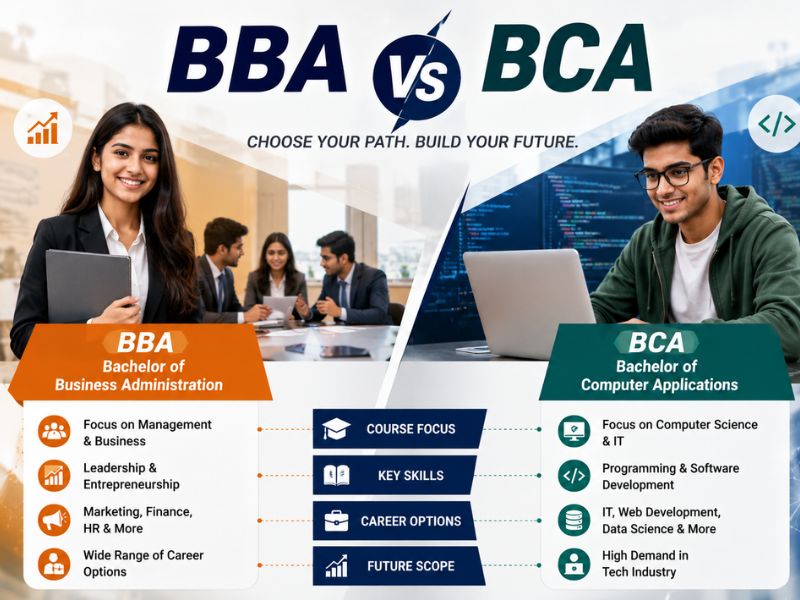
Choosing between BBA and BCA is one of the most common dilemmas for students after Class 12 — and in 2026, this decision matters more than ever as both fields evolve rapidly alongside AI, automation, and data-driven business practices. BBA (Bachelor of Business Administration) builds a foundation in management, finance, marketing, and organisational leadership, while BCA (Bachelor of Computer Applications) focuses on programming, software development, and technical computing skills.
Both are genuinely strong three-year undergraduate degrees with growing industry relevance, but they lead down meaningfully different career paths. BBA graduates typically enter management trainee programs, marketing, HR, or finance roles, often pursuing an MBA afterwards for career acceleration. BCA graduates typically enter software development, IT support, or technical roles, often pursuing an MCA or specialised tech certifications to deepen their expertise.
BBA (Bachelor of Business Administration) is a three-year undergraduate management degree designed to build foundational business knowledge across finance, marketing, human resources, and operations.
The curriculum covers core subjects like Principles of Management, Financial Accounting, Marketing Management, Human Resource Management, Business Communication, and Organisational Behaviour, giving students a broad, well-rounded understanding of how businesses function and are managed.
Students learn to write and debug code, design and manage databases, build websites and applications, and understand the underlying architecture of computer systems — preparing them for technical, execution-focused roles rather than purely managerial ones.
Here's a side-by-side breakdown to help clarify the genuine distinctions between these two degrees for 2026.
Core focus
BBA focuses on business management, strategy, and organisational leadership. BCA focuses on programming, software development, and technical computing.
Curriculum nature
BBA coursework is largely theoretical and case-study based, covering management principles, finance, and marketing. BCA coursework is largely practical and hands-on, involving coding, lab work, and software projects.
Skill set developed
BBA builds communication, leadership, strategic thinking, and business analysis skills. BCA builds programming, logical reasoning, technical problem-solving, and software development skills.
Typical entry-level job roles
BBA graduates typically enter roles like Marketing Executive, HR Executive, Business Analyst, or Management Trainee. BCA graduates typically enter roles like Software Developer, Web Developer, System Analyst, or IT Support Executive.
Further education pathway
BBA graduates commonly pursue an MBA to advance into leadership and general management roles. BCA graduates commonly pursue an MCA or specialised technical certifications (like AWS, Data Science, or Cybersecurity credentials) to deepen technical expertise.
Industry demand and salary trends
Both degrees show strong industry demand in 2026, though BCA graduates entering pure technical/coding roles often see slightly higher entry-level salaries in IT services, while BBA graduates often see stronger long-term growth potential through MBA-driven career acceleration into leadership roles.
Work environment
BBA careers typically involve more people-facing, strategic, and cross-functional collaboration. BCA careers typically involve more independent or team-based technical execution, often within IT or software development teams.
Our advice: Rather than choosing based on perceived salary or prestige, honestly assess whether you genuinely enjoy working with people and business strategy (BBA) or find satisfaction in solving technical problems through code (BCA) — this fundamental interest fit matters far more for long-term career satisfaction than which degree appears more "in demand" in any given year.
Here's what you need to qualify for each program in 2026.
BBA eligibility
BCA eligibility
Age requirement
Both programs generally require candidates to be at least 17 years old at the time of admission, with no significant differences between the two degrees on this front.
Entrance exam requirements
Both BBA and BCA admissions vary by institute — some rely on Class 12 merit alone, while others require CUET or institute-specific entrance exams testing general aptitude, reasoning, and (for BCA specifically) basic logical/mathematical ability.
Key eligibility distinction to note
The single biggest eligibility difference is BCA's frequent Mathematics requirement — if you didn't study Math in Class 12, your BCA options may be more limited compared to BBA, which remains open to students from any stream without this constraint.
Our advice: If you're a Commerce or Arts stream student without Mathematics in Class 12, verify your target BCA colleges' specific subject requirements carefully — some institutes are flexible on this, but many genuinely aren't, whereas BBA remains accessible regardless of your Class 12 subject combination for 2026 admissions.
Here's how the admission journey compares between the two degrees for 2026.
BBA admission process
Step 1: Research and shortlist colleges based on specialisation, placement records, and fee structure
Step 2: Check whether your target institute requires CUET, an institute-specific entrance exam, or admits based on Class 12 merit alone
Step 3: Submit your application with academic transcripts and required documents
Step 4: Appear for entrance exam (where applicable), typically testing general aptitude, reasoning, and English proficiency
Step 5: Attend Group Discussion/Personal Interview rounds (common at many top institutes)
Step 6: Receive admission offer based on merit score or entrance exam performance
Step 7: Complete document verification and fee payment
BCA admission process
Step 1: Research and shortlist colleges based on specialisation (Data Science, AI/ML, general BCA), placement records, and fee structure
Step 2: Check whether your target institute requires CUET, an institute-specific entrance exam, or admits based on Class 12 merit alone
Step 3: Submit your application with academic transcripts, ensuring Mathematics eligibility is confirmed where required
Step 4: Appear for the entrance exam (where applicable), typically testing logical reasoning, quantitative aptitude, and basic computer knowledge
Step 5: Some institutes conduct a Personal Interview assessing genuine interest in technology and problem-solving aptitude
Step 6: Receive admission offer based on merit score or entrance exam performance
Step 7: Complete document verification and fee payment
Key process difference
BCA admissions more frequently test computer/technical aptitude specifically (even at the entrance exam stage), while BBA admissions lean more heavily on communication skills and general business awareness during interviews and group discussions.
Our advice: Since both degrees follow broadly similar admission timelines and structures, the real differentiator is preparation focus — BBA applicants should prepare for GD-PI rounds emphasising communication and current affairs, while BCA applicants should brush up on basic logical reasoning and computer fundamentals for entrance tests, where required.
Here's how entrance exam requirements compare between the two degrees for 2026.
Common to both BBA and BCA
BBA-specific entrance exams
BCA-specific entrance exams
Exam content difference
BBA entrance exams typically emphasise verbal ability, general awareness, and business-oriented reasoning. BCA entrance exams typically emphasise logical/mathematical reasoning and basic computer literacy, reflecting the program's more technical orientation.
Our advice: Since exam content genuinely differs based on each degree's core focus, avoid generic "entrance exam prep" — instead, tailor your preparation specifically toward verbal/business reasoning for BBA or logical/mathematical reasoning for BCA, depending on which path you're pursuing for 2026.
Here's how program length compares between the two degrees for 2026.
Standard duration for both
Both BBA and BCA are three-year undergraduate programs, typically divided into 6 semesters — there's no difference in overall duration between the two degrees.
Semester structure
Integrated program options (extending duration)
Some institutes offer integrated BBA+MBA (5 years) or BCA+MCA (5 years) dual-degree tracks, allowing students to complete both undergraduate and postgraduate education in a compressed timeline compared to pursuing them separately.
Internship and practical component timing
Both programs typically include internship requirements in the final year, though BCA programs often emphasise live coding projects and technical internships slightly earlier in the curriculum, given the hands-on nature of programming skill development.
Our advice: Since duration is genuinely identical between BBA and BCA (3 years standard), this factor shouldn't influence your decision at all — focus instead on curriculum content and career fit, which differ far more meaningfully between the two programs.
Here's how the curriculum genuinely differs between these two degrees for 2026.
BBA syllabus (semester-wise overview)
BCA syllabus (semester-wise overview)
Practical/lab component comparison
BCA involves significantly more lab-based, hands-on coding work throughout all three years — nearly every core subject has an accompanying programming lab. BBA involves more case-study analysis, business simulations, and presentation-based learning, with practical exposure concentrated more heavily in internships and live projects during the final year.
Skill-building focus
BBA syllabus builds toward strategic thinking, communication, and cross-functional business understanding. BCA syllabus builds toward technical proficiency, systematic problem-solving, and software development capability.
Our advice: If you're unsure which degree suits you, honestly reflect on which subject list excites you more — if "Programming Fundamentals" and "Data Structures" sound genuinely interesting, lean BCA; if "Marketing Management" and "Organisational Behaviour" resonate more, lean BBA. This gut check often reveals more than salary comparisons alone.
Here's a realistic fee breakdown across both degrees for 2026.
BBA fees across institute tiers
BCA fees across institute tiers
General fee comparison observation
Fee ranges between BBA and BCA are broadly similar at comparable institute tiers, though BCA programs at some technology-focused universities can run slightly higher due to lab infrastructure, software licensing, and computing resource costs.
Additional cost considerations
Our advice: Since fee ranges are genuinely comparable between BBA and BCA at similar institute tiers, don't let cost be your deciding factor between the two degrees — instead, compare fees within your chosen degree category across different colleges, and let genuine career interest guide your BBA vs. BCA decision itself for 2026.
Here's a look at leading institutes offering each program in 2026.
Top BBA colleges in India
Top BCA colleges in India
A notable pattern
Several top universities (Christ, NMIMS, Loyola, Jain) offer both BBA and BCA as strong, well-regarded programs — meaning your college shortlisting process can often run in parallel regardless of which degree you ultimately choose, since these institutions maintain quality across both tracks.Specialised options worth considering
For BCA specifically, look for institutes with dedicated computer science departments or strong industry certifications embedded in the curriculum (like AWS or Google Cloud partnerships) — these often deliver better technical training than colleges offering BCA as a secondary program alongside primarily business-focused offerings.
Our advice: Since many strong universities offer both programs, prioritise researching each institute's specific placement records and industry partnerships for your chosen degree (BBA or BCA) rather than assuming overall university reputation automatically translates equally across both programs.
Here's how specialisation options compare between the two degrees for 2026.
Popular BBA specialisations
Popular BCA specialisations
Specialisation overlap worth noting
Business Analytics (BBA) and Data Science (BCA) increasingly overlap in skill requirements — both involve data interpretation and analytical tools, though BBA's Business Analytics track frames this within a business decision-making context, while BCA's Data Science track goes deeper into the underlying technical and statistical methods.
Choosing based on genuine interest
If you're drawn to understanding why businesses make certain decisions and how data supports that strategy, BBA's Business Analytics specialisation fits better. If you're drawn to building the actual data models, algorithms, and technical systems, BCA's Data Science or AI/ML specialisation is the stronger fit.
Our advice: Given the growing convergence between business and tech specialisations, some students genuinely benefit from choosing based on which "flavour" of a similar interest area appeals more — business-context-first (BBA) versus technical-execution-first (BCA) — rather than treating these as entirely separate universes.
Here's how long-term career trajectories genuinely compare between these two degrees for 2026.
BBA career trajectory
BBA graduates typically build careers across marketing, finance, HR, operations, and general management functions, with strong potential for cross-functional movement and eventual leadership roles — particularly when combined with an MBA. Career growth tends to be more relationship and strategy-driven, often involving people management as seniority increases.
BCA career trajectory
BCA graduates typically build careers in software development, IT infrastructure, data science, and technical consulting, with strong potential for deep technical specialisation or eventual movement into technical leadership (like CTO-track roles) — particularly when combined with an MCA or advanced certifications. Career growth tends to be skill and expertise-driven, often involving increasingly complex technical problem-solving as seniority increases.
Industry demand comparison for 2026
Both fields show genuinely strong industry demand — BCA benefits from India's massive and growing IT/software services sector, while BBA benefits from the broad, universal need for management talent across every industry, not just one sector.
Salary trajectory comparison
Entry-level salaries are often comparable (₹3-6 LPA range for both), though BCA graduates in pure technical roles at strong IT companies can sometimes see faster early-career salary growth, while BBA graduates often see stronger long-term growth through MBA-driven career acceleration into leadership positions.
Career flexibility comparison
BBA offers broader flexibility across industries (any company needs marketing, HR, and finance talent), while BCA offers deeper flexibility within the tech ecosystem specifically (software, IT services, product companies, startups).
Our advice: If you want broad industry flexibility and people-oriented leadership growth, BBA's career scope fits better. If you want deep technical mastery and strong demand specifically within India's booming IT sector, BCA's career scope offers genuinely excellent long-term prospects for 2026 and beyond.
Here's a detailed look at where a BBA degree can take you in 2026.
1. Marketing Executive/Manager
Develops and executes marketing campaigns, market research, and brand positioning strategies.
2. Human Resource Executive
Handles recruitment, employee onboarding, performance management, and organisational culture initiatives.
3. Financial Analyst
Analyses financial data, prepares reports, and supports investment or budgeting decisions.
4. Business Development Executive
Identifies new business opportunities, partnerships, and market expansion strategies.
5. Operations Executive
Manages day-to-day business operations, process optimisation, and logistics coordination.
6. Business Analyst
Bridges business strategy and data-driven decision-making, particularly relevant for Business Analytics specialisation graduates.
7. Sales Executive/Manager
Drives revenue growth through client acquisition and relationship management.
8. Management Trainee
Structured rotational programs at large corporations, providing exposure across departments before specialisation.
9. Entrepreneur/Business Owner
Uses BBA foundational knowledge to launch and manage independent business ventures.
10. Digital Marketing Specialist
Focuses on SEO, social media marketing, content strategy, and online advertising campaigns.
Our advice: Use your internships strategically to explore 2-3 different business functions before committing to a specific career track — BBA's genuine strength is the broad exposure it provides before you need to specialise.
Here's a detailed look at where a BCA degree can take you in 2026.
1. Software Developer/Engineer
Writes, tests, and maintains code for applications, websites, and software systems.
2. Web Developer
Builds and maintains websites, focusing on front-end, back-end, or full-stack development.
3. Data Analyst
Analyses datasets to generate insights, often the entry point for students pursuing further Data Science specialisation.
4. Database Administrator
Manages, maintains, and secures organisational databases and data infrastructure.
5. System Analyst
Evaluates and designs IT systems to meet organisational business requirements.
6. Mobile Application Developer
Builds applications specifically for Android or iOS platforms.
7. Cybersecurity Analyst
Monitors and protects organisational systems from security threats and vulnerabilities.
8. Cloud Support Engineer
Manages and maintains cloud-based infrastructure and services (AWS, Azure, Google Cloud).
9. IT Support/Technical Consultant
Provides technical troubleshooting and systems support for organisations.
10. Game Developer
Designs and codes video games, a growing niche within India's expanding gaming industry.
Our advice: Given how quickly technology evolves, actively build a portfolio of personal coding projects alongside your BCA coursework — practical, demonstrable skills (GitHub projects, certifications) often matter more to tech recruiters than academic performance alone for 2026 placements.
Here's a realistic, side-by-side salary breakdown for 2026.
BBA starting salaries
BCA starting salaries
Mid-career salary comparison (5+ years experience)
Key salary insight
Entry-level salaries are genuinely comparable between the two degrees, but BCA's ceiling in pure technical specialisations (AI, cloud architecture, cybersecurity) can climb higher and faster in India's booming IT sector, while BBA's growth is more consistently tied to pursuing an MBA for meaningful salary jumps.
Our advice: Don't choose your degree based on marginal starting salary differences — both fields offer strong earning potential, and the real salary differentiator in both cases is individual skill-building, further specialisation (MBA or MCA), and performance rather than which undergraduate degree you initially chose.
Here's who's hiring graduates from each program in 2026.
Top recruiters for BBA graduates
Top recruiters for BCA graduates
Overlap in recruiters
Companies like Amazon, Deloitte, Accenture, and Flipkart actively recruit from both BBA and BCA pools — but for genuinely different role types (business/strategy roles for BBA graduates, technical/development roles for BCA graduates), even within the same company.
Our advice: When researching a company as a potential employer, look specifically at which department or role type they're hiring for — the same company name appearing on both BBA and BCA placement lists doesn't mean identical opportunities; verify the specific job profiles being offered to each graduate pool.
Here's how postgraduate pathways compare between the two degrees for 2026.
BBA higher studies pathway
BCA higher studies pathway
Career growth acceleration comparison
Both degrees see meaningful career acceleration through further education — BBA graduates gain broader strategic and leadership capability through an MBA, while BCA graduates gain deeper technical mastery and specialisation through an MCA or targeted certifications.
Which higher studies path delivers faster ROI?
Industry-recognised technical certifications (AWS, Azure) often deliver faster, more targeted ROI for BCA graduates compared to a full MCA, since specific certifications directly signal in-demand skills to employers. For BBA graduates, a full MBA generally delivers more career transformation than standalone certifications, since management-track roles value the comprehensive leadership training an MBA provides.
Our advice: If you're a BCA graduate deciding between an MCA and certifications, consider your specific goals — an MCA suits those wanting deeper foundational knowledge or research/teaching ambitions, while targeted certifications suit those wanting faster entry into specific high-demand technical roles. BBA graduates, meanwhile, should strongly consider gaining 2-3 years of work experience before pursuing an MBA for maximum admission and career impact.
Rather than declaring one degree objectively "better," here's a genuine framework to help you decide for 2026.
Choose BBA if:
Choose BCA if:
A genuine self-assessment question
Think back to your favourite Class 12 subjects and extracurricular interests — if you gravitated toward economics, business studies, or leadership activities, BBA likely fits better. If you gravitated toward mathematics, computer science, or building/tinkering with technology, BCA likely fits better.
When the choice is genuinely close
If you're equally interested in both, consider your risk tolerance and industry preference — BCA offers more predictable, skill-based entry into India's massive IT sector, while BBA offers broader flexibility but often requires an MBA to unlock significant career acceleration.
Our advice: Talk to actual professionals in both fields (through LinkedIn, family connections, or college seniors) about their day-to-day work before deciding — hearing genuine, unfiltered descriptions of daily responsibilities often reveals fit more clearly than comparing curriculum or salary charts alone.
Here's an honest breakdown of the genuine trade-offs for each degree in 2026.
BBA: Pros
BBA: Cons
BCA: Pros
BCA: Cons
Our advice: Weigh these trade-offs against your own genuine strengths and interests rather than external perceptions of which field is "hotter" right now — both BBA and BCA offer strong, legitimate career paths in 2026, and the biggest determinant of your success will be your engagement and skill-building within whichever degree genuinely excites you.
1. Which is better, BBA or BCA?
Neither is objectively better — it depends entirely on your interests. BBA suits students drawn to business strategy, leadership, and people management, while BCA suits students drawn to coding, technical problem-solving, and software development.
2. Which course has better salary prospects, BBA or BCA?
Entry-level salaries are broadly comparable (₹3-6 LPA for both), though BCA graduatesin specialisedd technical roles (AI/ML, cloud architecture) can sometimes see faster salary growth, while BBA graduates typically see stronger acceleration through an MBA.
3. Do I need Mathematics in Class 12 for BCA?
Many institutes require or prefer Mathematics in Class 12 for BCA, though this varies by college — BBA, by contrast, is open to students from any stream without this requirement.
4. Can I switch from BBA to a tech career, or BCA to a business career, later?
Yes, genuinely. BBA graduates can move into tech-adjacent roles like Business Analytics or Product Management with additional upskilling, while BCA graduates can transition into business roles through an MBA or by building strong communication and strategic thinking skills alongside their technical expertise.
5. Which degree is more in demand in 2026?
Both show strong demand — BCA benefits from India's massive IT/software services sector, while BBA benefits from universal demand for management talent across every industry. Neither is inherently more "in demand" than the other.
6. Should I pursue an MBA after BBA or an MCA after BCA?
It depends on your goals. An MBA significantly accelerates BBA graduates into leadership roles, ideally after 2-3 years of work experience. An MCA deepens technical expertise for BCA graduates, though targeted certifications (AWS, Azure) can sometimes deliver faster ROI for specific technical roles.
7. Which course is easier, BBA or BCA?
Neither is inherently "easier" — BBA involves more theoretical, case-study-based learning and strong communication demands, while BCA involves more hands-on technical and logical problem-solving. Difficulty is largely subjective based on your natural strengths.
8. Can Commerce or Arts stream students pursue BCA?
Yes, though eligibility varies by institute — some BCA programs require Mathematics specifically (which is more common in Science/Commerce streams), while others accept Commerce or Arts stream students without this requirement, so always verify with your specific target college.
BBA and BCA represent two genuinely strong, legitimate undergraduate pathways in 2026 — one building toward business leadership and management, the other toward technical mastery and software development. Both degrees offer comparable entry-level salaries, strong industry demand, and clear postgraduate pathways (MBA and MCA respectively) for meaningful career acceleration.