
BBA in Aviation Entrance Exam 2026
Getting into a good BBA in Aviation program depends largely on your target institute's specific admission approach. Here's what to expect in 2026.
Merit-based admission (most common)
Many colleges offering BBA in Aviation admit students purely based on 12th-grade academic performance, without requiring a separate entrance exam — making this one of the more accessible specialisations to enter.
Institute-specific entrance exams
Several universities conduct their own entrance tests, typically assessing:
- General aptitude and reasoning
- English language proficiency
- Basic quantitative ability
- Current affairs, particularly aviation and travel industry awareness
National and state-level exams accepted by some institutes
- CUET (Common University Entrance Test): Increasingly used by central and several state universities for BBA admissions, including aviation specialisations
- State-level CETs: Various state common entrance tests may apply depending on your target university's location
Group Discussion and Personal Interview rounds
Beyond written tests, many institutes conduct GD-PI rounds specifically evaluating communication skills, presentation, and genuine interest in the aviation sector — given the industry's strong customer-facing nature.
Physical and medical assessment (select institutes)
Some programs, particularly those with cabin crew or ground staff training components, may include basic height and medical fitness screening as part of the selection process.
Our advice:
Since entrance requirements vary significantly between institutes — from pure merit-based admission to formal entrance exams plus interviews — research your specific target colleges early, and if GD-PI rounds are involved, practice articulating genuine interest in aviation industry trends and career goals for 2026.
BBA in Aviation Course Cutoffs 2026
Wondering what academic score you need to secure admission? Here's the honest picture for 2026.
General cutoff trends
Unlike highly competitive fields like medicine or engineering, BBA in Aviation cutoffs are generally more accessible, with most institutes requiring 50-60% aggregate marks in 12th grade for merit-based admission.
What affects cutoffs?
- Institute reputation and industry partnerships
- Number of available seats
- Category (General, OBC, SC, ST) with standard reservation-based relaxations
- Whether admission is merit-based or entrance-exam-based
- Overall applicant volume for that academic year
Top-tier private institutes
Well-established institutes with strong airline/airport industry connections may set slightly higher cutoffs, typically around 60-70%, given higher demand for their stronger placement records.
Mid-tier and emerging institutes
Many colleges maintain relatively accessible cutoffs around 50-55%, making this specialisation genuinely reachable for a wide range of students.
Reserved category relaxations
SC, ST, and OBC candidates typically benefit from standard cutoff relaxations of 5%, consistent with broader government reservation policies.
Our advice:
Rather than fixating on a specific cutoff number, focus on researching each institute's previous year's admission trends and actual placement outcomes — since BBA in Aviation's relatively accessible cutoffs mean your choice of institute (based on industry connections and placement quality) matters more than squeezing into the highest-cutoff college for 2026 admissions.
BBA in Aviation Syllabus
Understanding the curriculum structure helps you know exactly what to expect from a BBA in Aviation program in 2026.
Year 1: Foundation subjects
- Principles of Management
- Financial Accounting
- Business Communication
- Introduction to Aviation Industry
- Business Economics
- Organizational Behavior
- Basic Computer Applications
Year 2: Core aviation and business subjects
- Airline Operations Management
- Airport Management and Ground Handling
- Aviation Marketing
- Human Resource Management
- Travel and Tourism Management
- Business Law
- Financial Management
Year 3: Specialised and practical subjects
- Aviation Law and Regulations
- Cargo and Logistics Management
- Customer Relationship Management in Aviation
- Strategic Management
- Aviation Safety and Security
- International Aviation Business
- Industry Internship and Project Work
Practical components:
- Airport/airline industry visits
- Simulated ground operations and reservation system training
- Summer internship with airlines, airport authorities, or travel companies
- Final year capstone project addressing real aviation industry challenges
Elective specialisations (vary by institute):
- Cabin Crew and In-flight Services Management
- Cargo and Logistics Specialisation
- Travel and Tourism Management
- Airport Operations Specialisation
Assessment methods:
Programs typically combine written examinations, project work, internship evaluation, and continuous assessment through assignments and presentations.
Our advice:
When comparing programs, prioritise institutes offering genuine hands-on components — like simulated reservation systems, mock ground operations training, or strong internship placements — since practical exposure significantly impacts your job readiness upon graduation in 2026.
Top BBA in Aviation Colleges in India
Choosing the right college significantly impacts your industry connections and placement outcomes. Here are India's leading institutes offering BBA in Aviation for 2026.
Amity University, Noida
Offers a well-established BBA in Aviation program with strong industry tie-ups, modern infrastructure, and consistent placement records with major airlines and airport authorities.
Jamia Hamdard University, Delhi
Known for its structured aviation management curriculum and reasonable fee structure combined with decent placement support.
Chandigarh University
Offers BBA in Aviation with strong emphasis on practical training, industry visits, and placement partnerships with aviation companies.
Lovely Professional University (LPU), Punjab
Provides a comprehensive BBA in Aviation program backed by extensive industry collaborations and dedicated placement cells.
IGNOU (Indira Gandhi National Open University)
Offers a more affordable, flexible option for students preferring distance or open learning formats, particularly suited for working professionals.
Manipal University
Known for quality infrastructure and strong industry connections, particularly valuable for students seeking a well-rounded aviation management education.
Symbiosis Institute (various campuses)
Offers aviation-focused business programs known for practical, industry-aligned coursework and strong alumni networks.
Galgotias University, Greater Noida
Provides a BBA in Aviation with modern facilities and growing industry partnerships, particularly popular among students in the NCR region.
Our advice:
When shortlisting colleges, prioritise institutes with direct airline or airport authority partnerships for internships and placements, along with faculty who bring genuine industry experience, rather than relying on general university rankings alone.
Popular Private BBA in Aviation Colleges in India
Looking specifically at private institutes for your BBA in Aviation? Here are the top options offering strong programs in 2026.
Amity University (Multiple Campuses)
Widely recognised for its dedicated Aviation Management program, offering strong industry partnerships, modern infrastructure, and consistent placement performance across major campuses.
Chandigarh University
Known for practical, hands-on training combined with strong placement support and industry visits to airports and airline facilities.
Lovely Professional University (LPU)
Offers extensive industry collaborations and a well-structured curriculum, backed by dedicated placement cells specifically supporting aviation career placements.
Manipal University
Recognised for quality infrastructure, experienced faculty, and strong industry connections within the aviation and travel sectors.
Galgotias University
Popular particularly in the Delhi NCR region, offering modern facilities and growing partnerships with aviation companies for internships and placements.
ITM University, Gwalior
Offers specialised aviation management programs with practical training components and reasonable fee structures.
Jagannath University, Jaipur
Known for accessible admission criteria combined with decent industry exposure through internships and guest lectures.
Sharda University, Greater Noida
Provides BBA in Aviation with modern campus facilities and growing industry tie-ups, particularly appealing for NCR-based students.
What to prioritise:
When choosing between private institutes, focus on placement records specific to aviation roles, faculty industry experience, and the strength of airline/airport partnerships rather than institute reputation alone.
Our advice:
Since private institute fees can vary significantly, always request placement reports specifically for the Aviation specialisation (not just overall BBA placements) to get an accurate picture of career outcomes before committing to a 2026 admission.
BBA in Aviation Colleges Comparison
Comparing your options side by side makes decision-making easier. Here's how top institutes stack up across key factors for 2026.
Industry partnerships
- Amity University and Manipal University lead with strong, established airline and airport authority collaborations.
- Chandigarh University and LPU offer solid mid-tier industry connections with growing partnerships.s
- Galgotias and Sharda benefit from NCR proximity, providing easier access to Delhi airport-based internship opportunities
Placement strength
- Amity University and Manipal University typically report the strongest placement records with major airlines and airport operators.
- LPU and Chandigarh University offer consistent, solid placements though slightly below top-tier packages
- Newer or regional institutes generally show moderate placement outcomes, often stronger for ground operations and administrative roles.s
Fee affordability
- IGNOU offers the most budget-friendly option through distance/open learning
- Jagannath University and ITM Gwalior provide relatively accessible fee structures among on-campus options.
- Amity and Manipal charge premium fees reflecting their stronger infrastructure and industry connections
Curriculum depth and specialization options
- Amity and Symbiosis offer the widest range of elective specialisations (cabin crew, cargo, airport operations)
- Chandigarh University and LPU provide strong practical training components including simulated operations.
- Regional institutes often offer more standardised, less specialised curriculum structures.
Location advantage
- NCR-based institutes (Amity Noida, Galgotias, Sharda) benefit from proximity to Delhi's major international airport for internships and visits.s
- Manipal and Symbiosis offer strong campus infrastructure though slightly less direct airport proximity.
Our advice:
If strong industry connections and premium placements matter most, prioritise Amity or Manipal. If affordability and flexibility matter more, IGNOU or regional institutes like Jagannath University offer solid, accessible alternatives for 2026 admissions.
BBA in Aviation Fees
Planning your budget for BBA in Aviation? Here's a realistic breakdown of costs for 2026.
Premium private institutes:
- Amity University: Approximately ₹4-6 Lakhs for the complete three-year program
- Manipal University: Approximately ₹4-5.5 Lakhs for the complete program
- Symbiosis Institute: Approximately ₹4-6 Lakhs for the complete program
Mid-tier private institutes:
- Chandigarh University: Approximately ₹2.5-4 Lakhs for the complete program
- LPU: Approximately ₹2.5-4 Lakhs for the complete program
- Galgotias University: Approximately ₹2-3.5 Lakhs for the complete program
- Sharda University: Approximately ₹2-3.5 Lakhs for the complete program
Budget-friendly options:
- Jagannath University: Approximately ₹1.5-2.5 Lakhs for the complete program
- ITM Gwalior: Approximately ₹1.5-2.5 Lakhs for the complete program
- IGNOU (Distance/Open Learning): Approximately ₹50,000-1 Lakh for the complete program, significantly cheaper given the non-residential format
Additional costs to consider:
- Application fees (₹500-2,000 per institute)
- Hostel/accommodation fees, if applicable (₹80,000-1.5 Lakhs annually)
- Uniform and grooming costs, particularly for programs with cabin crew training components
- Industry certification costs (IATA courses), if not included in curriculum
Our advice:
Since fee structures vary significantly based on infrastructure and industry connections, weigh the cost difference against placement quality and industry partnerships — a moderately higher fee at an institute with strong airline tie-ups often delivers better long-term value than the cheapest option for your 2026 admission.
BBA in Aviation Placements
Placement outcomes are a major deciding factor when choosing your BBA program. Here's what to expect in 2026.
Overall placement trends
Given India's expanding aviation sector, BBA in Aviation programs at reputed institutes generally report solid placement percentages, particularly for graduates from institutes with strong airline and airport industry partnerships.
Who's hiring?
- Major domestic airlines (IndiGo, Air India, SpiceJet, Vistara)
- Airport authorities and operators (GMR Group, GVK, Adani Airports)
- Ground handling companies (Celebi, Bird Group)
- Travel and tourism companies (MakeMyTrip, Thomas Cook, Cox & Kings)
- Cargo and logistics companies within the aviation sector
- International airlines with India operations
Common job roles offered
- Ground Staff/Ground Operations Executive
- Customer Service Executive (Airlines/Airport)
- Cargo and Logistics Coordinator
- Airline Reservations and Ticketing Executive
- Airport Operations Trainee
- Cabin Crew (for programs with relevant specialisation)
Factors affecting placement quality
- Institute's specific airline/airport industry partnerships
- Internship performance during the program
- Communication skills and interview performance
- Physical fitness and grooming standards, particularly for customer-facing roles
Placement support systems
Top institutes typically maintain dedicated placement cells, organise campus recruitment drives with aviation companies, and provide grooming and interview preparation specifically tailored to the industry's customer-service expectations.
Our advice:
Since placement quality varies significantly based on specific airline/airport partnerships rather than general institute reputation, always request placement reports specifically for the Aviation specialisation before finalising your college choice for 2026.
BBA in Aviation Career: Scope, Job Profiles, Salary & Top Recruiters
Let's cut straight to it — here's what your career actually looks like after BBA in Aviation in 2026.
Career scope in a nutshell
India's aviation sector remains one of the fastest-growing globally, backed by expanding airport infrastructure, rising fleet sizes, and government connectivity initiatives like UDAN. This growth directly translates into consistent hiring demand across ground operations, customer service, and administrative roles.
Common job profiles:
- Ground Operations Executive
- Customer Service/Guest Relations Executive
- Cargo and Logistics Coordinator
- Airline Reservations and Ticketing Agent
- Airport Duty Manager (with experience)
- Travel Consultant
- Aviation Marketing Executive
Top recruiters:
- Domestic airlines: IndiGo, Air India, SpiceJet, Vistara, Akasa Air
- Airport operators: GMR Group, GVK, Adani Airports
- Ground handling companies: Celebi Aviation, Bird Group
- Travel companies: MakeMyTrip, Thomas Cook, Cox & Kings, Yatra
- Cargo and logistics: Various aviation-focused logistics firms
Salary expectations:
- Entry-level roles (ground staff, customer service): ₹2.5-4 LPA
- Reservations/ticketing executive: ₹2.5-4 LPA
- Airport operations trainee: ₹3-4.5 LPA
- Cargo/logistics coordinator: ₹3-5 LPA
- With 3-5 years of experience (supervisory roles): ₹5-8 LPA
Career progression path:
- 0-2 years: Ground Staff, Customer Service Executive, Reservations Agent
- 2-5 years: Team Lead, Duty Manager, Senior Operations Executive
- 5-10 years: Airport Operations Manager, Airline Station Manager
- 10+ years: Regional Manager, Head of Ground Operations
Further specialisation option
Many graduates pursue an MBA in Aviation Management or IATA certifications to accelerate their progression into higher management roles.
Our advice:
While entry-level aviation salaries may not match tech or finance sectors, the industry offers genuine job stability, career progression, and dynamic work environments — particularly valuable for students who prioritise industry engagement over pure salary figures in their early career for 2026.
Popular BBA in Aviation Specialisations
Not all aviation career paths look the same. Here are the specialisations worth knowing about within BBA in Aviation programs.
1. Airport Operations Management
Focuses on ground handling, airport administration, security protocols, and day-to-day airport facility management.
2. Airline Operations Management
Covers flight scheduling, crew management, airline ticketing systems, and overall airline business operations.
3. Cabin Crew and In-Flight Services
Specialises in passenger service excellence, in-flight safety protocols, and hospitality management specific to airline cabin operations.
4. Cargo and Logistics Management
Concentrates on air freight operations, cargo handling procedures, and supply chain management within the aviation sector.
5. Travel and Tourism Management
Focuses on travel agency operations, tour package management, and the broader travel industry ecosystem connected to aviation.
6. Aviation Marketing and Customer Relations
Specialises in airline branding, customer loyalty programs, and marketing strategies specific to the aviation and travel industry.
7. Aviation Safety and Security Management
Covers regulatory compliance, safety protocols, and security management critical to airport and airline operations.
Why does specialisation matter?
Choosing a focused specialisation helps you build deeper expertise in a specific aviation function, making you more attractive to niche employers seeking targeted skills rather than generalist knowledge.
Our advice:
Select a specialisation based on your personal strengths and interests — customer-facing students might thrive in cabin crew or customer relations tracks, while those preferring operational and logistics work might find airport or cargo management specialisations more fulfilling for their 2026 career journey.
Most Popular Courses Related to BBA in Aviation
Considering related options before committing to BBA in Aviation? Here's a quick rundown of comparable courses worth knowing about in 2026.
1. BBA in Airport Management
Focuses specifically on airport operations, ground handling, and facility management, offering a narrower but deeper specialisation compared to the broader BBA in Aviation.
2. BBA in Airlines, Tourism and Hospitality Management
Combines aviation knowledge with broader tourism and hospitality principles, ideal for students interested in the wider travel industry beyond just airlines.
3. BSc in Aviation
A science-focused alternative emphasising technical and operational aspects of aviation, generally less business-management oriented than a BBA.
4. Diploma in Airport Management
A shorter, skill-focused program (typically 1-2 years) suited for students seeking quicker workforce entry into ground operations or customer service roles.
5. BBA in Travel and Tourism Management
Focuses more broadly on the travel industry, including aviation but also covering hotels, tour operations, and destination management.
6. Cabin Crew Certificate Courses
Short-term, specialised training programs (typically 6 months to 1 year) focused exclusively on in-flight service and safety training, often pursued alongside or instead of a full degree.
7. BBA in Logistics and Supply Chain Management
For students interested specifically in the cargo and logistics side of aviation, this broader logistics-focused degree offers relevant skills with wider industry applicability.
Which one should you choose?
If you want a well-rounded management foundation with aviation-specific expertise, BBA in Aviation remains the most comprehensive choice. If you prefer deeper specialisation in one specific function (like airports or cabin crew), the narrower alternatives above might suit you better.
Our advice: Compare curriculum depth and industry partnerships across these options rather than choosing based on course name alone — some "BBA in Airport Management" programs offer broader aviation exposure than their title suggests, and vice versa.
Skills Required for a Career in Aviation Management
Wondering what skills actually matter in this field? Here's a comprehensive breakdown for 2026.
Technical and operational skills
- Airline reservation systems knowledge: Familiarity with GDS (Global Distribution Systems) like Amadeus or Sabre, commonly used for ticketing and reservations
- Airport ground operations understanding: Knowledge of baggage handling, check-in procedures, and ground support equipment coordination
- Aviation regulations and compliance: Understanding of DGCA (Directorate General of Civil Aviation) rules and international aviation safety standards
- Cargo and logistics coordination: Basic understanding of air freight documentation and handling procedures
Customer service and communication skills
- Excellent verbal communication: Critical given the industry's intensely customer-facing nature across ticketing, ground staff, and cabin crew roles
- Conflict resolution: Ability to handle passenger complaints, flight delays, and stressful situations calmly and professionally
- Multilingual ability: A genuine advantage, particularly for international airline or airport roles
Business and analytical skills
- Problem-solving under pressure: Aviation operations often involve time-sensitive, high-stakes decision-making
- Attention to detail: Critical for safety compliance, documentation accuracy, and operational precision
- Basic financial and operational analysis: Useful for roles involving route planning, pricing, or operational efficiency
Soft skills and personal attributes
- Professional grooming and presentation: Particularly important for customer-facing and cabin crew roles
- Adaptability and flexibility: Given irregular working hours, shift patterns, and the industry's dynamic nature
- Teamwork and collaboration: Essential given the highly coordinated nature of airport and airline operations
- Composure under pressure: Managing high-stress situations like flight delays or emergencies calmly
Emerging skills for 2026
- Basic digital literacy: Familiarity with airline apps, digital check-in systems, and online booking platforms
- Data-driven decision-making: Growing relevance as airlines increasingly use analytics for pricing and operations optimisation
Our advice: While your BBA coursework builds foundational knowledge, actively working on communication skills, grooming, and stress management through internships and practical training will significantly strengthen your employability in 2026's competitive aviation job market.
Higher Studies After BBA in Aviation
Considering further education after your BBA in Aviation? Here are the most valuable pathways for 2026.
1. MBA in Aviation Management
The most popular and directly relevant choice, offering advanced management education specifically focused on airline strategy, airport operations, and aviation business leadership.
2. MBA in General Management
For students wanting broader business exposure beyond aviation specifically, a general MBA with relevant electives can open doors to leadership roles across industries, not just aviation.
3. PGDM in Aviation Management
Offered by specialised institutes, Post Graduate Diploma programs provide similar depth to an MBA, often with more industry-aligned, flexible curriculum structures.
4. IATA (International Air Transport Association) Certifications
Globally recognised professional certifications covering areas like airline cargo, ground operations, and travel and tourism, significantly boosting your credibility without requiring a full additional degree.
5. Master's in Airport Planning and Management
For students interested specifically in the infrastructure and planning side of aviation, this specialised master's degree offers deep technical and strategic expertise.
6. Certificate Courses in Aviation Safety and Security
Short-term certifications focusing on regulatory compliance and safety management, particularly valuable for students targeting airport security or compliance roles.
7. Study Abroad Options
Countries like the UAE, Singapore, and the UK offer specialised aviation management master's programs, providing international exposure and potentially stronger global career opportunities.
8. PhD/Doctoral Studies
For those interested in aviation policy research or academia, pursuing a PhD in Aviation Management or a related field offers a long-term academic career path.
Our advice: If you're considering an MBA, gaining 2-3 years of aviation industry work experience first often leads to better admission chances and more meaningful application of your business analytics coursework, particularly for competitive aviation-focused MBA programs.
BBA in Aviation vs BBA in Airport Management
Trying to decide between these two closely related specialisations? Here's an honest comparison for 2026.
Core focus difference
BBA in Aviation takes a broader approach, covering airline operations, airport management, travel and tourism, and aviation marketing collectively. BBA in Airport Management narrows in specifically on airport operations, ground handling, and facility administration.
Curriculum comparison
BBA in Aviation offers wider exposure across multiple aviation functions — airlines, airports, cargo, and travel — providing broader career flexibility. BBA in Airport Management goes deeper into airport-specific operations, security protocols, and facility management, offering more specialised expertise in that narrower domain.
Career path differences
BBA in Aviation graduates have flexibility to pursue roles across airlines, airports, travel agencies, or cargo companies. BBA in Airport Management graduates typically move more specifically into airport operations, ground handling, or airport administration roles.
Industry demand
Both specialisations show strong demand given India's expanding aviation sector, though BBA in Aviation's broader scope may offer slightly more diverse job opportunities, while BBA in Airport Management offers deeper specialisation for airport-specific career tracks.
Who should choose which?
- Choose BBA in Aviation if you want broader exposure across airlines, airports, and travel industries, keeping multiple career paths open.
- Choose BBA in Airport Management if you have a specific, focused interest in airport operations and ground handling specifically.y
Salary comparison
Both specialisations offer similar entry-level salary ranges (₹2.5-4 LPA), though career progression may differ slightly based on the specific functional expertise each program builds.
Our advice: If you're unsure exactly which aviation function excites you most, BBA in Aviation's broader curriculum gives you more flexibility to explore different paths before specialising further, while BBA in Airport Management suits students already certain about pursuing airport-specific careers for 2026 and beyond.
Future Scope of BBA in Aviation
Wondering if this specialisation holds long-term value? Here's why the outlook remains genuinely strong for 2026 and beyond.
1. Rapid airport infrastructure expansion
India continues expanding its airport network under government initiatives like UDAN (Ude Desh ka Aam Nagrik), aimed at improving regional air connectivity — this directly translates into growing demand for skilled aviation management professionals across new and existing airports.
2. Rising fleet sizes and airline expansion
Major Indian carriers continue expanding their fleets to meet growing domestic and international travel demand, creating consistent hiring needs across ground operations, customer service, and administrative roles.
3. India's position as a global aviation hub
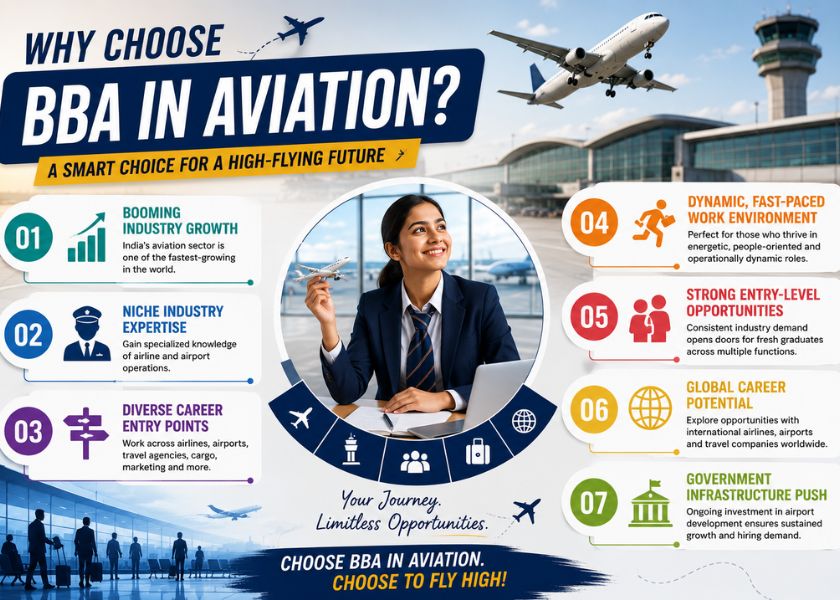
With India emerging as one of the world's fastest-growing aviation markets, the sector's long-term trajectory points toward sustained job creation across airlines, airports, and related service industries.
4. Growing cargo and logistics demand
As e-commerce and international trade continue expanding, air cargo operations represent a growing sub-sector within aviation, creating additional specialised career opportunities beyond passenger services.
5. Technology integration in aviation operations
Growing adoption of digital check-in systems, AI-driven customer service, and data analytics in airline operations is creating new hybrid roles combining aviation knowledge with basic tech literacy.
6. Global career mobility
As international airlines and airport authorities continue expanding operations, aviation management skills remain transferable across borders, offering genuine international career potential for ambitious graduates.
7. Government focus on regional connectivity
Continued investment in smaller, regional airports under connectivity schemes ensures job creation isn't limited to just major metro airports, spreading opportunities across tier-2 and tier-3 cities as well.
The bigger picture:
While specific job roles will continue evolving alongside technology and industry shifts, the fundamental demand for skilled aviation management professionals remains strong, backed by sustained government investment and India's growing position in global air travel — ensuring genuine long-term career relevance well into 2026 and beyond.
Why Choose Get Your College?
Navigating BBA in Aviation admissions — from choosing the right institute to understanding specialisations and career pathways — involves plenty of decisions. That's where Get Your College makes the difference.
1. Personalised program guidance
Our expert counsellors help you evaluate institutes and specialisations that genuinely align with your career interests, academic background, and budget considerations.
2. Industry-connected college shortlisting
We help you identify colleges with genuine airline and airport industry partnerships, rather than relying on marketing claims alone, ensuring your investment translates into real placement opportunities.
3. End-to-end application assistance
From application form submission to entrance exam preparation and interview coaching, we handle every step of your admission process with precision.
4. GD-PI preparation support
Our mock Group Discussion and Personal Interview sessions help you build confidence and articulate genuine aviation industry interest clearly to admission panels.
5. Transparent fee and placement comparisons
We provide honest, data-backed insights into fee structures and placement records specifically for Aviation specialisations, helping you make informed decisions rather than relying on general rankings.
6. Higher studies and certification guidance
If you're considering an MBA in Aviation Management or IATA certifications after your BBA, we help you plan the right timeline and preparation strategy.
7. Proven track record
With years of experience guiding students through successful aviation management admissions, we bring honest, practical advice to every step of your journey.
The bottom line: Choosing BBA in Aviation is a smart, industry-focused career move — partnering with Get Your College ensures that decision translates into real admission and career success in 2026.
Frequently Asked Questions (FAQs)
1. What is the eligibility for BBA in Aviation?
Candidates need to complete 12th grade (any stream) with a minimum of 50% aggregate marks from a recognised board, along with meeting age requirements typically between 17 and 25 years.
2. Is BBA in Aviation a good career choice?
Yes, given India's rapidly expanding aviation sector, growing airport infrastructure, and consistent hiring demand across airlines, airports, and related industries, it offers genuinely strong career prospects.
3. What is the average salary after BBA in Aviation?
Fresh graduates typically earn between ₹2.5-4 LPA in entry-level roles, with salaries rising to ₹5-8 LPA with 3-5 years of experience in supervisory positions.
4. Do I need to clear an entrance exam for BBA in Aviation?
It depends on the institute. Many colleges admit based on merit (12th-grade marks) alone, while others require institute-specific entrance exams or CUET scores.
5. What are the top job roles after BBA in Aviation?
Common roles include Ground Operations Executive, Customer Service Executive, Cargo Coordinator, Airline Reservations Agent, and Airport Operations Trainee.
6. Can I pursue an MBA after BBA in Aviation?
Yes, an MBA in Aviation Management is a popular and highly relevant choice, ideally pursued after gaining 2-3 years of industry experience for better admission chances and practical application.
7. Which companies hire BBA in Aviation graduates?
Major recruiters include IndiGo, Air India, SpiceJet, Vistara, GMR Group, Adani Airports, and travel companies like MakeMyTrip and Thomas Cook.
Conclusion
BBA in Aviation offers Indian students a genuinely promising pathway into one of the country's fastest-growing industries in 2026. With expanding airport infrastructure, rising fleet sizes, and government initiatives promoting regional connectivity, the sector continues creating consistent demand for skilled management professionals across airlines, airports, and related service industries.
From accessible entrance requirements and diverse specialisation options to strong entry-level placement prospects and clear pathways for further specialisation through an MBA or IATA certifications, this degree provides a well-rounded, industry-focused foundation for a dynamic career. While starting salaries may not match some other business fields, the industry's genuine growth trajectory, career variety, and international mobility potential make it a compelling choice for students genuinely drawn to aviation.